.svg&w=384&q=75 "GoalGist logo")
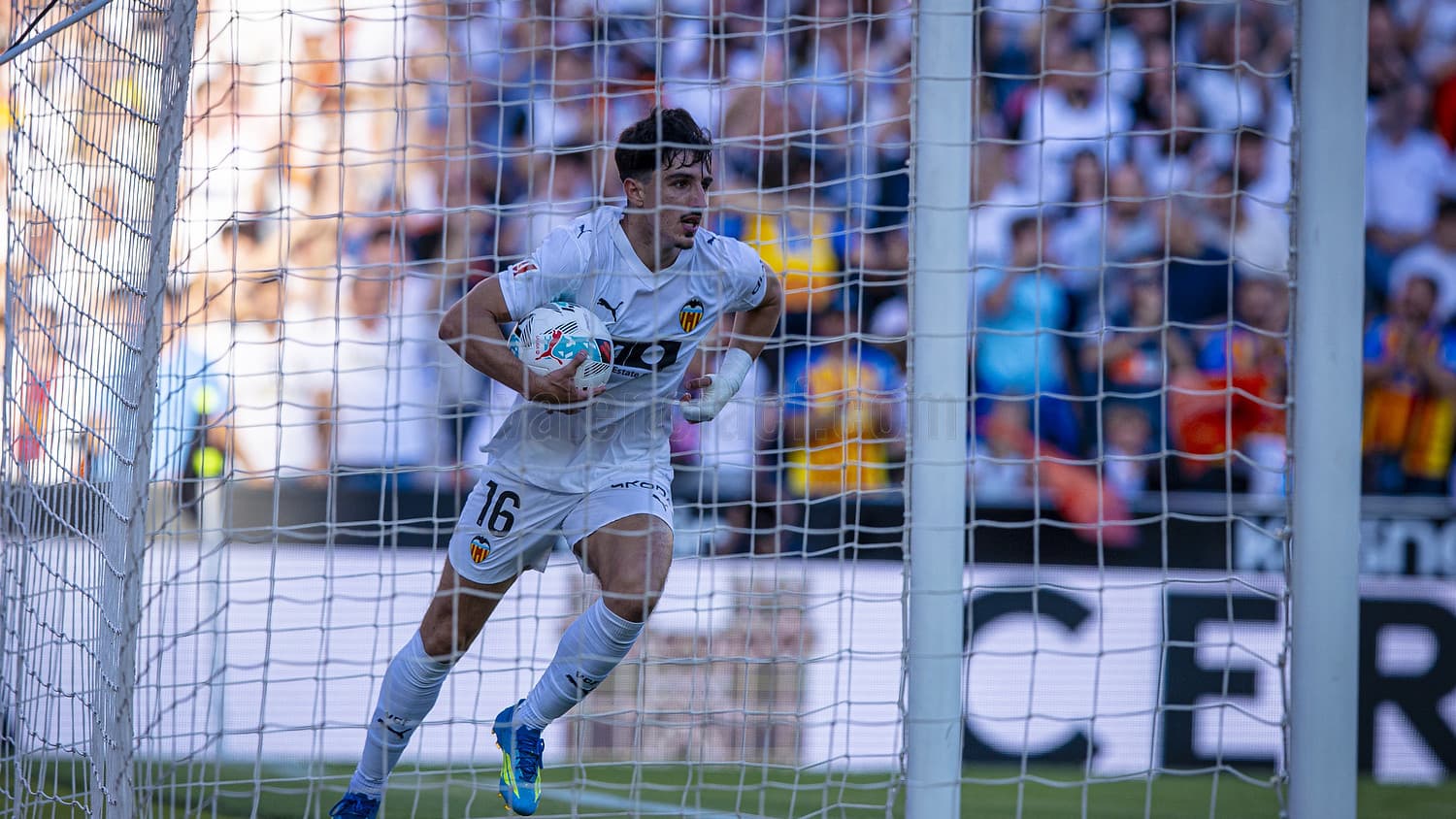
Valencia and Rayo Vallecano Draw 1–1 in Tactical Stalemate
Under the late-afternoon light at Estadio de Mestalla, Valencia and Rayo Vallecano played out a 1–1 draw that felt less like an end-of-season dead rubber and more like a tactical seminar between two mid-table sides fine‑tuning their identities. Following this result, Rayo sit 10th on 44 points, Valencia 11th on 43, their trajectories mirroring each other across 36 league matches: Valencia with 11 wins, 10 draws and 15 defeats; Rayo with 10 wins, 14 draws and 12 losses. The goal differences tell their stories neatly—Valencia at -12 from 39 scored and 51 conceded, Rayo at -6 from 37 for and 43 against.
I. The Big Picture – Two Systems, One Stalemate
Carlos Corberan doubled down on Valencia’s seasonal DNA by returning to his most-used shape: a 4‑4‑2, the formation they have deployed in 22 league fixtures. S. Dimitrievski, intriguingly facing his former club’s colours, anchored a back four of Renzo Saravia, C. Tarrega, E. Comert and José Gayà. Ahead of them, a flat but flexible midfield of D. Lopez, Pepelu, G. Rodriguez and Luis Rioja supported the front pair of Hugo Duro and Javi Guerra.
Opposite him, Inigo Perez leaned into Rayo’s own blueprint. Their 4‑2‑3‑1, used 22 times this season, was again the reference: A. Batalla in goal, with I. Balliu, F. Lejeune, N. Mendy and P. Chavarria across the back. O. Valentin and G. Gumbau formed the double pivot, while F. Perez, P. Diaz and Pacha operated behind lone forward R. Nteka.
The 1–1 scoreline at both half-time and full-time captured a balance between Valencia’s stronger home scoring profile—24 goals at home, averaging 1.3 per match—and Rayo’s compact overall defence, which has limited opponents to 1.2 goals per game in total this campaign.
II. Tactical Voids – Absences Shape the Chessboard
Both benches were forced into structural compromises by a long list of absentees.
Valencia were without L. Beltran (knee), J. Copete (ankle), M. Diakhaby (muscle) and D. Foulquier (knee). The loss of Diakhaby and Copete stripped Corberan of aerial and rotational depth in central defence, making the selection of Tarrega and Comert almost non‑negotiable. Without Beltran’s control in midfield, Pepelu’s role as the central metronome became even more pronounced, tasked with linking defence and attack in a side that, overall, scores 1.1 goals per match but concedes 1.4.
On Rayo’s side, the absences cut right through the spine of their creativity and defensive leadership. I. Akhomach (muscle), A. Garcia, Luiz Felipe, D. Mendez (knee) and, crucially, Isi Palazón (suspension after a red card) were all unavailable. The loss of Isi was particularly seismic: he has 3 goals, 3 assists, and is one of La Liga’s most carded players with 10 yellows and 1 red, plus a missed penalty on his record—an attacking talisman and emotional barometer removed from the equation. Without him, Rayo’s right-sided threat and set-piece variety were blunted, forcing greater creative responsibility onto F. Perez and P. Diaz.
Disciplinary trends framed the risk profile of this contest. Heading into this game, Valencia’s yellow cards skewed late: 22.86% of their bookings arrive between 76–90', and another 15.71% between 91–105', signalling a tendency to defend on the edge as fatigue sets in. Rayo, meanwhile, spread their cautions more evenly, with notable spikes between 46–60' and 61–75' (both 19.19%), and a remarkable 33.33% of their reds coming in the 91–105' window—evidence of a team that often pushes the emotional limit in closing phases.
III. Key Matchups – Hunter vs Shield, Engine Room vs Enforcer
The “Hunter vs Shield” narrative was written around Rayo’s leading scorer Jorge de Frutos and Valencia’s defence. De Frutos, with 10 goals and 1 assist in 34 appearances, is an all‑action attacker: 47 shots, 26 on target, 27 key passes, and 55 dribble attempts (26 successful). Even though he did not start here, his season profile loomed over Valencia’s back line, which in total has conceded 51 goals—22 at home and 29 on their travels. Against a team that allows 1.2 goals per game at Mestalla, the spectre of De Frutos’ late introduction was always a tactical card Perez could play.
On the other side, the “Engine Room” duel pitted Valencia’s creators against Rayo’s disciplined structure. Luis Rioja and Javi Guerra have quietly become one of La Liga’s most industrious creative pairings. Rioja’s 6 assists, 37 key passes and 61 dribble attempts (35 successful) make him Valencia’s primary line‑breaker from the left. Guerra matches him with 6 assists of his own, 29 key passes and an impressive defensive contribution—28 tackles, 6 blocked shots and 23 interceptions—making him a true two‑way midfielder.
Their task was to unpick a Rayo unit that, at home, concedes just 0.8 goals per match and, overall, has kept 11 clean sheets. Even away, where they ship 1.6 goals per game, the double pivot of O. Valentin and G. Gumbau is designed to screen central spaces and funnel attacks wide, where full-backs like Balliu and Chavarria can engage. Behind them, N. Mendy’s profile as a stopper is clear: 21 blocked shots, 21 interceptions and a heavy card load (8 yellows, 1 straight red). He is the pure “shield” in front of Batalla, ready to step out and break Valencia’s combinations between the lines.
IV. Statistical Prognosis – Margins, xG and Defensive Steel
The numbers suggest that this 1–1 draw was almost pre‑written in the data. Heading into this game, both teams averaged 0.8 goals per match away from their comfort zones: Valencia on their travels and Rayo away from Vallecas. At Mestalla, Valencia’s 1.3 home goals per match met Rayo’s overall concession rate of 1.2, pointing towards a narrow home edge offset by Rayo’s compactness.
Valencia’s penalty record—5 from 5 in total, a perfect 100.00% conversion—offered a latent xG boost that never materialised on the night, while Rayo’s own perfect 3 from 3 from the spot helped underpin their seasonal scoring, even as they failed to win the penalty lottery here. With both sides failing to find that extra gear, the expected goals profile of the contest would sit tightly around parity: Valencia probing but rarely carving, Rayo countering in measured bursts rather than waves.
In the end, the match became a faithful reflection of their campaigns: Valencia, slightly more expansive but fragile; Rayo, marginally more solid but short of a ruthless edge. Following this result, both remain locked in a mid‑table orbit—two teams whose tactical clarity is evident, but whose statistical ceilings still feel just out of reach.