.svg&w=384&q=75 "GoalGist logo")
USA Dominates Paraguay 4-1: Tactical Analysis of a High-Pressure Match
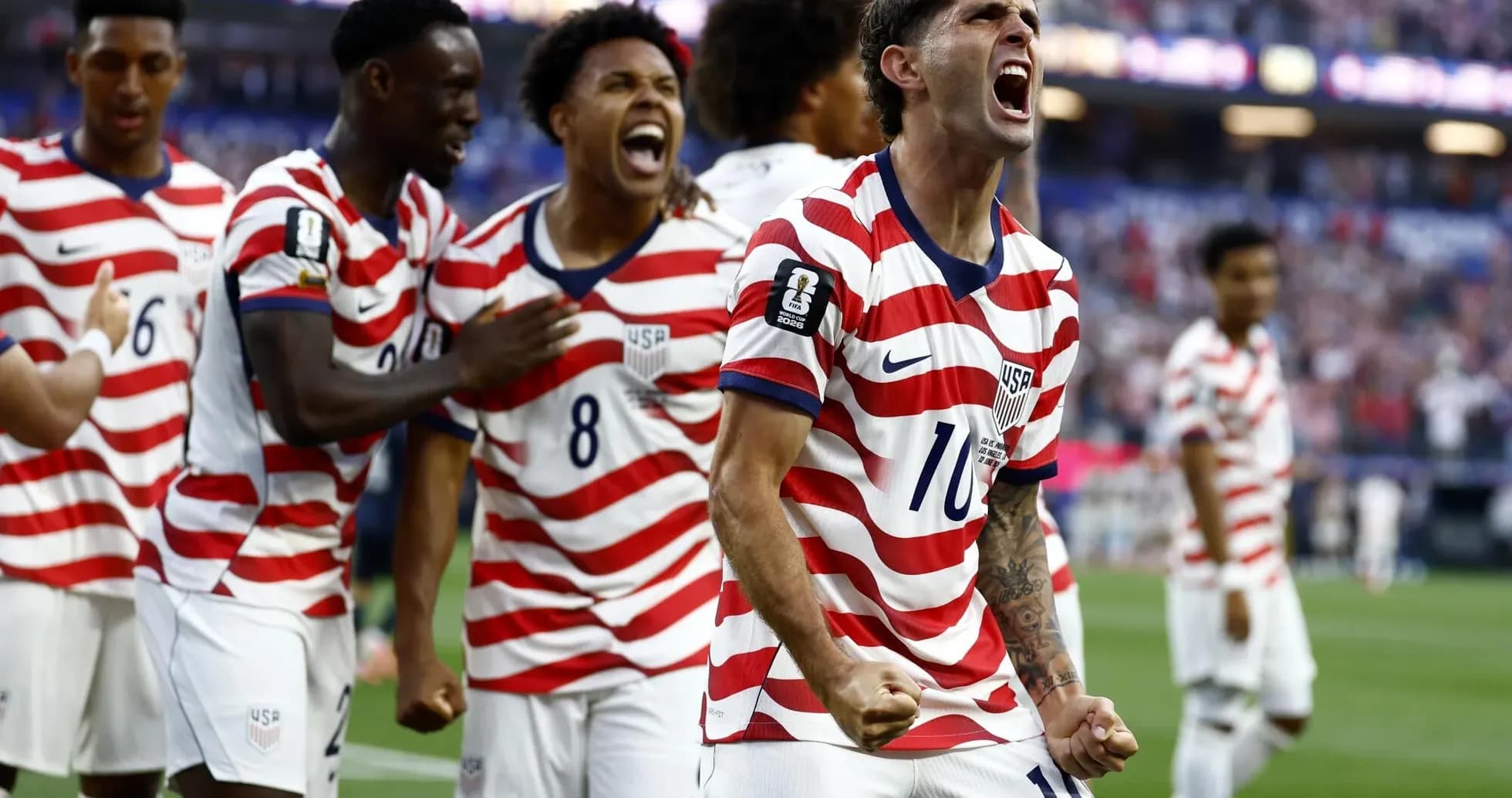
USA’s 4-1 win over Paraguay at SoFi Stadium was built on structural control and a clear contrast of game models. Mauricio Pochettino’s side, in a 4-2-3-1, used a high-possession, positionally disciplined approach to dominate territory and tempo, while Gustavo Alfaro’s 4-4-2 Paraguay looked for compactness and transition but were pinned too deep for too long. The statistical profile – 65% possession, 596 passes at 85% accuracy, and a 16-9 shot advantage – underlined how comprehensively USA dictated the match, even if the xG gap (1.27 vs 0.51) suggested ruthlessness rather than sheer volume decided the scoreline.
Structural Stability
Structurally, USA’s 4-2-3-1 was very stable. Tyler Adams and Malik Tillman formed the double pivot, with Adams anchoring centrally (grid 3:2) and Tillman slightly left (3:1). Ahead of them, Sergiño Dest, Weston McKennie and Christian Pulišić operated as the three behind Folarin Balogun, creating a flexible line that often morphed into a 2-3-5 in settled possession. Full-backs Antonee Robinson and Alexander Freeman pushed high and wide, pinning Paraguay’s wingers and forcing the away full-backs into permanently defensive roles.
The early own goal from Damián Bobadilla at 7' (credited to USA) immediately tilted the tactical landscape. With a lead, USA could keep the ball and stretch Paraguay’s 4-4-2 block side to side. Paraguay’s front two, Antonio Sanabria and Julio Enciso, were routinely outnumbered by USA’s first line of build-up: centre-backs Chris Richards and Tim Ream plus Adams dropping between or alongside them. That superiority allowed clean progression into midfield and made Paraguay’s pressing sporadic and reactive.
Balogun's Pivotal Role
Balogun’s performance at the tip of the structure was pivotal. After seeing a potential goal disallowed by VAR for offside at 28', he adjusted his timing and runs, then scored twice – at 31' from a Pulišić assist and at 45+5' from a Tillman pass. Both goals reflected USA’s ability to find the half-spaces: Pulišić and Tillman received between Paraguay’s lines, then slipped vertical passes into Balogun attacking the channels between centre-back and full-back. The fact USA generated 13 of their 16 shots from inside the box shows how effectively they penetrated the last line once the midfield block was bypassed.
Out of Possession
Out of possession, USA’s pressing shape was a 4-2-3-1 that could tilt into a 4-4-2 when McKennie stepped up alongside Balogun. Paraguay’s 320 passes at 72% accuracy reveal how little sustained possession they enjoyed; most of their sequences were short and under pressure. The USA midfield screen, led by Adams, was aggressive in duels – his yellow card for “Roughing” at 59' was a by-product of that intensity – and consistently cut off central progression to Miguel Almirón and Bobadilla.
Paraguay’s Challenges
Paraguay’s 4-4-2 had clear theoretical strengths: two forwards to attack space behind USA’s high line, and Almirón drifting in from the left to combine with Enciso. In practice, they were pushed too low. With only 35% possession and just 9 shots (4 inside the box), their attacking threat was sporadic. The introduction of Mauricio for Bobadilla at 46' and Alex Arce for Sanabria at 62' slightly changed the profile: Mauricio offered more ball security between the lines, and Arce more penalty-box presence. Their best sequence came at 73', when Enciso assisted Mauricio’s goal, a rare moment where Paraguay broke through USA’s midfield screen and attacked a disorganized back line.
Defensive Struggles
Defensively, Paraguay’s back four were under constant stress. They registered 5 blocked shots, a sign of last-ditch defending, but the discipline data (17 fouls, 5 yellow cards) shows how often they were forced into reactive interventions. Juan Cáceres’ early booking for “Tripping” at 10' and later yellows for Almirón (“Diving” at 53'), Diego Gómez (“Holding” at 79'), Arce (“Roughing” at 88') and Junior Alonso (“Holding” at 90+3') chart a pattern of a side struggling to contain USA’s rotations and 1v1 quality.
USA's Passing Network
On the ball, USA’s passing network was both dense and efficient. With 596 total passes and 508 accurate (85%), they repeatedly recycled through Ream and Richards, then used Adams as the central hub to switch play. Dest, starting as a listed midfielder on the right (grid 4:3), functioned as an advanced full-back / winger hybrid, stretching Paraguay’s left side and creating space inside for McKennie’s underlaps. After Dest was replaced by Tim Weah at 72', USA retained width but added more direct running in behind, which helped sustain counter-pressure as Paraguay chased the game.
Substitutions and Control
The substitutions in attacking midfield underlined Pochettino’s control of the rhythm. Pulišić made way for Sebastian Berhalter at 46', a move that traded some individual flair for extra midfield stability with a three-man interior line when needed. Later, Balogun and Tillman were replaced by Ricardo Pepi and Giovanni Reyna at 72' and 82' respectively, freshening the front line and maintaining the capacity to threaten depth and combine centrally. Reyna’s late goal at 90+8', assisted by Freeman, was emblematic: even in stoppage time, USA still had the structure and energy to advance a full-back high and find the spare man in the box.
Goalkeeping Performance
In goal, Matthew Freese (USA) was largely protected by the dominance in front of him. USA allowed only 1 shot on target and Freese made 1 save; Paraguay’s xG of 0.51 and USA’s defensive control meant his night was about concentration rather than volume. At the other end, Orlando Gill (Paraguay) faced 6 shots on goal and made 3 saves. The combination of a negative goals prevented figure (-1.16 for Paraguay) and USA’s 4 goals from 1.27 xG suggests that USA finished at a high level and Paraguay’s last line – both goalkeeper and defenders – underperformed relative to the quality of chances conceded.
Statistical Verdict
The statistical verdict reinforces the tactical story. USA’s 65% possession, 16-9 shot edge and 3-1 lead in corner kicks show territorial dominance and sustained pressure. Their 13 fouls and single yellow card indicate controlled aggression, while Paraguay’s 17 fouls and 5 bookings reflect a team frequently defending in emergency mode. The xG split (1.27 vs 0.51) is closer than the 4-1 scoreline, pointing to USA’s clinical edge in key moments, especially through Balogun’s brace and Reyna’s late strike. Overall, USA’s 4-2-3-1 delivered superior structure in all phases, and Paraguay’s 4-4-2 never found a consistent way to disrupt the hosts’ build-up or protect the central channels.