.svg&w=384&q=75 "GoalGist logo")
Thierno Barry's Journey: From Gamble to Everton's Key Striker
Thierno Barry walked slowly, deliberately, towards the touchline, milking every last second of noise from the Hill Dickinson Stadium. Less than a quarter of an hour remained, Everton were closing out a Premier League opening-day win over Crystal Palace, and the stadium announcer had just confirmed it: the match-winner was making way for Beto.
For the blue half of Merseyside, it was the cue for one more ovation. For Barry, it felt like a line in the sand.
This time last year, the 23-year-old Frenchman was the £27m gamble from Villarreal who couldn’t buy a goal. Fourteen league games without scoring, one goal in his first 18 Premier League appearances, and a fanbase wondering if the club’s biggest attacking investment in years had misfired.
Now he left the pitch grinning, his name ringing around a ground that has seen enough false dawns to be wary of them.
From slow burn to main man
The key moment came early in the second half. Everton led 1-0, Palace were probing, and tension was starting to creep into the stands. Then Iliman Ndiaye peeled wide, shaped his body, and whipped in the kind of cross that begs to be finished.
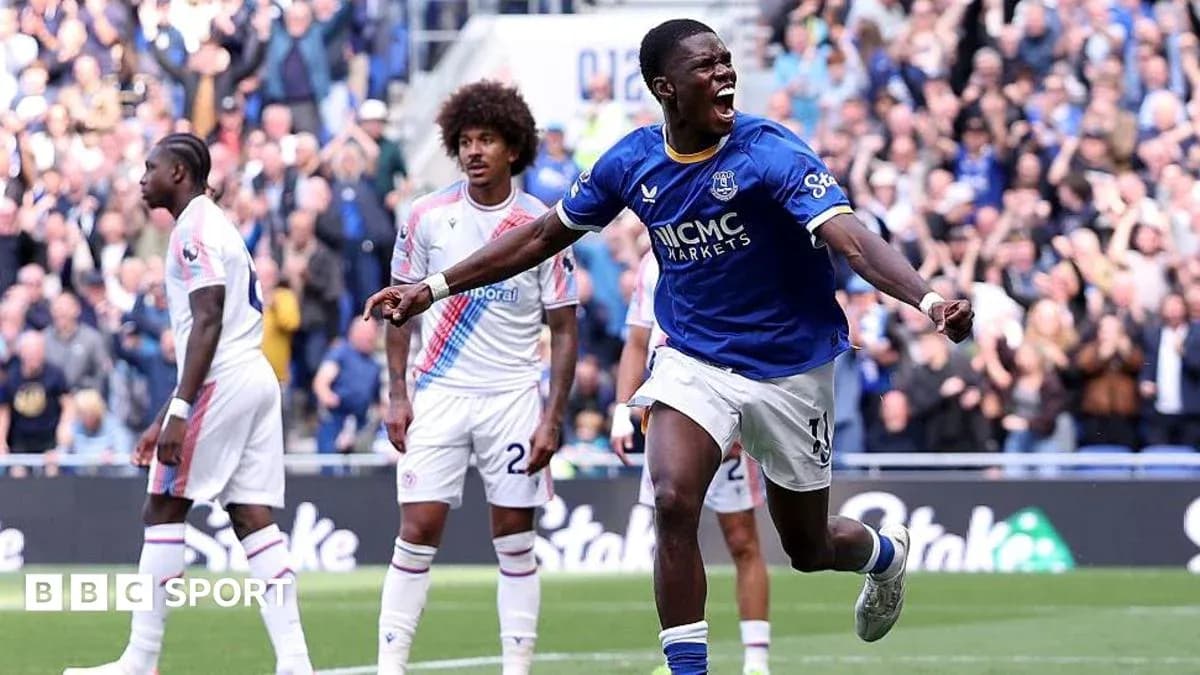
Barry attacked it. Right place, right time, clean header. Two-nil. Palace’s resistance cracked, and Everton’s season had its first roar.
As he wheeled away, arms spread, the contrast to last winter was stark. Back then, the same player cut a frustrated figure, snatching at chances, struggling to adapt to the pace and physicality of English football after his 11-goal campaign in La Liga.
Everton knew what they were buying: potential, not the finished product. The club’s situation gave them little choice. Years of managerial churn, repeated relegation battles and a damaging points deduction for breaching the Premier League’s Profit and Sustainability Rules had stripped away both financial muscle and glamour.
David Moyes and his recruitment team went hunting for a striker they could grow, not a superstar they could unveil. Barry arrived with promise and raw edges, and the understanding that this would take time.
Patience, though, is not a famous trait in football crowds. By mid-season, with just one league goal to his name, the murmur of doubt grew louder.
Then January changed everything.
Barry suddenly caught fire. His movement sharpened, his confidence returned, and he began to finish with the composure that had tempted Everton in the first place. By the end of his debut Premier League campaign he had eight goals in 38 appearances – not spectacular, but significant given where he started.
Strip away the noise and the numbers tell a cleaner story. An xG of 8.1, eight goals scored, a shot conversion rate of 21.1% – just a fraction below Erling Haaland’s 21.4%. For a 23-year-old in a new league, in a team still finding its attacking patterns, that output looks less like a concern and more like a platform.
What made it more impressive was timing. Half of those goals came after Jack Grealish, Everton’s creative hub, suffered a season-ending injury in January. As others faded during the run-in, Barry’s form surged, helping drag the club towards a European push.
That late-season surge is why this opening-day performance felt like more than just another goal. It looked like a continuation.
Moyes’ demands, Barry’s response
Moyes, though, has never been one for easy headlines. In the bowels of Hill Dickinson Stadium after the win over Palace, he praised his striker’s contribution, but he also made it clear the job is far from done.
“Look, strikers will probably be judged on their goals, so he can walk away and be really happy with it,” he said, before swiftly pointing to the supply line. “I thought it would be wrong not to mention the quality of the cross from Ndiaye. Thierno getting in the right spot was huge and scoring with a header was really big for us because it was an important time in the game.”
That “right spot” is non-negotiable for Moyes. He built his first Everton side around the ruthless instincts of a young Wayne Rooney, and he knows exactly how high the bar sits for a forward who wants to dominate this league.
So the compliments came laced with challenge.
“I need his build-up play to be better,” Moyes admitted. “I need him to be able to retain the ball for us so we can play into him more often.
“I want him to get in the right spaces, which he did today for the cross. He had a couple where the ball got played to him and he didn’t quite deal with it with his feet.
“Sometimes he is out linking up when he doesn’t need to be linking up. I think there is a lot to his game.”
That was the other side of Barry’s display against Palace. The goal and the ovation will dominate the highlight reels, but Moyes spent the afternoon barking at his No 9 when he drifted too wide, dropped too deep or let the ball bounce off him during counter-attacks.
Everton want Barry as the focal point, not a roaming forward chasing touches. They need him to be the out-ball that sticks, the presence that pins centre-backs, the finisher who turns half-chances into points.
The encouraging part for Moyes is not just the numbers, or the header that killed Palace. It’s the attitude.
“I said last year that when you’re a young striker coming in, it’s not always easy,” he said. “I think he’s come in with a really, really positive attitude this year.
“I think he’s come back with something that has stirred him up a little bit more, as if he’s got something to prove.”
You could see that edge in the way Barry celebrated, in the way he acknowledged the crowd as he left the pitch, and in the way he listened – really listened – to his manager on the touchline.
Everton once again find themselves trying to build something stable out of years of turbulence. They lack the budget to shortcut their way to a superstar forward. What they do have is a 23-year-old who has already ridden out one storm, matched his xG, and started this season by deciding a game almost single-handedly.
If this is Barry with something to prove, the question for the rest of the league is simple: what happens when he proves it?