.svg&w=384&q=75 "GoalGist logo")
Sunderland's Early Season Struggles Amidst War Threat
On the eve of war, Sunderland’s worries were supposed to be simpler. A new manager, a reshaped side, a season to repair the damage of recent decline. Instead, Roker Park’s first real glimpse of Bill Murray’s Sunderland came with the shadow of a looming global crisis hanging over the terraces.
Murray, appointed in March to replace Johnny Cochrane, had walked back into a club he knew intimately. He had played under Cochrane, understood the demands of Roker Park and the weight of a recent past in which Sunderland had been league champions in 1936 and FA Cup winners in 1937. His task was clear: restore those standards after a sharp fall from grace in Cochrane’s final year.
An opening-day win over Derby County in the 1939-40 campaign hinted that the revival might be quick. Optimism flickered. Then Huddersfield Town arrived.
Huddersfield expose Sunderland’s frailties
On this day in 1939, Huddersfield left Wearside with both points and with Sunderland’s early-season confidence punctured. Clem Stephenson’s side were better drilled, more cohesive, and far more convincing across the pitch. Their organisation underlined just how far Murray’s men still had to travel before they could again call themselves genuine contenders.
Sunderland were ragged at the back. Defenders hesitated, lost their men, and failed to deal with Huddersfield’s movement. Up front, the home side rarely clicked. Attacks broke down before they built any real pressure, and the crowd watched a team that never quite found its rhythm.
Newspaper reports the following day pointed accusing fingers at the officials for allowing a succession of borderline Huddersfield challenges to go unchecked, suggesting Sunderland’s forwards never got much protection. But the real blow came when captain Raich Carter took a knock and could no longer glide across the pitch as usual. With their playmaker hampered, Sunderland’s attacking plan lost its shape.
The criticism was blunt. Too many players failed to step into the gap left by their injured captain. Only goalkeeper Johnny Mapson escaped with any real credit. The consensus was that he could do little about either goal and had prevented the scoreline from looking worse.
An own goal, a captain’s response, and a late winner
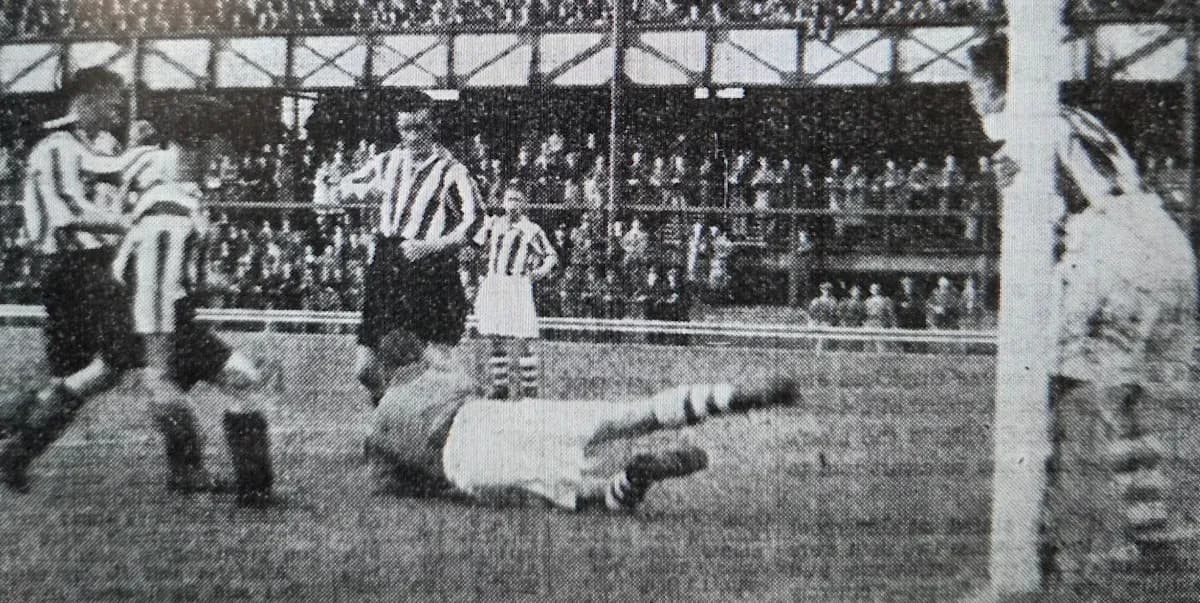
The opening goal arrived early and sparked immediate argument. After just four minutes, Billy Price met a cross with a firm header. Some in the ground were adamant the ball went straight in. The referee, though, ruled it an own goal, recording that the final touch had come off Jimmy Gorman as he challenged Price in the air. Either way, Sunderland were behind and chasing.
Carter briefly dragged his side back into the contest. On 33 minutes he levelled the scores, giving the home crowd a short-lived sense that Sunderland might yet grind out a result. For a while, the game sat in the balance.
Then the pressure told again at the wrong end. With ten minutes to play, Price struck what proved to be the winner, finishing off Huddersfield’s more polished display. This time there was no debate. No late rally from Sunderland either.
As the Roker Park crowd drifted away, few could seriously argue with the result. The better side had won. The questions on the walk home were not just about Murray’s rebuilding job or Carter’s fitness, though. By then, many were wondering how long they would be watching league football at all.
Football under a darkening sky
Anyone who had picked up a newspaper before heading to the ground that afternoon knew the backdrop. Front pages were dominated by spiralling international tension and the grim possibility of another world war.
The Sunderland Echo and Shipping Gazette spoke of French radio being handed over to military control and of frantic diplomatic exchanges across Europe. A photograph showed workmen piling sandbags in front of the Royal Infirmary, a stark visual reminder that the threat was real and close.
There was a chilling practicality to other stories. Parents in Sunderland were being briefed on helmet and respirator arrangements for their children, with demonstrations and collection points set up at schools across the town. Redby, Hudson Road, Cowan Terrace, Thomas Street, Commercial Road, Hylton Road, Diamond Hall, High Southwick, James William Street and Barnes were all listed as venues where children would be fitted, with specially adapted gear for infants.
Those details were hard to ignore. They must have seeped into the mood at Roker Park. Football remained an escape of sorts, but the outside world was pushing through the turnstiles.
Among the 16,315 in attendance were soldiers and sailors already called up under the emergency. They were allowed in for half price, provided they entered through what was usually the “boys gate”. It was a small gesture in a week that felt anything but ordinary. The performance they watched did little to lift spirits on Wearside, yet some in uniform may have suspected this might be their last live match for quite some time.
War arrives, and football disappears
Within days, events moved faster than any fixture list. By the time Sunderland travelled to Arsenal the following weekend, German forces had invaded Poland and a wider conflict was no longer a threat but a certainty.
The match at Highbury went ahead, but even that carried the marks of crisis. Kick-off was pushed back to 17:00, later than originally planned, to ease the strain on emergency public transport timetables and to allow a hurried evacuation of nearby children to be completed. Football, always important in its own world, suddenly sat a long way down the list of national priorities.
Soon, the results that had seemed so significant – the win over Derby, the home defeat to Huddersfield, the trip to Arsenal – were wiped from the official records. The 1939-40 season, barely begun, was effectively erased.
Murray’s job changed overnight. Instead of plotting a careful rebuild, he found himself overseeing fitness work for troops stationed in County Durham. Roker Park, marked out as an evacuation zone, fell largely silent. For almost two years it sat idle, a football ground waiting for the world to make room for football again.
On that August afternoon in 1939, Sunderland simply looked like a team in transition, short of cohesion and searching for their old authority. Within a week, that seemed a trivial concern. The real question became when – or even whether – supporters would next see their club rise back to the heights they had so recently taken for granted.