.svg&w=384&q=75 "GoalGist logo")
AC Milan Faces Benfica in Europa League Defeat
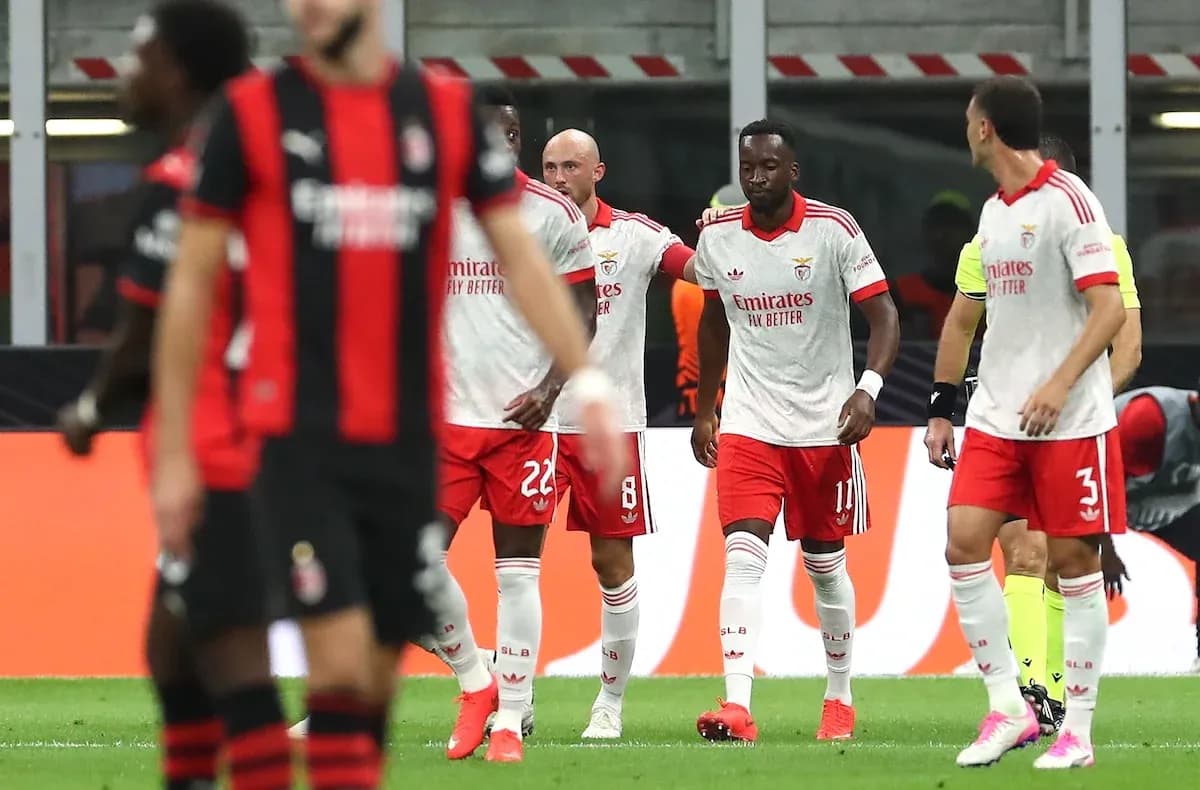
Under the San Siro lights, AC Milan’s Europa League return began with a jolt of reality. A 0–2 home defeat to Benfica leaves them rooted in 31st place in the league table, with 0 points and a goal difference of -2 after 1 match, while the Portuguese side stride away from Milano with 3 points, 2 goals scored and none conceded, sitting 7th overall. Following this result, the contrast in seasonal profiles is stark: Milan’s continental campaign reads as one game, one loss, no goals scored; Benfica’s broader Europa journey shows 7 matches played in total, 5 wins, 1 draw and just 1 defeat, with 21 goals for and 6 against.
I. The Big Picture – Structures and Identities
Ruben Amorim set Milan up in a 3-4-2-1, a shape that on paper promised verticality and width but in practice often looked like a back five under Benfica’s pressure. Mike Maignan anchored the structure behind a trio of defenders: Koni De Winter central, flanked by Strahinja Pavlovic and Filippo Terracciano. Ahead of them, a young, industrious midfield band of four – Samuel Chukwueze, Ardon Jashari, Yunus Musah and Davide Bartesaghi – was tasked with both screening and supplying the front line. The attacking trident of Omari Hutchinson, A. Cisse and Gonçalo Ramos was meant to stretch Benfica’s back four and pin their double pivot.
Marco Silva’s Benfica, by contrast, arrived with a clear identity honed over the qualifying rounds. Their 4-2-3-1 has been the backbone of a prolific campaign: in total this season they average 3.0 goals per match, with a devastating 4.7 at home and a still-dangerous 1.8 on their travels. At San Siro, Anatoliy Trubin stood behind a back four of D. Banjaqui, Alessandro Circati, Tomás Araujo and Soufiane El Karouani. In front, the double pivot of Fredrik Aursnes and João Palhinha provided the platform for a fluid attacking trio – Dodi Lukebakio, Georgiy Sudakov, Jakub Kamiński – behind lone forward Jhon Durán.
Benfica’s Europa League defensive record underpins their ambition: across all venues they concede just 0.9 goals per game, with only 6 allowed in 7 matches. On their travels, that figure tightens further to 1.0 per game, a balance that allows them to commit numbers forward without losing control.
II. Tactical Voids – Absences and Discipline
Milan’s squad sheet was heavy with experience on the bench – Fikayo Tomori, Pervis Estupiñán, Luka Modrić, Ruben Loftus-Cheek, Adrien Rabiot, Christian Pulisic – but Amorim chose to start with a younger, more dynamic core. The void was less about who was missing and more about how the chosen XI struggled to knit the lines together. With no established deep playmaker in the starting side, Jashari and Musah were forced to juggle build-up and protection, often leaving Ramos isolated and the wing-backs pinned.
Benfica’s only listed absentee was Alexander Bah, ruled out through injury. His absence at right-back could have been a structural weakness, but Banjaqui’s inclusion kept the line stable and allowed Lukebakio to stay high and wide. Importantly, Benfica carried their aggression without tipping into recklessness: in the wider Europa campaign their yellow cards are spread, with a clear late-game spike – 30.00% of their cautions arriving between 76–90 minutes – but there is no red card on record. Milan, by contrast, have a single yellow card in the competition so far, and it came early: 100.00% of their cautions have fallen in the 0–15 minute window, a sign of nervous starts and reactive defending.
III. Key Matchups – Hunter vs Shield, Engine Room Battles
The “Hunter vs Shield” duel tilted decisively towards Benfica. As a team, they arrived with 21 goals in total across 7 matches; Milan, after this opening league-stage fixture, have yet to score in Europe and have already conceded 2 at home, an average of 2.0 goals against per match in their own stadium. The back three of Pavlovic, De Winter and Terracciano were repeatedly asked to defend space rather than just bodies, especially as Sudakov and Kamiński drifted between the lines.
Kamiński, one of the competition’s standout attacking midfielders, has 1 goal and 1 assist in 6 Europa League appearances, with 3 key passes and 76% passing accuracy in his continental campaign. His ability to receive between Milan’s midfield and defence forced Musah and Jashari to collapse centrally, opening corridors for Lukebakio and Kaminski (from wide) to attack the half-spaces. Lukebakio, with 1 goal, 3 shots on target from 3 attempts and 7 duels won out of 10 in the competition, played the role of direct runner and pressing trigger, constantly testing Bartesaghi and Pavlovic’s timing.
In the engine room, the duel between Benfica’s double pivot and Milan’s central pairing defined the game’s rhythm. Palhinha and Aursnes combined ball-winning and progression, allowing Benfica to sustain pressure. Milan’s midfielders, for all their energy, struggled to impose a passing rhythm that could bring Hutchinson and Cisse into consistent, threatening positions.
On the disciplinary front, Benfica’s bench options added another layer of edge. Vangelis Pavlidis and Leandro Barreiro, both on 2 yellow cards in the competition, embody the side’s combative streak, though neither has crossed the line into red. That controlled aggression contrasted with Milan’s more tentative approach, where early bookings in their Europa campaign risk forcing defenders into caution too soon.
IV. Statistical Prognosis – Where the Numbers Lead
Following this result, the numbers sketch a clear tactical story. At home in Europe, Milan have played 1, lost 1, scored 0 and conceded 2. They have failed to score in that single fixture, and they have yet to keep a clean sheet. Benfica, away from home in this competition, have played 4 matches in total, winning 2, drawing 1 and losing 1, with 7 goals scored and 4 conceded. Their away goal difference is +3, and they have kept 1 clean sheet on their travels.
Without explicit xG values, the trend lines still point one way: a Benfica side whose attacking volume and efficiency overwhelm a Milan team still searching for an offensive identity in this competition. Milan’s reliance on individual bursts from Hutchinson or Chukwueze, rather than a structured chance-creation scheme, left Ramos starved of service and Trubin largely untroubled.
Defensively, Benfica’s compact 4-2-3-1 and their ability to maintain intensity deep into matches – reflected in that 30.00% late yellow-card share without a single dismissal – suggest a side comfortable suffering and then striking. Milan, by contrast, must solve their structural disconnect between a back three and an inexperienced midfield if they are to reverse the narrative of a campaign that, after one painful night at San Siro, already feels like an uphill climb.