.svg&w=384&q=75 "GoalGist logo")
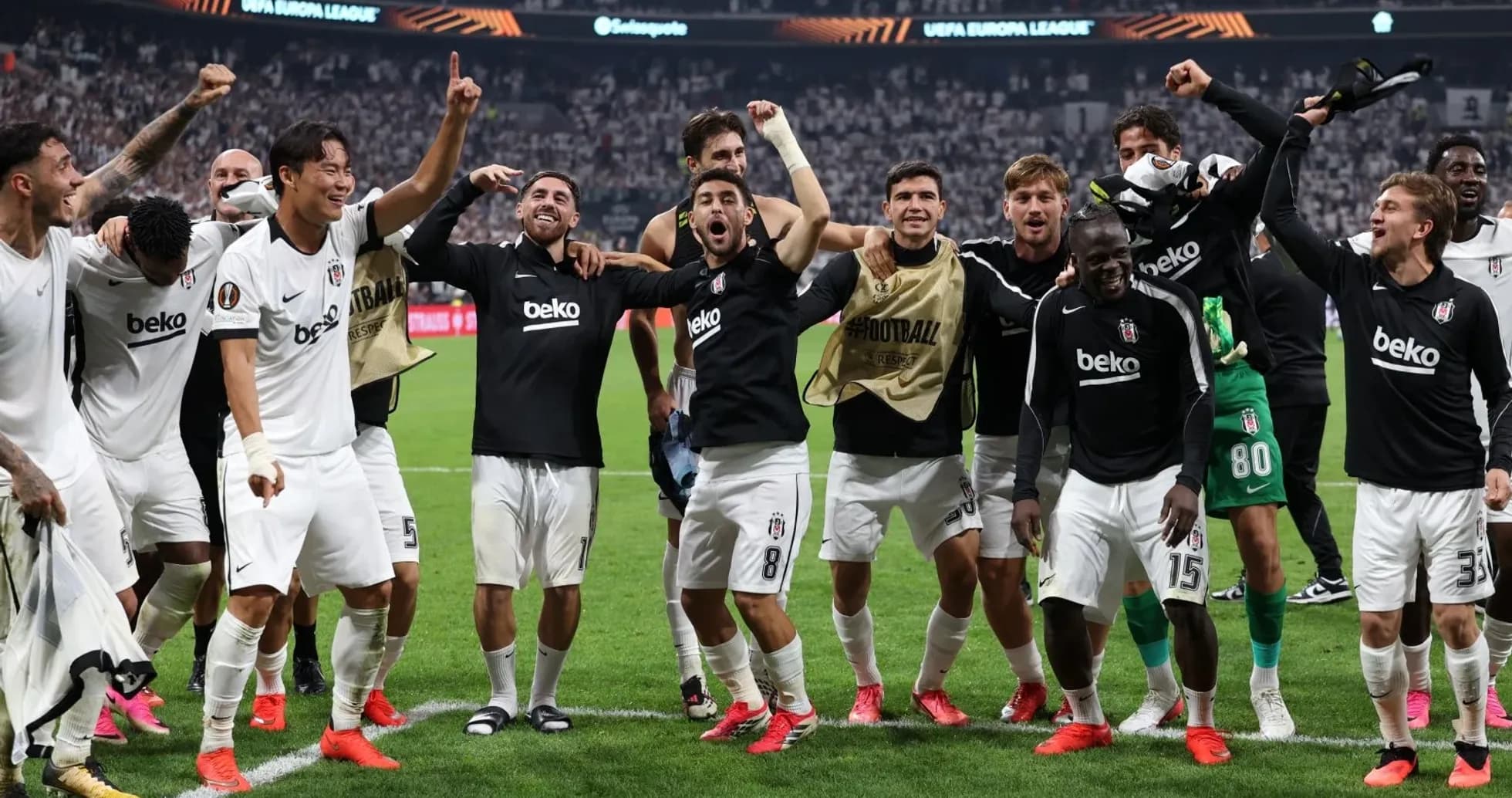
Beşiktaş Dominates Marseille in Europa League Opener
Under the lights of Tüpraş Stadium, Beşiktaş did far more than open their UEFA Europa League league stage campaign; they announced themselves as one of the competition’s most coherent, aggressive units. A 4-1 win over Marseille in Istanbul, with the score already 1-1 at half-time, was the kind of statement performance that turns a good start into a narrative. Following this result, Beşiktaş sit 4th in the overall league round table with 3 points and a goal difference of +3 (4 scored, 1 conceded), while Marseille are marooned in 32nd, pointless with a goal difference of -3 (1 scored, 4 conceded).
I. The Big Picture – Structural Superiority
Vincenzo Italiano stayed loyal to the 4-1-4-1 that has become Beşiktaş’s European identity. It is not just a formation; it is a system honed across 7 Europa League matches in which they have won 6 and lost only 1 overall. At home, they have been almost immaculate: 4 wins from 4, with 9 goals scored and just 1 conceded, an average of 2.3 goals for and 0.3 against at Tüpraş Stadium. The league stats paint a picture of control and ruthlessness: 5 clean sheets overall, only 2 goals conceded across the entire campaign.
Against that, Marseille arrived with a fledgling 4-2-3-1, used just once in Europe this season. On their travels, they have played 1, lost 1, scoring 1 and conceding 4, with an away average of 1.0 goal for and a punishing 4.0 against. The gulf in tactical maturity between the two structures was stark over 90 minutes.
Beşiktaş’s lineup was built on a solid spine. A. Nübel in goal, shielded by a back four of K. Ouattara, E. Topçu, E. Agbadou and A. Murillo, gave the hosts both physical presence and width. In front of them, S. Özcan operated as the single pivot, with a high-energy band of four – I. Fakili, O. Kökçü, J. Olaitan and V. Černý – rotating behind lone striker D. Vlahović.
Marseille’s shape looked more fragile. J. de Lange started in goal behind a back line of U. Garcia, D. Cornelius, C. Egan-Riley and T. Weah. The double pivot of P. Højbjerg and H. Abdelli sat beneath an attacking trio of A. Harit, A. Gomes and K. Abdallah, supporting N. Maupay up front. On paper, it was a balanced 4-2-3-1; on the pitch, it struggled to cope with Beşiktaş’s layered pressure and verticality.
II. Tactical Voids – Absences and Discipline
Both sides entered this fixture with notable absentees that subtly reshaped their plans. Beşiktaş were without C. Keles and M. Rashica (both off the roster) and, more significantly, L. Trossard through injury. Trossard’s absence removed a natural left-sided creator and finisher, placing greater creative responsibility on V. Černý and O. Kökçü between the lines, and on the emerging I. Fakili to attack the half-spaces.
Marseille, for their part, were missing G. Kondogbia and T. Nnadi, both injured. Without Kondogbia’s physical presence and screening, the double pivot lacked a true enforcer. That deficiency became critical as Beşiktaş repeatedly flooded central areas with late runs from Fakili and Olaitan, dragging Højbjerg and Abdelli into uncomfortable defensive duels.
Disciplinary trends from the wider campaign also framed the contest. Beşiktaş are a side that live on the edge late in games: 50.00% of their yellow cards have arrived between 76-90 minutes, and their only red card this season came between 61-75 minutes. Players like K. Ouattara, with 1 yellow and a yellow-red in the competition, and the combative Oh Hyeon-Gyu, who has collected 2 yellows, embody that aggressive edge. Marseille, by contrast, have collected just a single yellow card in Europe this season, between 61-75 minutes, suggesting a team that is more reactive than proactive in duels. Over 90 minutes in Istanbul, that lack of controlled aggression cost them territory and initiative.
III. Key Matchups – Hunter vs Shield, Engine Room vs Enforcer
The defining battle was on Beşiktaş’s right, where V. Černý and A. Murillo combined to torment U. Garcia and the left side of Marseille’s defence. Černý’s Europa League profile – 1 goal, 3 shots, 2 key passes, 4 dribble attempts with 3 successful, and a strong 7.87 rating – underlines his role as the creative hunter in this system. With Murillo overlapping, offering 35 passes at 85% accuracy and a goal to his name this European campaign, Beşiktaş created a two-man overload that Marseille’s 4-2-3-1 could not adequately plug.
On the opposite flank, K. Ouattara’s inclusion at left-back added vertical thrust but also a hint of volatility. His history of 1 yellow and 1 yellow-red in the competition shows a defender willing to step out and engage aggressively. Against Marseille’s right side of T. Weah and A. Gomes, Ouattara’s duels were a calculated risk that paid off, allowing Beşiktaş to compress the pitch and keep Marseille pinned.
In the engine room, the contest between Beşiktaş’s creators and Marseille’s would-be enforcers was decisively one-sided. J. Olaitan, one of the Europa League’s top assist providers with 2 assists and an 8.34 rating, orchestrated from the right half-space, while O. Kökçü, also on 2 assists with a 7.86 rating, dictated tempo centrally. Their combined 6 key passes in the competition and comfort under pressure allowed Beşiktaş to play through Marseille’s first and second lines with ease.
Højbjerg and Abdelli, lacking a true destroyer beside them, were repeatedly dragged out of position. As they stepped to Kökçü or Olaitan, Fakili – another top Beşiktaş performer with 1 goal, 2 key passes and 91% passing accuracy – attacked the gaps. The 4-1-4-1 became a 4-1-2-3 in possession, with Özcan anchoring and the trio ahead of him rotating fluidly. Marseille’s 4-2-3-1, by contrast, often collapsed into a flat 4-5-1 without the ball, with Maupay isolated and the midfield line retreating too deep.
IV. Statistical Prognosis – A System Built to Last
Beşiktaş’s broader Europa League numbers suggest this 4-1-4-1 is not a one-night phenomenon but a sustainable model. Overall, they have played 7 matches, winning 6 and losing only 1, scoring 12 and conceding just 2. That is an overall average of 1.7 goals for and 0.3 against, underpinned by 5 clean sheets and only 1 match in which they failed to score. At home, the pattern is even more emphatic: 4 wins from 4, 9 goals scored and 1 conceded.
Marseille’s early European profile is the mirror opposite. Overall, they have played 1 match, lost it, scored 1 and conceded 4. On their travels, that same 1-4 ratio stands alone as both their biggest away defeat and their only data point. There are no clean sheets, no penalties taken, and only a single yellow card to suggest any kind of disruptive edge.
In tactical terms, this match underlined a simple truth: Beşiktaş have a well-drilled, high-ceiling structure, with defined roles for their key performers – Černý as the wide hunter, Olaitan and Kökçü as twin playmakers, Fakili as the emerging connector, and a back line that concedes at a rate of just 0.3 goals per game overall. Marseille, still searching for balance without Kondogbia and Nnadi, look like a side whose 4-2-3-1 is yet to acquire either the defensive steel or the pressing cohesion needed at this level.
Following this result, the numbers and the narrative align. Beşiktaş are not just winning; they are imposing a repeatable game model on opponents. Marseille, by contrast, leave Istanbul with a clear verdict: unless their defensive structure and midfield protection evolve quickly, the Europa League’s league stage will be a long, unforgiving journey.