.svg&w=384&q=75 "GoalGist logo")
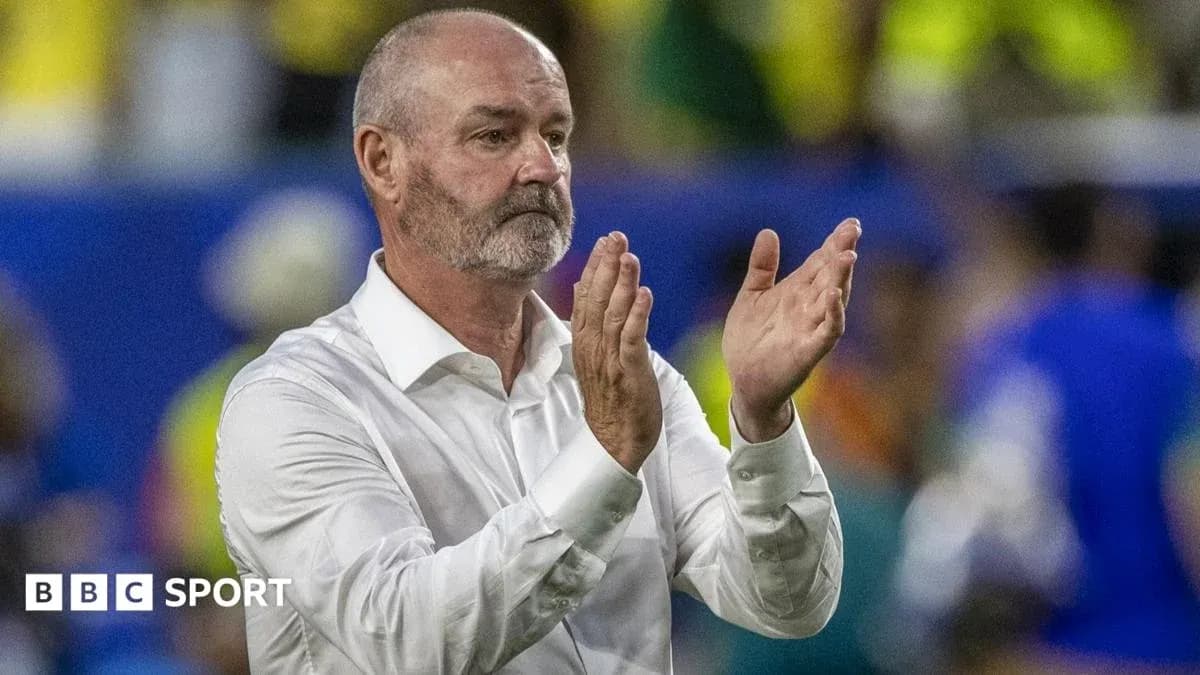
Steve Clarke on Scotland Exit: Controlling My Narrative
Steve Clarke has revealed he had to push the Scottish FA into handing him a new deal before the World Cup – all while knowing he would walk away if Scotland once again failed to escape the group stage.
Speaking publicly for the first time since stepping down, the 63-year-old former national coach laid out the timeline of his departure during an interview with former Chelsea and Scotland team‑mate Pat Nevin at a Spartans Community Foundation dinner in Edinburgh.
Clarke had signed a four-year extension on the eve of the tournament in the Americas. Yet he told the audience, as quoted by The Scotsman, that his decision to resign after Scotland’s group-stage exit was not a late change of heart.
“It was never really a change of mind,” he said. “I am quite a complex person. I wanted to control my narrative.”
Contract stand-off and a “little shove” to the SFA
Clarke described a tense spring in which he began to suspect the Scottish FA were waiting to see how the summer would play out before committing.
“Obviously we got to March and I hadn’t been offered a new contract, which I thought was pretty strange,” he said. “You start to think are they hedging their bets a little bit, waiting on the tournament in the summer.”
So he turned to the media.
Clarke admitted he “did a little bit in the media in March to give the SFA a little shove”, and from there negotiations became relentless.
“We negotiated non-stop from the beginning of April really to the middle of May, just before the Curacao game,” he explained. “And I said to them if we don’t agree a new contract before we go to the World Cup then I will say I am leaving the job. They panicked a little bit and gave me the new contract.
“It was like drawing teeth trying to get it over the line. But we got it over the line anyway.”
Quiet exit plan behind the new deal
Even as the ink dried, Clarke had already set his own conditions for staying in charge.
“But I always knew in my head that if we did not get out of the group stage then I would probably leave,” he said. “The only way I would have stayed on is if they had been three fantastic games and they went against you.”
Scotland’s campaign never hit that level. They opened with a 1-0 win over Haiti but then lost 1-0 to Morocco before a bruising 3-0 defeat to Brazil left their hopes hanging by the thinnest of threads, reliant on a complicated sequence of results elsewhere to sneak through as one of the best third-placed teams.
The squad were forced to linger in Charlotte, waiting on other nations to decide their fate.
“We had to stay for four or five days [in Charlotte], the longest four or five days ever just sitting and waiting, knowing you are going home because the goal difference was not good enough,” Clarke recalled.
He had gone into the tournament with a clear target.
“I knew we needed four points. I got hammered in the media for saying that. Somebody hammered me for saying, ‘nah, that’s us, we are going home’. But I was right.”
Time for a new voice
The Brazil defeat did more than end Scotland’s World Cup. It confirmed to Clarke that his cycle with this group of players had run its course.
He revealed he spoke to several senior squad members after that game and sensed the need for change if Scotland are to finally break their knockout-stage hoodoo at a major tournament.
Those conversations helped crystallise his decision to resign, despite the security of a long-term contract.
Backing Pocognoli and a pointed Euro 2028 verdict
Clarke has already extended an olive branch to his successor. He confirmed he spoke to new head coach Sebastien Pocognoli last week to wish him well in the role he has just vacated.
And he could not resist a wry comment about Scotland’s chances of reaching Euro 2028, which the country will co-host.
With two spots at the finals reserved for the best-ranked host nations who fail to qualify as group winners or runners-up, Clarke believes the path is as open as it has ever been.
He told the audience he thinks “even Scotland” cannot fail to qualify under that format.
The challenge now sits squarely with Pocognoli and a squad that has heard one voice for years. The safety net is there. The expectation, unmistakably, is too.