.svg&w=384&q=75 "GoalGist logo")
Bournemouth’s Journey from -17 to European Glory
“From -17 to Europe,” declared the flag in the away end at Anoeta, a strip of fabric that told Bournemouth’s story better than any glossy brochure ever could.
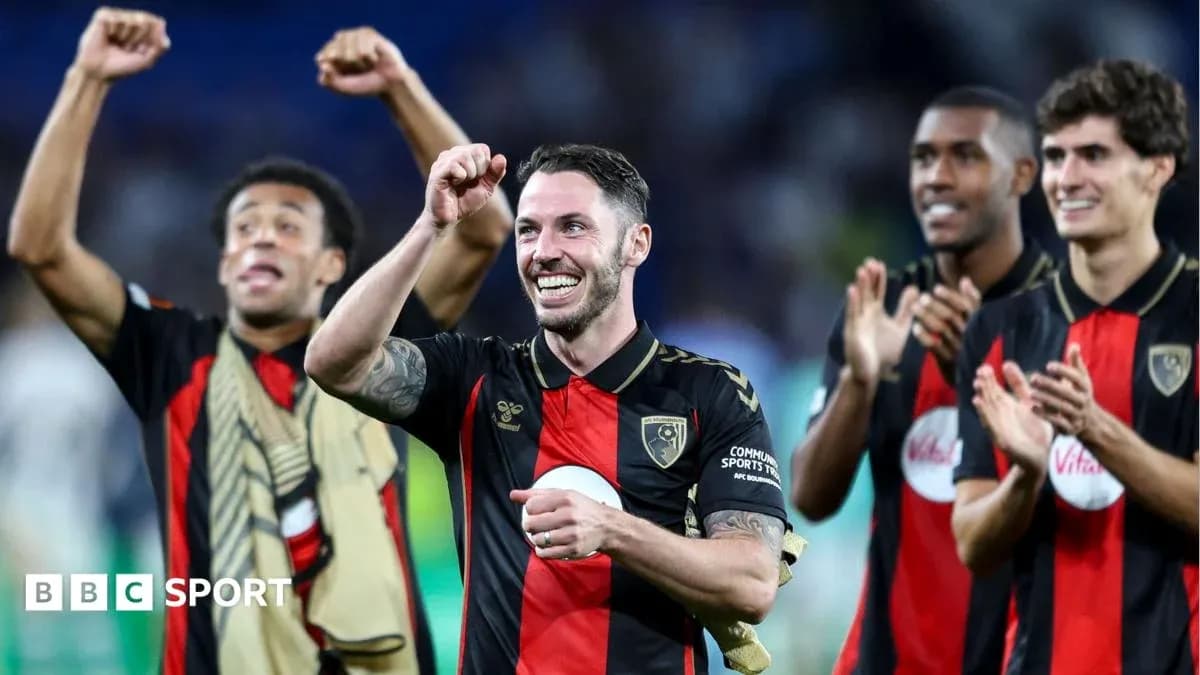
On a warm night in San Sebastian, the club’s first European game in 127 years ended with a 2-1 win over Real Sociedad and a feeling that this adventure is only just getting started.
From the brink to the big time
For a growing generation of Bournemouth fans, the Premier League is simply what Saturdays look like. Eleven years in the top flight will do that. Europe, then, might feel like the natural next step for a club that has made a habit of defying gravity.
But to the thousands bouncing in the away section, it still feels like a dream someone forgot to end.
Eighteen years ago, Bournemouth were staring into the abyss. Administration brought a 10-point deduction and relegation to League Two. To even be allowed to start the 2008-09 season, they had to swallow a 17-point penalty and agree not to appeal, having failed to secure a Company Voluntary Arrangement. Survival in the Football League, not trips to Spain, was the battle line.
Back then, the idea of a £100m-rated midfielder clipping a cross onto the head of a Brazil winger to win a European tie was pure fantasy. Now it is the reality.
Alex Scott strolled around San Sebastian like he owned the place, showing exactly why the Premier League’s elite are circling. Rayan, at the sharp end, offered another reminder of why Bournemouth will not blink at that reported £130m release clause. You want him? Pay for him.
“This is a brilliant win in our first European game. It’s brilliant for the club and the 2,000 fans from Bournemouth,” manager Marco Rose told TNT Sports. He didn’t sound like a man satisfied. More like one who expects this to be the standard.
A ‘proper’ European away performance
Bournemouth have no European history to lean on, no old tales of continental nights to dust off. So they went and wrote one.
Up against a Real Sociedad side led by World Cup winner Mikel Oyarzabal and fresh from beating Atletico Madrid to the Copa del Rey last season, Rose’s team owned the first half.
They pressed high and hard. They hunted in packs. Time and again they nicked the ball in Sociedad territory and, crucially, had the composure to use it. This wasn’t just chaos and energy; it was control with the ball as well as without it.
Sociedad looked rattled. Anoeta, usually a cauldron, simmered instead.
The reaction after the break was inevitable. There is steel in this Basque side, and pride too. They came out snarling, pressing higher, moving the ball quicker, testing Bournemouth’s legs and nerve.
Rose’s players had burned through plenty of fuel in that ferocious opening 45 minutes. The adrenaline that had carried them began to ebb. The spaces grew. The duels became more desperate.
Bournemouth’s recent Premier League history flashed through the mind: leads squandered in each of their first four games this season, late goals conceded, control slipping away. This, you felt, was the kind of night that could turn on a single mistake.
But the collapse never came.
Djordje Petrovic, sharp and assured, stood tall when the pressure peaked. Blocks went in. Clearances found touch, not trouble. The Cherries bent, but they did not break.
“It was very intense and tough,” Rose admitted to TNT Sports. “Brilliant first half in everything. The way we won balls and the possession high up. In the second half, we needed to suffer because we were not so sharp.”
They suffered. They survived. They won.
Howe’s legacy and Smith’s moment
The road to Anoeta really starts in January 2009 with Eddie Howe, the rookie manager handed a club on life support and told to keep it alive.
He did more than that. Howe dragged Bournemouth clear of the drop despite that brutal 17-point deduction, finishing nine points above the relegation zone. Six and a half years later, back for a second spell, he had them in the Premier League. A fairytale, written in fast-forward.
It felt right, then, that on this latest landmark night the team was led out by a player who has lived almost every chapter of that story.
Adam Smith first arrived on loan in the 2010-11 season, signed permanently in 2014 and never left. Close to 400 league appearances later, he walked out in San Sebastian as captain, a symbol of everything the club has become.
“Adam has been with the club for so long,” former Cherries full-back Charlie Daniels told BBC Radio Solent. “Dedicated himself to the club, and it’s such a proud moment, not only for him, but for his family, his team-mates and old team-mates to see how he’s grown – not only as a player but as a man as well.
“To lead out the Cherries on this historical night is fantastic.”
Smith added a slice of history of his own. At 35 years and 141 days, he became the oldest English outfielder to make his debut in major European competition since Ipswich’s Reginald Pickett in 1962. A long wait, but worth every step.
No one on that pitch will have understood the journey better.
The fight to stay at the top
Bournemouth’s rise has never been smooth, never linear. Relegation in 2020 was a jolt. Rebuilding in the Championship, then re-establishing themselves in the Premier League, demanded another surge of energy and investment.
Then came a new challenge: hanging on to the people who made it possible.
Every summer seems to bring another raid from Europe’s heavyweights, another key player plucked away. The manager, too. Even qualifying for Europe could not keep Andoni Iraola, who returns to the Vitality Stadium on Sunday with Liverpool, a reminder that progress at this level is never secure.
That pattern is unlikely to change. When you grow this fast, the bigger fish notice.
But nights like this tilt the balance a little. They offer something more than survival, more than mid-table anonymity. They offer a stage.
For the 2,000 fans in Anoeta, for the thousands more watching at home, the message on that flag felt bang on. From -17 to Europe. From the edge of the Football League to a statement win in Spain.
They know enough of the hard years to recognise what this is.
These are the good times. The only question now is how far this story can go.