.svg&w=384&q=75 "GoalGist logo")
Raphinha's Transformation: From Injury to Barcelona's Key Player
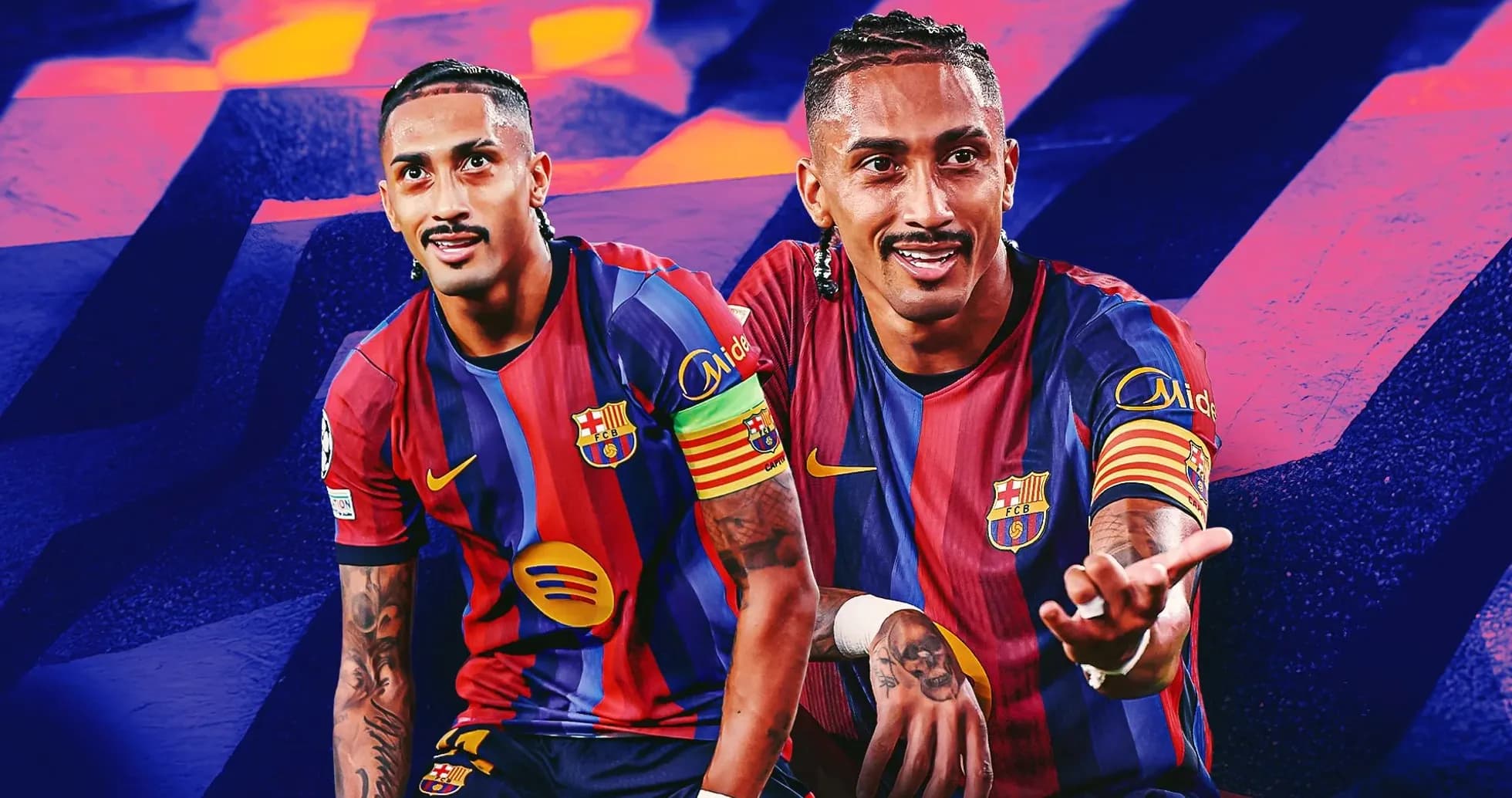
A year ago, Raphinha’s season was defined by the treatment table. Now, it’s defined by numbers Barcelona haven’t seen in six decades.
The Brazilian has been transformed under Hansi Flick, shifted from his familiar role on the left into the heart of the attack. The move has turned a gifted winger into the sharp point of a fluid, ferocious frontline – and left his coach openly baffled that the Ballon d'Or voters ignored him.
Raphinha produced 60 goal contributions in a dazzling 2024-25 campaign, only to see his follow-up year wrecked by hamstring problems. He missed 125 days through injury, his tally slumped to 29, and his World Cup was ruined. The Ballon d'Or nod never came. This time, he was not even among the 30 nominees.
Flick didn’t hide his frustration. “He (Raphinha) is far too good not to be on that list, but we can’t change it,” the Barca boss said, speaking with the conviction of a man who knows what he has on his hands.
The Brazilian is repaying that faith in devastating fashion.
A new No. 9 in everything but name
The turning point came on Europe’s biggest stage. Feyenoord arrived for Barca’s Champions League opener and left shredded, victims of a new version of Raphinha.
His first goal was pure theatre. He took a slightly loose pass from Lamine Yamal, skipped past one defender, surged into the box and shaped to shoot. Instead, he sold an outrageous dummy, sending two Feyenoord defenders crashing to the turf, before passing the ball into the net with icy calm.
The second was classic centre-forward craft. He initially moved towards Dani Olmo, dragging his marker with him, then spun away and burst into space. Olmo threaded the pass, Raphinha met it in stride and lashed a low finish across the helpless goalkeeper. Barca cruised to a 5-1 win, and Raphinha walked away with the Player of the Match award. It felt less like a breakout and more like a statement.
“Rapha has played fantastic,” Flick said. “He’s on another level – he’s unbelievable.”
The numbers support the claim. Raphinha already has 11 goals this season – a benchmark no Barcelona player has hit this quickly in the last 60 years. Lionel Messi reached 10 in his first seven outings of 2012-13 and hit nine at the same stage twice more. Ronaldo reached nine in 1996-97. Raphinha has gone beyond them.
This is not a traditional No. 9 suddenly dropped into the box. It’s a forward who floats, disrupts and dictates.
Lewandowski bullied centre-backs with his back to goal. Ferran Torres sliced in behind with clever, angled runs. Raphinha gives Flick something else entirely: a roaming, high-speed focal point who stitches moves together and then finishes them.
At 29, he now drifts between the lines, using his acceleration and tight control to drag defenders into places they don’t want to go. That movement carves out lanes for Yamal and Anthony Gordon on the flanks, while he constantly lurks on the blind side, ready to punish any lapse.
Hat-trick, high press, and a team built in Flick’s image
If Feyenoord was the warning, Racing Santander felt like a demolition. Barca smashed them 7-2 in La Liga, with Raphinha helping himself to a hat-trick.
Two came from the penalty spot. The middle one showed why defenders are already second-guessing every step around him. Again, Olmo spotted the gap. Raphinha slipped between Racing’s centre-backs, paused, waited, then pounced on the pass. One touch to set, a half-volley steered into the corner. Simple in execution, ruthless in intent.
On the ball, he makes the game look easy. Off it, he sets the standard. Barca’s press starts with him, and it rarely relents. He chases lost causes, harries centre-backs, and forces rushed clearances. That intensity is exactly what Flick demands.
The German coach wanted Julian Alvarez in the summer. That deal never materialised. Right now, he won’t be losing any sleep over it. Raphinha has become the ideal spearhead for a system built on movement, aggression and constant rotation. The frontline is humming, and the club can channel their resources into other parts of the squad in the next windows.
Walking in the footsteps of R9
Barcelona’s history with Brazilian brilliance is rich: Romario, Rivaldo, Ronaldinho, Neymar. But one season still towers over the rest – Ronaldo’s lone, savage year in 1996-97.
Ronaldo arrived from PSV for a then-world record $19.5m fee at just 20. In 49 games, he scored 47 goals, lifted the Copa del Rey, UEFA Cup Winners’ Cup and Supercopa de España, and terrorised defences with raw power, blistering pace and clinical finishing. He claimed the Pichichi with 34 league goals, the European Golden Shoe, and the 1997 Ballon d'Or.
He left a trail of iconic moments: the slaloming solo run against SD Compostela, the hat-trick that dragged Barca to a 4-3 comeback over Atletico Madrid in the Copa del Rey.
“He is the most spectacular player I’ve ever seen,” said then-coach Sir Bobby Robson. Laurent Blanc summed up the defenders’ view: “I’ve never seen anyone with that velocity and power. He was like a freight train coming at you with a ball at his feet.”
Raphinha isn’t a fixed reference point in the way ‘R9’ was. He roams more, drops deeper, drifts wider. But the instincts are familiar. The directness. The hunger to attack space. The ability to eviscerate a defence in seconds.
If he sustains this level, his output could start to resemble Ronaldo’s – and the trophies might, too. Barca are already playing like a team capable of chasing a treble.
Captaincy, evolution and a career rescued
That Raphinha is even in this conversation owes everything to Flick’s intervention.
His first two seasons at Camp Nou under Xavi never quite clicked. The talent was obvious, the end product sporadic, the starting spot never fully secure. By 2024, a departure felt likely.
Flick changed the trajectory. He saw a player with untapped potential and handed him more responsibility instead of pushing him out. When Marc-André ter Stegen left on loan to Ajax in the summer, Flick didn’t hesitate: Raphinha became Barcelona’s permanent captain.
He is the first Brazilian to wear the armband in Catalonia. So far, he is redefining what it means.
His work rate, passion and team-first mentality have turned him into a reference point for the younger players. He doesn’t just wear the armband; he grabs games by the throat.
Raphinha himself refuses to bask in it. After the Racing rout, he said: “I will never say I am performing well; I always strive to improve everything I can. I am happy with the goals, and with the win, and that is the most important thing, but we have to keep improving.”
He added that he feels “comfortable” through the middle and credited Flick for reshaping his game and mentality. “He is the coach who changed the way I think and how I see myself,” Raphinha said. “I am extremely grateful.”
Depth, protection and a devastating partnership
Flick has built enough depth to avoid running his captain into the ground again.
Despite losing Lewandowski and Torres, and sending Marcus Rashford back to Manchester United, Barca’s attack looks sharper than ever. Gordon, Karim Adeyemi and Gabriel Jesus have settled quickly, while 18-year-old Hamza Abdelkarim has stepped up from Barca B to offer another option through the middle.
“Raphinha, Gabby and Hamza are three different profiles, but there are other ways we could play,” Flick said. “Anthony and Karim can also play in this position (as striker). Or Dani Olmo. Dani has showed us in last two years he can play there – the same with Fermin [Lopez]. We have a lot of options.”
Those options allow Flick to be ruthless with minutes. Raphinha was withdrawn early against Feyenoord and again in league wins over Athletic Club and Racing. Every substitution is a reminder: Barca know they cannot gamble with his hamstrings again.
The same goes for Yamal. The teenager has become even more dangerous operating closer to Raphinha. Their understanding is instinctive and brutal. The moment a centre-back adjusts his body to track Yamal, the youngster slips the ball into the channel, already knowing Raphinha will be darting into the blind spot.
There is no tug-of-war for status. Yamal seems content to let Raphinha be the main man. The dressing room is loaded with star power, yet egos are kept in check. The collective edge is unmistakable – and ominous for the rest of Europe.
Raphinha embodies that spirit more than anyone. If this level holds, the question won’t be whether he belongs in Barca’s Hall of Fame alongside Ronaldo.
It will be where, exactly, his name gets carved on the wall.