.svg&w=384&q=75 "GoalGist logo")
Spain Crowned World Champions After 1-0 Victory Over Argentina
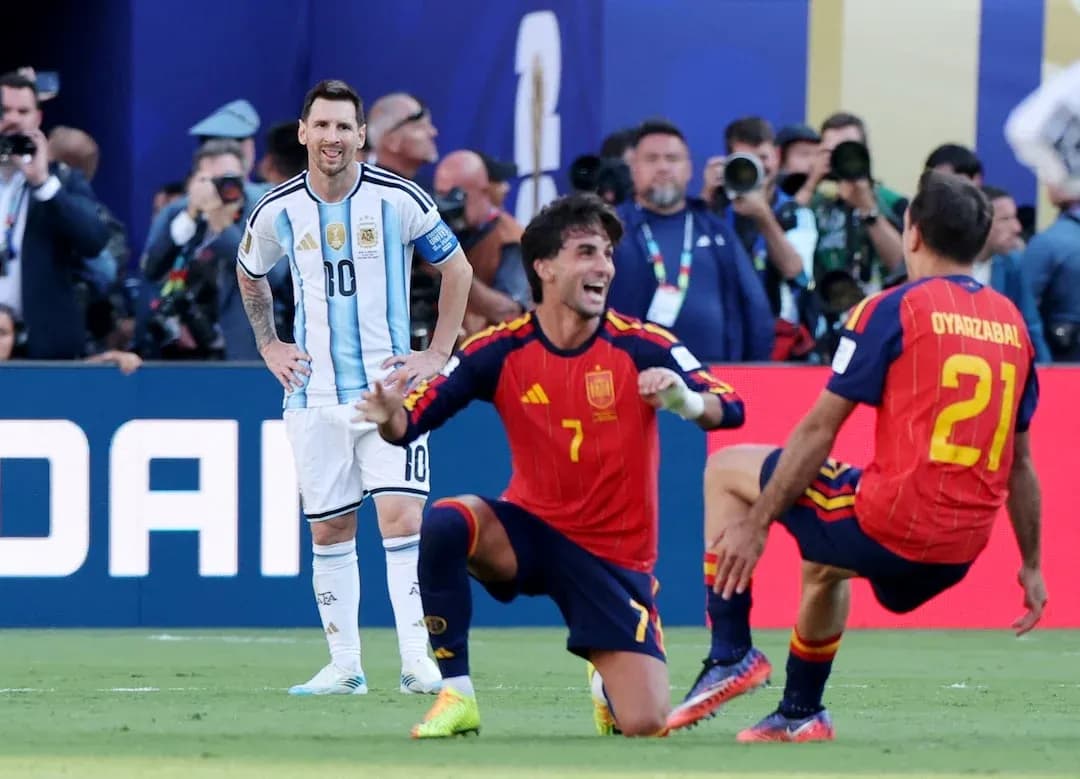
Spain 1-0 Argentina (after extra time) at MetLife Stadium crowns Spain world champions, with Ferrán Torres’s extra-time winner delivering the trophy and confirming the Group H winners’ perfect knockout run, while previously flawless Group J winners Argentina fall just short on the final night.
Match Report
The final unfolded as a tense, tactical battle with discipline and substitutions playing a major role before Spain finally broke through in extra time.
On 41', Argentina’s back line absorbed another Spanish attack but paid a disciplinary price when Lisandro Martínez (Argentina) was booked — yellow card (Foul) — as he stepped in late to halt a Spanish move.
Three minutes later, on 44', Lionel Scaloni made his first defensive adjustment: Nicolás Otamendi replaced Lisandro Martínez (Argentina), an early reshuffle at centre-back after the booking and under sustained Spanish possession.
On 45', Argentina altered their attacking structure as well, with Leandro Paredes replacing Nicolás Iván Gonzalez (Argentina), adding another passer into midfield to help them escape Spain’s press.
Early in the second half, tension rose again. On 52', Leandro Paredes (Argentina) — yellow card (Argument) — was cautioned after protesting a decision, underlining how much pressure Argentina were under without the ball.
On 58', Scaloni freshened the right flank: Nahuel Molina replaced Gonzalo Montiel (Argentina), aiming for more energy and overlapping threat on the counter.
Spain responded with a double change on 62' to inject more penetration in the final third. Ferrán Torres replaced Mikel Oyarzabal (Spain), and Pedri replaced Fabián Ruiz (Spain), giving Luis de la Fuente extra dribbling and creativity between the lines against a deepening Argentine block.
Argentina then made a double defensive and midfield change on 70'. Facundo Medina replaced Cristian Romero (Argentina), while Giuliano Simeone Baldini replaced Rodrigo De Paul (Argentina), a surprising attacking tweak that sought fresh legs higher up but also altered the team’s defensive cohesion.
On 75', Spain continued to rotate their attacking midfielders: Nico Williams replaced Alejandro Baena Rodríguez (Spain), and Mikel Merino replaced Daniel Olmo Carvajal (Spain), further increasing Spain’s ball-carrying and aerial presence around the box.
As the tension escalated in the closing stages of normal time, Argentina’s midfield discipline frayed. On 82', Enzo Fernández (Argentina) — yellow card (Dissent) — was booked for protesting, reflecting Spain’s territorial dominance and Argentina’s growing frustration without chances.
In stoppage time of the second half, on 90+2', Cristian Romero (Argentina) — yellow card (Dissent) — also went into the book, another sign of Argentina struggling to cope emotionally with long spells without the ball.
With the match goalless after 90 minutes, extra time began with Spain reshaping their spine. On 99', Martín Zubimendi replaced Rodrigo Hernandez Cascante (Spain), and Eric García replaced Aymeric Laporte (Spain), moves that refreshed the holding role and centre-back line to maintain Spain’s high defensive line and counter-press for the extra 30 minutes.
On 102', Argentina made another change, this time in attack: Marcos Senesi replaced Julián Álvarez (Argentina), a curious shift that effectively added another defender and underlined Scaloni’s intent to survive Spanish pressure and reach a shootout.
Even the technical area felt the strain. On 104', Lionel Sebastián Scaloni (Argentina) — yellow card (Dissent) — was cautioned, as the Argentina coach voiced his anger from the touchline.
The decisive moment arrived on 106'. Spain goal — Ferrán Torres (assisted by Nico Williams). Williams drove at a tiring Argentine back line on the left and delivered a telling ball that Torres converted, finally turning Spain’s territorial and statistical dominance into a 1-0 lead in extra time.
Argentina’s frustrations continued to surface. On 111', Alexis Mac Allister (Argentina) — yellow card (Foul) — was booked after a late challenge as Argentina chased an equaliser they never truly looked like finding. Spain then managed the closing stages with control, seeing out the remaining minutes to secure the 1-0 victory after extra time.
Fixture Statistics & Tactical Audit
- xG: — not provided vs — not provided
- Possession: Spain 65% vs 35% Argentina
- Shots on Target: Spain 12 vs 0 Argentina
- Goalkeeper Saves: Spain 0 vs 11 Argentina
- Blocked Shots: Spain 3 vs 1 Argentina
The numbers underline how thoroughly Spain controlled this final. With 65% possession and a 12-0 advantage in shots on target, Spain’s dominance (65% possession, 20-2 total shots) was clear, even if the breakthrough only came in extra time. Argentina’s approach became increasingly reactive: only 2 total shots, neither on target, and they relied heavily on Emiliano Martínez, who made 11 saves, to keep them alive. Spain’s structure in a 4-1-2-3 allowed them to pin Argentina back, recycle the ball through their single pivot, and repeatedly create shooting positions around the box, as reflected by 20 attempts and 3 blocked shots. Argentina’s low block and compact 4-4-2 limited the scoreline but at the cost of any attacking threat, with their inability to register a single shot on goal leaving them dependent on a penalty shootout scenario that never arrived. The 1-0 scoreline slightly flatters Argentina given the volume and quality of Spain’s pressure, and the eventual winner for Ferrán Torres felt like a delayed confirmation of the pattern that had been evident all night.
Standings Update & Seasonal Impact
Spain, who came into the knockout phase from Group H with 7 points, 5 goals scored and none conceded, add three more points for this win, moving to 10 points overall in their World Cup campaign. Their goal tally rises to 6 scored and 0 conceded, for a new goal difference of +6, completing a title run built on defensive perfection and territorial control. Argentina, who advanced from Group J with a perfect 9 points, 8 goals for and 1 against, remain on 9 points after this defeat. Their totals move to 8 goals scored and 2 conceded, with goal difference narrowing from +7 to +6. In the context of the tournament, Spain finish as world champions with the superior record in the knockout phase, while Argentina, despite dominating their group, fall at the final hurdle, their previously potent attack unable to lay a glove on Spain’s defence in the decisive match.
Lineups & Personnel
Spain Starting XI
- GK: Unai Simón
- DF: Pedro Porro, Pau Cubarsí Paredes, Aymeric Laporte, Marc Cucurella
- MF: Rodri, Dani Olmo, Fabián Ruiz, Álex Baena
- FW: Lamine Yamal, Mikel Oyarzabal
Argentina Starting XI
- GK: E. Martínez
- DF: G. Montiel, C. Romero, Lisandro Martínez, N. Tagliafico
- MF: R. De Paul, E. Fernández, A. Mac Allister
- FW: N. González, L. Messi, J. Álvarez
Post-Match Verdict
This was a controlled, methodical triumph for Spain rather than a spectacular one. Their performance was dominant (65% possession, 20-2 shots) in every phase except the scoreline, where wastefulness and Argentina’s goalkeeper kept the contest alive into extra time. Spain’s midfield box, anchored by Rodri and then Martín Zubimendi, suffocated Argentina’s attempts to play through the thirds, forcing Lionel Messi and Julián Álvarez to feed on hopeful transitions that produced just 2 shots and none on target. Defensively, Spain were impeccable (0 shots on target conceded), maintaining concentration even as they pushed full-backs high and committed numbers forward.
Argentina’s display was resilient but ultimately too passive. They were vulnerable (12 shots on target faced) whenever Spain accelerated around the box and became increasingly reliant on Emiliano Martínez, whose 11 saves kept the scoreline narrow. The succession of yellow cards — five bookings plus one for Scaloni — reflected a side straining to cope without the ball. Substitutions that tilted further towards defensive reinforcement, such as Marcos Senesi coming on for Julián Álvarez, underlined Argentina’s priority of survival over ambition. In contrast, Spain’s bench usage was clinical (decisive goal scored by substitute Ferrán Torres, assisted by substitute Nico Williams), with fresh attackers finally converting the territorial advantage into the winning moment. Over 120 minutes, the data and the pattern of play align: Spain were the more coherent, proactive team, and their 1-0 win after extra time is a fair reflection of their control of the World Cup final.