.svg&w=384&q=75 "GoalGist logo")
South Korea's Tactical Victory Over Czechia in World Cup Opener
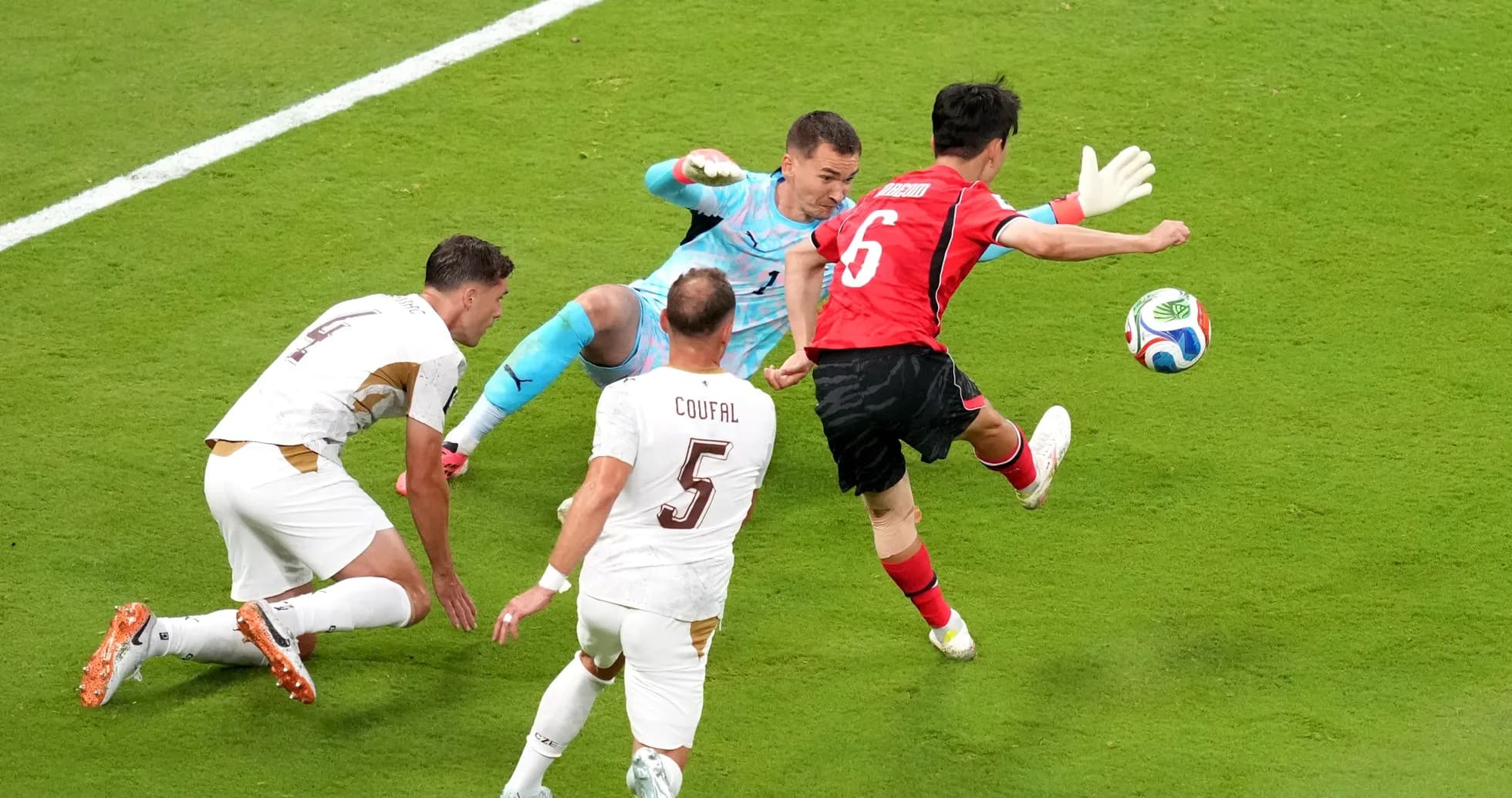
Under the lights of Estadio Akron in Guadalajara, South Korea’s 2–1 victory over Czechia felt like more than just an opening Group A result. It was a statement of tactical identity. Both sides mirrored each other in a 3-4-2-1, yet the match evolved into a study in how differently that shape can be interpreted – and how fine the margins are at World Cup level.
Following this result, South Korea sit 2nd in Group A with 3 points, a goal difference of 1 (2 goals scored, 1 conceded). Czechia, with 0 points and a goal difference of -1 (1 scored, 2 conceded), occupy 3rd, their “Possible Advanced” tag already under pressure.
I. The Big Picture – Two 3-4-2-1s, One Clearer Idea
Myung-Bo Hong doubled down on South Korea’s season-long template. Heading into this game they had used 3-4-2-1 in every outing, and he rolled it out again: Kim Seung-gyu behind a back three of Gi-Hyuk Lee, Kim Min-jae and Han-Beom Lee, with Lee Tae-seok and Young-woo Seol as wing-backs and a double pivot of Hwang In-beom and Seung Ho Paik. Ahead of them, Kang-in Lee and Jae-sung Lee floated behind Son Heung-min.
On the other bench, Miroslav Koubek matched the structure: Matěj Kovář in goal, a back line of Ladislav Krejčí, Robin Hranáč and Štěpán Chaloupek; Vladimír Coufal and Jaroslav Zelený wide; Tomáš Souček and Alexandr Sojka central; Lukáš Provod and Pavel Šulc supporting Patrik Schick.
But where South Korea’s 3-4-2-1 pulsed with rotation and technical fluency, Czechia’s interpretation was more rigid, leaning on direct routes to Schick and late surges from Krejčí.
II. Tactical Voids – Discipline, Risk and the Cost of Aggression
The disciplinary ledger tells its own story. Across the World Cup campaign so far, South Korea’s only recorded yellow card came in the 91–105 minute range, and it belonged to Gi-Hyuk Lee – and with it, a red. The data lists him among both the top yellow and top red card recipients, underlining how a single reckless moment can reshape a defensive plan.
That dismissal at 90+ added an edge to the closing phase. Lee had been quietly efficient: 62 passes at 93% accuracy, 3 interceptions, and 10 duels contested with 6 won. His sending-off forced South Korea to compress into a de facto back two plus screening midfield, inviting Czechia onto them and turning the final minutes into a test of nerve and structure.
Czechia, by contrast, finished without any recorded yellows or reds in their season statistics so far. On paper, that speaks to control; in practice, it hinted at a lack of calculated aggression in midfield. Souček and Sojka were often half a step late to Hwang and Paik, neither disrupting the rhythm nor truly committing to tactical fouls when transitions broke against them.
III. Key Matchups – Hunter vs Shield, Engine Room vs Enforcer
Hunter vs Shield
South Korea’s attack has started the tournament with clarity. Overall, they average 2.0 goals per game, with all 2 goals coming at home in this fixture. The Hunter role is shared: Hwang In-beom and Oh Hyeon-gyu both found the net, while Son Heung-min’s gravity and Kang-in Lee’s creativity stretched Czechia’s back three.
Hwang’s numbers are those of a controller who can kill you between the lines: 1 goal, 1 assist, 3 shots (2 on target), 81 passes at 90% accuracy, plus 2 interceptions. His late withdrawal after 84 minutes was as much about preservation as fatigue; by then, he had already authored the game’s central narrative.
For Czechia, the Shield was supposed to be the three-man back line anchored by Krejčí. Yet the defensive metrics of their campaign tell a more fragile tale: on their travels they have conceded 2.0 goals per game, 2 in total, with a 2–1 defeat their defining result so far. Krejčí himself was outstanding individually – 1 goal from his only shot on target, 43 passes at 72% accuracy, 3 tackles, 13 duels with 7 won – but the line around him bent under the constant manipulation from South Korea’s front three.
Engine Room – Playmaker vs Enforcer
The midfield duel framed the match. Hwang In-beom and Seung Ho Paik formed a double pivot that could both dictate and press. Hwang’s blend of progression and final-third incision put him at the top of both the scoring and assist charts for South Korea, a dual-threat “regista-plus” who never lost his positional discipline.
Opposite him, Tomáš Souček was cast as the enforcer. Yet the numbers across Czechia’s campaign suggest a unit that struggles to fully protect its back line: they concede 2.0 goals per game away and have yet to keep a clean sheet. Souček’s screening was often undermined by the spaces Coufal and Zelený left when stepping out, forcing him to cover too much lateral ground. When Kang-in Lee drifted inside, dragging a centre-back with him, Hwang consistently found the free man – often Paik or a wing-back on the weak side.
The other key axis lay down South Korea’s right: Young-woo Seol and Kang-in Lee versus Jaroslav Zelený and Krejčí. Kang-in’s performance – 37 passes at 100% accuracy, 3 key passes, 6 dribbles attempted with 5 successful, and 10 duels won out of 14 – turned that flank into a pressure point. Zelený and Krejčí were forced to choose between stepping out to meet him or holding the line; whichever option they took, space opened elsewhere.
IV. Statistical Prognosis – What This Game Tells Us About the Road Ahead
Following this result, the numbers sketch a clear early pattern. South Korea’s attack is efficient: 2 goals from their first 2 shots on target-heavy performances, an overall scoring average of 2.0 per game, and no matches yet where they have failed to score. Defensively, they are not watertight – 1.0 goal conceded per game overall, with no clean sheets – but their structure is coherent enough that most danger comes from set pieces or late chaos, as Krejčí’s goal underlined.
Czechia, meanwhile, are walking a thinner line. They average 1.0 goal scored per game overall, but concede 2.0, with a goal difference of -1. They have also yet to fail to score, which suggests they will remain a threat in every group match, especially with Schick as a reference point and Coufal already on the assist chart. But unless the midfield shield tightens and the wing-backs choose their moments more carefully, their 3-4-2-1 risks becoming a 5-2-3 pinned too deep, too often.
In xG terms – even without raw figures – the pattern is evident. South Korea’s chance quality is built on crafted central combinations and high-percentage shots for late runners like Oh Hyeon-gyu, whose 1 goal from 1 shot on target and 4 duels won from 4 attempts off the bench show how ruthlessly they can weaponise substitutions. Czechia’s threat, by contrast, leans more on set pieces, crosses and second balls, the kind of routes that produce spiky but less sustained xG.
The verdict: South Korea look like a side whose offensive structure and technical ceiling will keep their xG consistently higher than their opponents, even if their defensive xG against remains non-trivial. Czechia will stay competitive through physicality, deliveries and the individual quality of players like Krejčí and Coufal, but unless their defensive solidity improves, the data hints at a campaign where they are always chasing, rarely controlling.