.svg&w=384&q=75 "GoalGist logo")
Sarasota Paradise Defeats Naples 2-0 in USL League One Cup
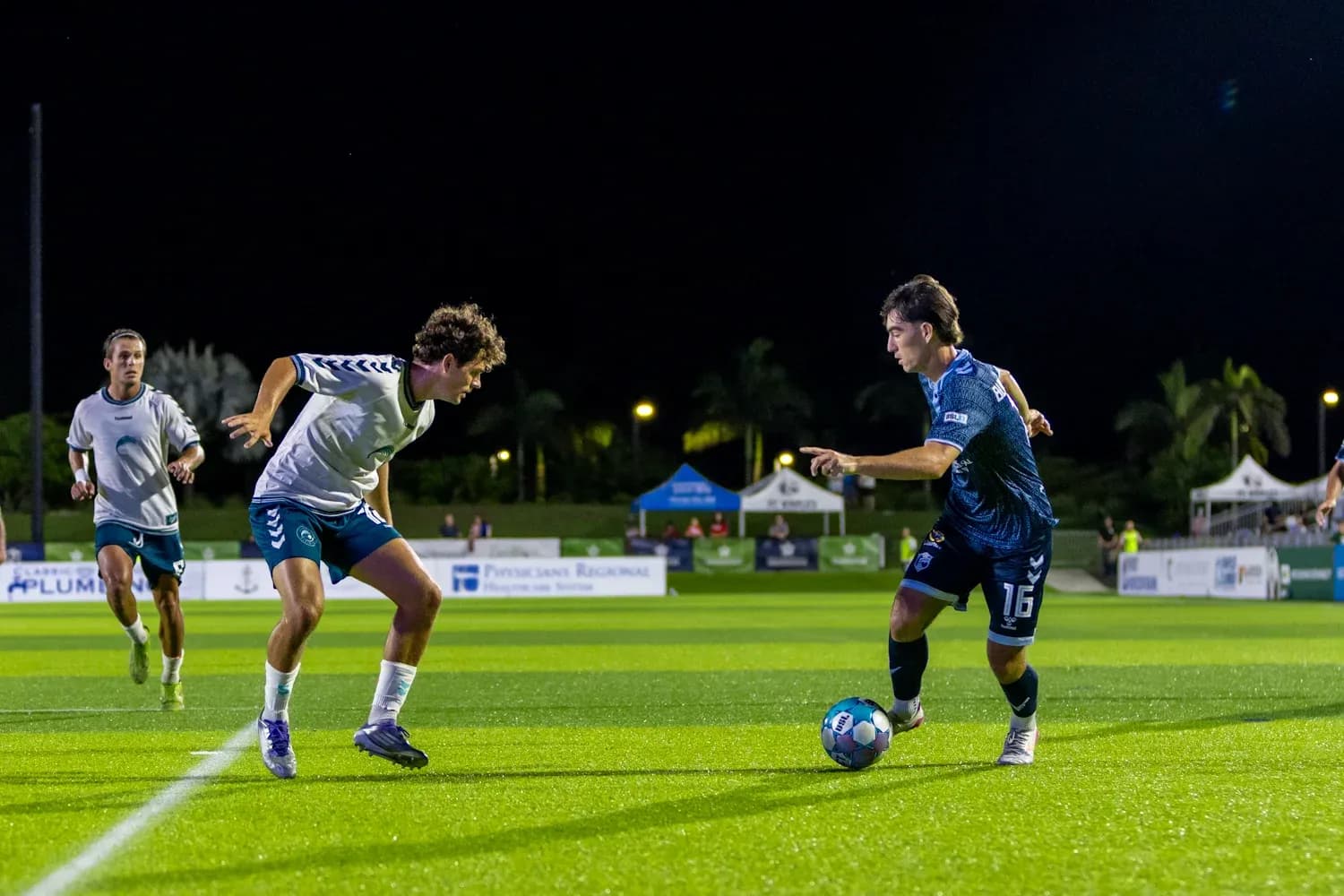
Under the Paradise Coast lights, this USL League One Cup group-stage tie closed with a clear verdict on the scoreboard: Naples 0–2 Sarasota Paradise. Yet beneath that simple line lay a more complex story of two evolving squads, each still learning what kind of Cup team it wants to be.
I. The Big Picture – Diverging Cup Identities
Heading into this game, the standings already framed this as a meeting of strugglers trying to salvage Group 7 momentum. Naples arrived ranked 5th in the group with 2 points, their overall goal difference at -3 from 5 goals for and 8 against across 3 matches. At home they had been competitive but fragile: 2 home goals scored, 3 conceded, with a split record of one win and one loss.
Sarasota Paradise, 4th in the same group on 3 points, carried a different kind of tension. Overall they had scored just 2 goals and conceded 4 in 3 fixtures, for a goal difference of -2. Their path was oddly binary: a 0-2 home defeat offset by a 0-2 away win, plus a 2-0 away loss. On their travels they had been sturdier, with 2 goals scored and 2 conceded across 2 away matches.
This match, then, was less about free-flowing attacks and more about which side could impose structure and manage risk. Sarasota did that better, leaning into a compact, disciplined shape that slowly suffocated a Naples side still searching for balance.
II. Tactical Voids – Discipline and the Edges of Control
Neither club listed formal absentees, so both coaches had near-full decks to play with. That put the spotlight on tactical choices and in-game discipline rather than personnel crises.
Naples came in with a disciplinary profile that hinted at volatility. In total this campaign they had yet to keep a clean sheet and had already seen one red card, shown in the 46-60 minute band. Their yellow-card pattern skewed towards the middle and later phases: 20.00% of their yellows arriving between 31-45 minutes, 40.00% between 46-60, 20.00% between 76-90, and another 20.00% from 91-105. It paints a picture of a team that can lose composure as intensity rises after the break.
Sarasota, by contrast, were serial yellow-card accumulators but without crossing the red line. Their cautions were spread, but with a clear late-game spike: 12.50% between 16-30, another 12.50% between 31-45, 25.00% between 46-60, 37.50% between 76-90, and 12.50% in added time from 91-105. They walk the disciplinary edge but rarely topple over it.
In this context, Sarasota’s ability to maintain eleven players on the pitch, stay compact, and ride out Naples’ surges was decisive. Naples’ lack of clean sheets in total and their tendency to concede—7 goals against overall at an average of 2.3 per game—again told in the final scoreline.
III. Key Matchups – Hunter vs Shield, Engine Room vs Enforcer
Without official top-scorer or assist charts, the roles in this fixture were defined more by positional archetypes than by raw numbers.
For Naples, the attacking trident of J. Grant (shirt 99), G. Miglietti (9), and C. Garcia (11) carried the burden of turning a modest attacking record into something more threatening. Overall, Naples had scored 3 goals in total across 3 fixtures, with an average of 1.0 goals per game both at home and away. The issue was never pure chance creation alone, but how quickly their attacks broke down under pressure.
Their “shield” behind the ball—figures like J. Cisneros (3), J. Osorio (8), and the deeper roles of H. Gay (12) and I. Cerro (30)—had to contend with a Sarasota side that, while not prolific, were ruthlessly selective. Sarasota’s overall goals-for tally of just 2 in total masks the fact that on their travels they averaged 1.0 goals per away game and had already produced a 0-2 away win as their biggest road success.
On the Sarasota side, the “hunter vs shield” dynamic centered on the forward line led by J. Bender (9) and the wide threat of S. Karani (11), supported by the creative presence of E. Bryant (7) and M. Tainio (20). Their task was to probe a Naples defense conceding 1.5 goals per game at home and 4.0 on their travels, with 7 goals conceded in total. Sarasota did not need volume; they needed precision, and they found it twice.
In the engine room, Naples’ midfielders like J. Yoder (22) and C. Garcia (11) tried to knit transitions, but Sarasota’s central axis—A. Rodriguez (16), the composed R. Valentine (3), and the industrious D. Watters (4)—kept the game in front of them. With Sarasota having already managed one clean sheet away from home this campaign, the back line’s understanding of spacing and timing again proved crucial.
IV. Statistical Prognosis – xG Logic and Defensive Solidity
While explicit xG numbers are absent, the season’s statistical patterns offer a clear prognosis for how this match unfolded and what it signals going forward.
Naples’ overall attacking average of 1.0 goals per game, combined with a total of 7 goals conceded, implies a side whose underlying chance quality is being undercut by defensive lapses. Their inability to keep a single clean sheet in total suggests that even modest opposition xG tends to be converted against them. Sarasota, with 4 goals conceded in total at an average of 1.3 per game, are more comfortable in low-event contests where one or two high-quality chances can decide the outcome.
This 0-2 result fits that script perfectly. Sarasota likely generated fewer but clearer opportunities, capitalizing on Naples’ structural gaps, while their own block—anchored by R. Burlew (2), R. Valentine (3), and H. Backstrand (22)—absorbed pressure and kept Naples’ shot quality low. Their prior away record of 2 goals scored and 2 conceded in 2 matches hinted at a side built for tight margins; here, they tipped those margins decisively in their favor.
Following this result, the narrative of Group 7 sharpens. Naples remain a side with flickers of attacking promise but a soft defensive underbelly. Sarasota Paradise, meanwhile, emerge as a pragmatic, travel-hardened unit: not spectacular, but structurally sound enough that, when the game slows into a tactical chess match, they tend to move the final piece.