.svg&w=384&q=75 "GoalGist logo")
Roberto De Zerbi's Tottenham Hotspur Rebuild Faces Major Challenges
Roberto De Zerbi will soon be nudging the £400m mark on his Tottenham Hotspur rebuild. On this evidence, he might need a bigger budget for therapists, not footballers.
One game into the Premier League season, all that money looked powerless against something far more corrosive: a losing mentality that refuses to leave north London.
A new era, same old Spurs
De Zerbi admitted last spring that he was more psychologist than coach when he walked into Spurs with seven games to save them. He kept them up – just – with a final-day win over Everton. Survival was the brief. It was hardly a vision.
This summer was supposed to change everything. Vast funds. Big names. A squad remodelled so Spurs would not flirt with the drop for a third straight year after back-to-back 17th-place finishes.
Instead, under a hot west London sun, they unravelled. Again.
Brentford tore into them at The Gtech Community Stadium and found the soft centre that has haunted this club for years. The first sign of pressure, and Spurs crumbled. The scoreline was bad enough. The manner of it was worse.
De Zerbi’s side were “dismantled”, and that was exactly how it looked: Brentford quicker, stronger, sharper, more committed in every duel. Spurs looked like a team built in a lab and dropped into a street fight.
The Italian tried to explain it. He talked about conditioning, about players returning late from the World Cup, about new signings still finding their feet. But that did not cover the basics that went missing.
“Bad game,” he told BBC Sport’s Match of the Day. “We lost and suffered the difference in the duels. It was the key of this game. We didn't fight in the right way. Maybe credit to them because it's the best quality Brentford have.
“Our physical condition was not in the right level for all players because many came later after the World Cup and there were many new players in the squad and first XI. But we have to analyse this game better because we can't play this way in this type of game.”
He was right about one thing: this was not about fitness alone.
Optimism to exodus in 49 minutes
The day began with noise and hope. In one corner of The Gtech, Spurs fans greeted their new signings like saviours, the away end bouncing with that familiar early-season belief that this time might be different.
By the 49th minute, many of them had seen enough.
When Michael Kayode slammed in Brentford’s third to make it 3-0, a stream of Spurs supporters headed for the exits. Those who stayed to the end watched their players applaud rows of empty plastic. The symbolism was brutal.
It could have been uglier. Igor Thiago, usually so reliable from the spot, hit the post with a penalty. Even that felt like a let-off Spurs scarcely deserved.
Somewhere in the stands, Jon Bon Jovi watched on. If he came looking for inspiration, Spurs handed him the soundtrack to a season’s worth of sad ballads – a team that started badly and fell apart even faster.
New faces, same frailties
De Zerbi threw four of his new signings straight in. Andrew Robertson. Marcos Senesi. Jan Paul van Hecke. Sandro Tonali. All of them making their Spurs debuts. None of them able to lift the level.
They were not alone. Nobody in white emerged with much credit.
Tonali, the £100m marquee signing from Newcastle United, was supposed to bring class and control to the midfield. Instead, he was overrun and overshadowed by Brentford’s record buy, Mamadou Sangare, who dominated the game and set the tone.
Tonali’s most memorable moment? A wild first-half shot that flew high into the sky, greeted by mocking chants from Brentford fans suggesting Spurs had thrown their money away.
Matheus Fernades, an £85m arrival from West Ham United, came off the bench. Savinho and possibly Omar Marmoush will add more options in the weeks ahead. But the problem here was not a lack of talent.
It was a lack of heart.
From the first whistle, Spurs’ “brave new world” looked disturbingly like the old one. Brentford sensed it immediately. They pressed high, snapped into tackles, hunted in packs. Spurs shrank.
And they paid.
Keane Lewis-Potter opened the scoring after 12 minutes, a goal that had been coming. By the time Vitaly Janelt made it 2-0 before the break, the contest felt close to done.
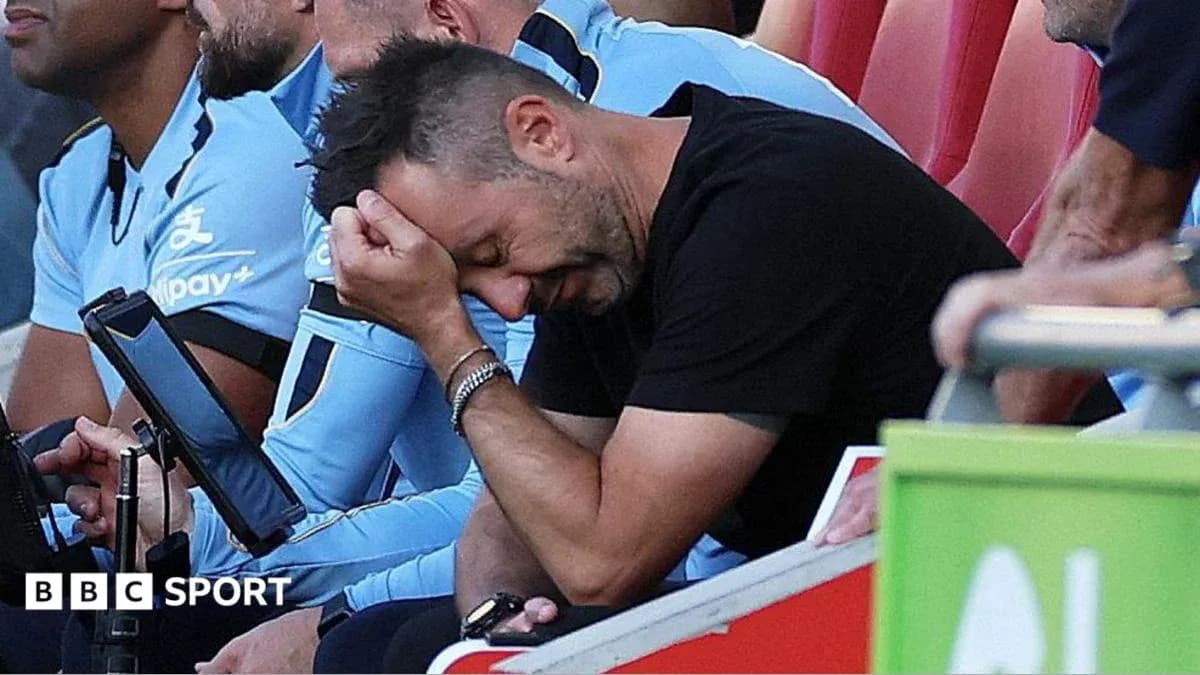
On the touchline, De Zerbi raged and gestured, trying to inject some life into a side that looked beaten long before the final whistle. Heads dropped. Challenges were lost. Panic crept in. There was no hint of a comeback.
Conor Gallagher and Lucas Bergvall did not reappear for the second half, withdrawn at the interval. They could hardly argue if others had joined them.
The ghosts that money cannot shift
This is not the first ambitious club to start a Premier League season with a nightmare. One bad day does not define a campaign.
But this did not feel like a one-off. It felt like a continuation.
Spurs have lived with this pattern – defeat, doubt, despair – for too long. It has outlasted managers, signings, slogans. Ange Postecoglou at least delivered a Europa League title before his departure. Thomas Frank and Igor Tudor came and went, Tudor’s reign so brief it barely registered.
Now it is De Zerbi’s turn to wrestle with the same demons.
“I am surprised for the result and performance,” he said. “I knew we were not in the right condition. We can't find an excuse. I am sorry for the result and performance. We are starting a new project and we couldn't find the principle.
“Marcos Senesi, Jan Paul van Hecke and Sandro Tonali are not in the best physical condition. We knew that before the game. We have to improve on that and many other things like organisation and pressing.”
There may be more signings. There usually are at Spurs when panic sets in. De Zerbi, though, refused to hide behind that.
“I don't want the excuse that the first XI was not enough to compete and get a result. Brentford's spirit on the pitch was great, it has to be the right example for us.”
He is right again. New faces are only ever part of the story.
This defeat laid bare something deeper: a culture that has learned to accept days like this as almost inevitable. A club where a bad start quickly feels like a familiar script.
De Zerbi has already spent heavily on changing the squad. Now comes the harder task.
He has to change the mindset of a team that has forgotten how to stand up when it is punched in the mouth. He has to rip out habits that have survived managers, signings and promises of a “new project”.
He does not just need better players.
He needs a different Spurs. And after a brutal opening day at Brentford, how long will he get to find it?