.svg&w=384&q=75 "GoalGist logo")
Rhode Island Dominates Westchester SC in USL League One Cup
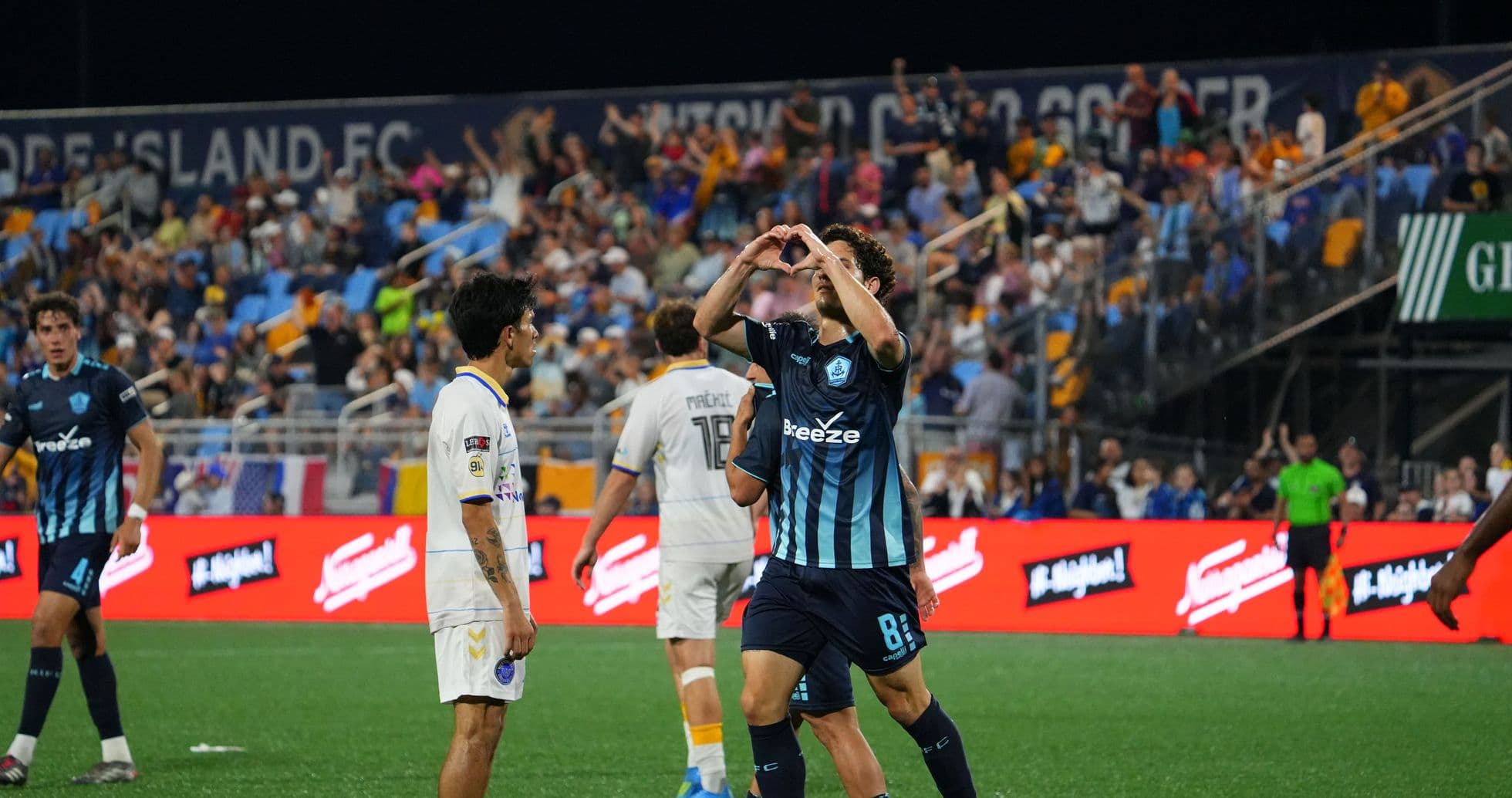
Under the lights at Centreville Bank Stadium, Rhode Island’s 3–0 win over Westchester SC felt less like a routine group-stage result and more like a declaration of intent in the USL League One Cup. Following this result, the group table underlines the contrast: Rhode Island sit 3rd in Group 5 on 5 points with a goal difference of 3, while Westchester trail in 6th on 2 points and a goal difference of -3. The scoreline matched the broader seasonal DNA of both sides: Rhode Island efficient, compact, and ruthless at home; Westchester expansive, chaotic, and far too open.
I. The Big Picture – Structure and Identities
Rhode Island came into this campaign with a clear statistical profile. Overall, they had played 3 matches, winning 2 and losing 1, with 5 goals for and only 2 against. At home, the numbers were emphatic: 1 match, 1 win, 3 goals scored and none conceded, averaging 3.0 goals for and 0.0 against. The 3–0 on the night simply reinforced that pattern: Centreville Bank Stadium is already forming into a fortress.
Westchester’s story was the mirror image. Heading into this game, they had played 3 matches overall, winning 1 and losing 2, with 5 goals for and 8 against. At home, they could live with a shootout (2.5 goals for and 2.5 against on average), but on their travels they were fragile: 1 away match, a 3–0 defeat, and an average of 0.0 goals scored and 3.0 conceded. This latest 3–0 away loss in Rhode Island felt like a continuation rather than an aberration.
II. Tactical Voids and Discipline
With no official absentees listed, both coaches had the luxury of naming strong squads. Khano Smith leaned into continuity and balance. The spine of Koke Vegas, F. Nodarse, H. Bacharach Capdevila, and A. Rodriguez gave Rhode Island a stable axis through the thirds. Around them, the athleticism of K. Yao, A. Sanchez, and the energy of N. Fuson and C. Holstad allowed the hosts to compress the pitch and dictate tempo.
On the other bench, George Gjokaj assembled a side that looked built to transition quickly: L. Marinelli between the posts, a defensive core of M. Jennings, T. Timchenko, C. Dickerson, and J. Jimenez, and a midfield/attack line loaded with runners and direct threats in S. Powder, A. Armas, B. Vasquez, M. Diaz, K. Evans, and E. Mackic. On paper, it was a team designed to break quickly and attack space, but their season-long numbers hinted at a structural vulnerability: 8 goals conceded overall at an average of 2.7 per game, and a complete absence of clean sheets.
Disciplinary trends added another layer. Rhode Island’s yellow cards this season were split evenly: 50.00% in the 46–60' window and 50.00% between 91–105'. That profile suggests a side that starts each half clean, then becomes more combative as intensity spikes after the interval and in late-game management. Westchester’s caution map was different: 50.00% of their yellows arrived between 31–45', and 50.00% between 76–90'. They tend to fray at the edges just before the break and again in the closing stages—precisely the moments when concentration must be highest.
III. Key Matchups – Hunter vs Shield, Engine Room
Without individual goal tallies, the “Hunter vs Shield” narrative is best framed collectively. Rhode Island’s home attack had averaged 3.0 goals heading into this match, and they hit that exact mark again. Their biggest home win so far in the competition was 3–0; they reproduced that scoreline here, underscoring how repeatable their attacking patterns are.
The “Shield” Westchester offered was statistically porous. On their travels they had conceded 3 goals in 1 match, and their overall defensive record of 8 goals conceded in 3 games painted the picture of a line that can be pulled apart by sustained pressure. The front unit of N. Fuson, C. Holstad, A. Rodriguez, and J. Williams exploited that. Fuson’s vertical running, Williams’ presence as a central reference, and Rodriguez’s craft between the lines ensured Rhode Island could pin Westchester back and keep the ball in advanced zones.
In the engine room, the duel was more nuanced. A. Shapiro-Thompson and H. Bacharach Capdevila knitted Rhode Island’s phases together, linking Koke Vegas’ build-up from the back to the more expressive players ahead. Their job was to bypass the pressing lanes of A. Armas and B. Vasquez, who form Westchester’s first midfield barrier. When Rhode Island did manage to play through that line, Westchester’s back four were repeatedly exposed, forced into last-ditch defending rather than controlled positioning.
The benches told their own tactical stories. For Rhode Island, the presence of J. Castro, D. Rovira, G. Stoneman, Leo Afonso, K. Vang, Z. Herivaux, and J. Peters gave Smith options to either lock down a lead or chase more goals. Stoneman and Rovira offered defensive reinforcement, while Afonso and Vang provided fresh attacking legs. For Westchester, Gjokaj could turn to M. Molina, D. Guezen, B. Pierre, D. Burko, D. Bouman, K. Blommestijn, and C. McGlynn. It’s a bench tilted toward adding attacking impetus—Guezen and Blommestijn especially—but with a back line already under siege, offensive substitutions risked further imbalance.
IV. Statistical Prognosis – xG Logic and Defensive Solidity
We do not have explicit xG numbers, but the patterns are clear enough to sketch an “expected goals” logic. Rhode Island’s season-long averages—1.7 goals for and 0.7 against overall, 3.0 for and 0.0 against at home—suggest a side that consistently creates high-quality chances while limiting opponents to low-probability efforts. Two clean sheets from three matches overall underline that defensive control.
Westchester, by contrast, live on the edge. Overall, they score 1.7 goals per match but concede 2.7. At home, their 2.5 goals for and 2.5 against suggest wild, open contests. Away, the picture is stark: 0.0 goals scored, 3.0 conceded, and no clean sheets anywhere. Even with a perfect penalty record this season—1 taken, 1 scored—they cannot mask the structural issues behind them.
Following this result, the numbers and the narrative converge. Rhode Island look like a side whose game model scales: disciplined, compact, and ruthless when chances arrive, especially at Centreville Bank Stadium. Westchester, meanwhile, remain an entertaining but vulnerable outfit, capable of scoring in bursts yet repeatedly undone by their own defensive looseness. In xG terms, Rhode Island’s solidity and chance creation profile would almost always tilt the balance their way in a fixture like this—and on the night, the 3–0 scoreline simply brought that underlying probability to life.