.svg&w=384&q=75 "GoalGist logo")
Real Madrid Players' Mixed Response to Ceuta Solidarity Campaign
At Martinez Valero on Tuesday night, the message was supposed to be clear. It wasn’t.
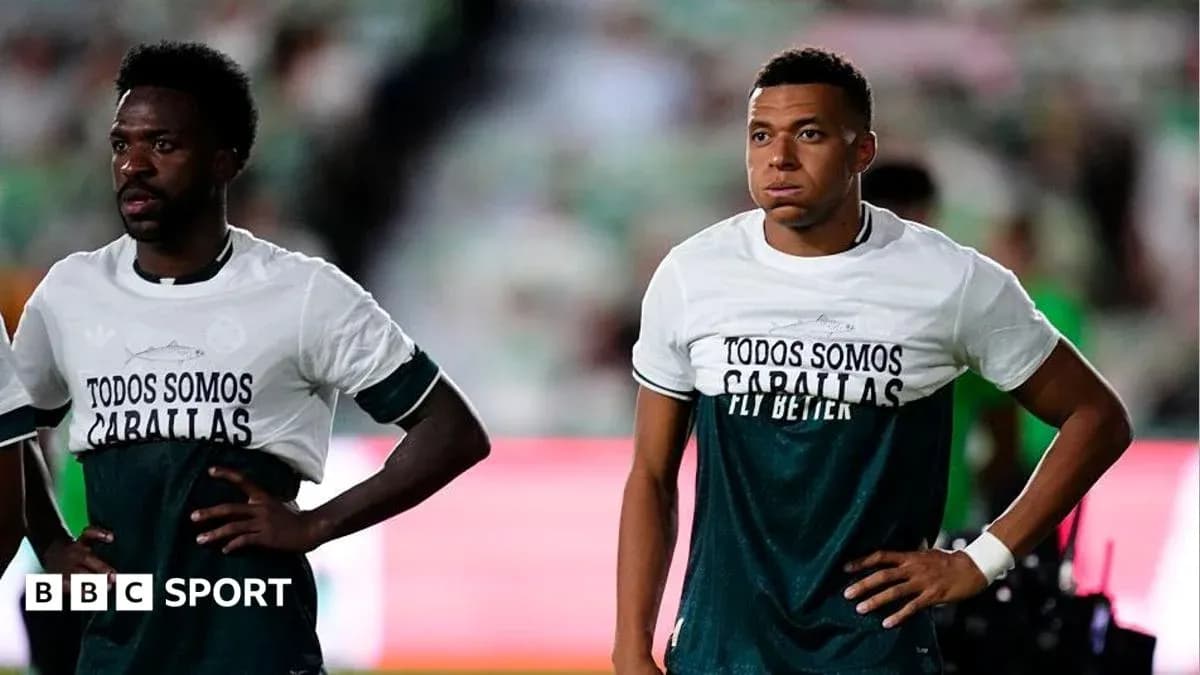
As Real Madrid and Elche players walked out, they did so in white T‑shirts bearing the slogan “Todos somos caballas” – “We are all Ceutans” – a coordinated gesture of solidarity with the Spanish autonomous city of Ceuta, gripped by a migration crisis on the North African coast.
Most players wore the shirts as intended. Three did not.
Kylian Mbappe, Vinicius Junior and Ibrahima Konate rolled their T‑shirts up to chest height, folding the fabric so that parts of the slogan and references to Ceuta disappeared from view. Mbappe and Vinicius then took theirs off entirely before the pre-match handshake, while Konate kept his rolled-up shirt on a little longer. Around them, their team-mates and the Elche players stayed in full campaign attire through the formalities.
The contrast was stark: one unified line of players, three visible exceptions.
A city under strain
Ceuta, perched on the North African coast opposite mainland Spain and separated by the Strait of Gibraltar, has been at the centre of a major migration emergency.
On 30 and 31 July, at least 72,000 migrants crossed from Morocco into the territory, many of them swimming around a border fence to reach Spanish soil. According to figures cited by Ceuta’s mayor, at least 100 people died attempting the crossing.
Most of those who made it across have since returned, but as many as 5,000 migrants are still in and around the city, living in makeshift camps or sleeping on streets and beaches. The strain has spilled over. Local residents have voiced safety fears, some have destroyed shelters, and there have been attempts to block aid deliveries.
Against that backdrop, Spanish football had been drafted in to amplify a message of unity and support. On this night, that message met resistance from within Real Madrid’s own ranks.
Madrid’s mixed message
This was not Madrid’s first show of support for Ceuta. Before their Champions League tie against Inter Milan at the Santiago Bernabeu on 8 September, fans in the south stand raised a mosaic of cards forming the city’s coat of arms. The rest of the stadium joined with a round of applause in a carefully staged tribute.
At Elche, the club again stepped into the political and humanitarian arena. The shirts were part of a wider La Liga campaign, with players at other fixtures wearing the “Todos somos caballas” tops fully and without alteration. Barcelona, notably, did not participate in the initiative at all.
The scene at Martinez Valero, then, did more than send a message of solidarity. It exposed fault lines over how – and whether – players align themselves with such causes on matchday.
Representatives of the players involved have been asked for comment.
Drama on the pitch
Once the whistle went, the focus swung sharply back to football. Madrid lived through a wild night.
They let a two-goal lead slip, invited Elche back into the contest and then snatched a 3-2 victory in stoppage time, Carlos Espi delivering the decisive blow at the death. Mbappe, who had earlier rolled up his T‑shirt, was among the scorers. Vinicius started the game and played his part in a contest that lurched from control to chaos and back again.
By full-time, Madrid had three points and another comeback story. The pre-match images, though, lingered.
In an era when clubs and leagues increasingly step into social and political debates, the sight of three star players literally rolling up – and then removing – a cause from their chests raises a sharper question: when the campaign walks out with the team, how many will truly wear it?