.svg&w=384&q=75 "GoalGist logo")
Rangers Facing Financial Crisis Amid Poor Performance
The warning landed like a punch.
“Be very careful – as much as we’re loyal, if this rot continues, the atmosphere in the crowd will lead to people not turning up and buying what you’re selling us.”
One shareholder, one microphone, about 800 Rangers investors listening. Then the applause rolled round the room. Not polite. Not nervous. Angry, knowing applause.
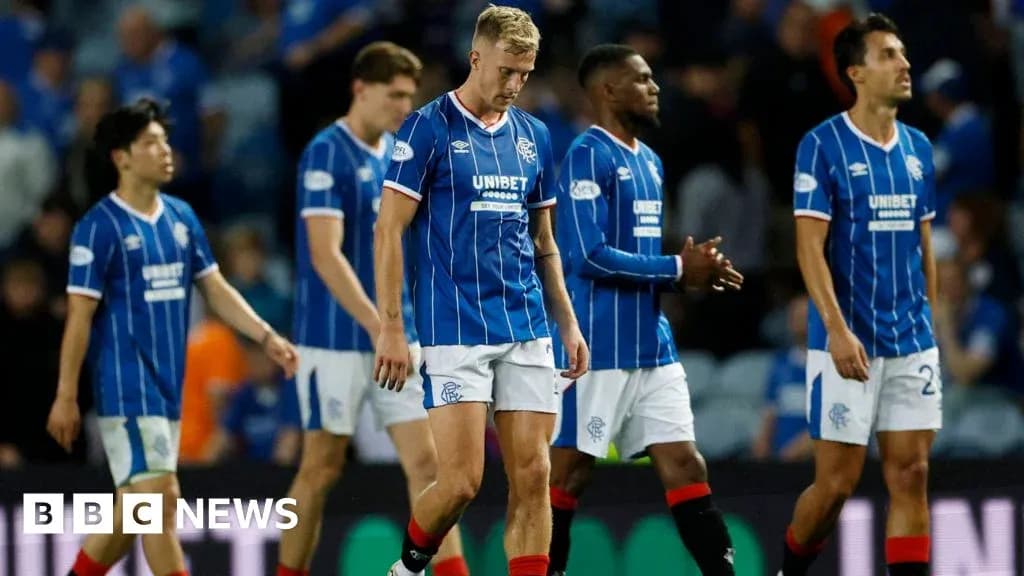
Four days later, those same fans watched Rangers stumble out of the Europa League with a 1-1 draw against Jagiellonia Bialystok at Ibrox. A must-win night turned into another bleak marker of a season that has barely started and already feels off course under Derek McInnes.
Four games. Two draws. Two defeats. No momentum. No convincing sign that the “rot” the shareholder spoke about is being cut out.
Fans, finances and a fragile pact
McInnes is still working out what his Rangers team is meant to be on the pitch. In the boardroom, the equation is more brutal. If supporters stop buying what the new US-led consortium is selling, the numbers stop adding up.
The model is simple enough on paper. Rangers need their fans to keep turning up and keep spending while the football side is repaired. But football is not a patient business, and Ibrox has already seen what happens when that pact breaks.
Confidence, at this club, has always been built on winning. Winning fills the stands, shifts the merchandise, lifts the balance sheet. And in modern Scottish football, where domestic TV money is modest, the real accelerators are clear: European football and player trading.
Over the past five years, Rangers have banked roughly £18m from European participation alone, excluding matchday income. In the last set of accounts, that was about 19% of total turnover. That cash does not arrive without cost – bonuses, travel, squad depth – but it has underpinned the club’s recent budgets.
This season, that tap has been turned down sharply.
The European shortfall
The Europa League exit hurts in more ways than one. To get close to that £18m figure again, Rangers would need to go all the way and win the Europa Conference League. That is the financial reality of dropping into UEFA’s third-tier competition.
“For every pound you make in the Europa Conference League, you can make £2 in the Europa League and £7 in the Champions League,” said Kieran Maguire of the Price of Football.
On top of that, the Conference League offers only three home group games, compared with four in the Europa League. That means fewer gate receipts, fewer hospitality packages, fewer matchday takings.
There is one upside: if Rangers can reach the Conference League group stage, the level of opposition should give them a better shot at progressing deeper into the tournament. But that is still an “if”.
First, they have to get past Jablonec over two legs just to secure league-stage football and the guaranteed income that comes with it. Even then, the club could be staring at a European revenue shortfall of around £8m compared with recent seasons.
For a mid-table English Premier League side, that kind of drop can be absorbed. For a Scottish club still trying to stabilise after years of turbulence, it bites hard.
The transfer market that never quite clicks
One way to close the gap is obvious: sell players well. It is also something Rangers have struggled to do consistently.
Reports suggest the club recently turned down a bid of around £22m for striker Youssef Chermiti. Not long after, Chermiti suffered a serious injury that could rule him out for the rest of the season. A fee of that size would have gone a long way to easing the financial pressure created by the Europa League exit. Instead, it now sits in the realm of regret and hindsight.
Behind Chermiti, Nico Raskin is widely seen as the next most valuable asset. The Belgian midfielder is currently valued at about £14.5m by Transfermarkt. Even if a club met that figure, Rangers would then be forced into the market again, trying to replace one of their key players while under scrutiny for previous recruitment.
And that is another sore point.
Over the past 12 months, more than 20 players have come through the door. The board raised £16m through a share issue, telling investors that money would strengthen the squad. Yet questions over the quality and coherence of that recruitment drive are growing louder with each poor result.
Investment promises and mounting costs
The current consortium, many of whose members remain unnamed in public, put in an initial £20m when they took control a year ago. On top of that, Rangers have laid out plans to refurbish Ibrox and upgrade their training ground. Both projects carry significant price tags.
The message from the club is that recent results have not altered their long-term financial outlook or their aim of winning regularly and doing it sustainably. The numbers, they say, still add up.
But the numbers are only one side of the story. To keep pushing, those investors may have to reach into their pockets again before the year is out. Whether they are willing, or able, to do that remains an open question.
And while they weigh it up, the warning from that shareholder meeting hangs in the air.
Yes, the owners have admitted to mistakes. They have apologised. Yet apologies only carry weight if the behaviour changes – on the pitch, in the market, and in the way the club communicates its plan.
The breaking point nobody can afford
Chris Jack of the Rangers Review put it bluntly when he spoke to BBC Scotland News.
“You cannot knock the loyalty and support the Rangers fans have given the club over many, many years, but every individual fan or fan base has a breaking point.
“They’re going to have a point where they say, ‘actually, I don’t fancy it this afternoon and it’s time for the club, the players and the manager to give me something.’”
For years, when things have gone wrong at Ibrox, the default response has been fury. Protests, banners, walkouts. Anger, at least, is engaged. It buys you time because it shows people still care enough to shout.
Now, in some corners of the support, that anger is starting to cool into something more dangerous: apathy.
In football, apathy is deadly. It means empty seats, muted atmospheres, shrinking commercial returns. It means the people who once queued round the block decide, quietly, to stay at home.
For a club still trying to rebuild its finances, still reliant on its fanbase to bridge the gap to richer leagues, that is a cost Rangers simply cannot afford to pay.