.svg&w=384&q=75 "GoalGist logo")
Premier League Trophy: A Symbol of Domestic Dominance
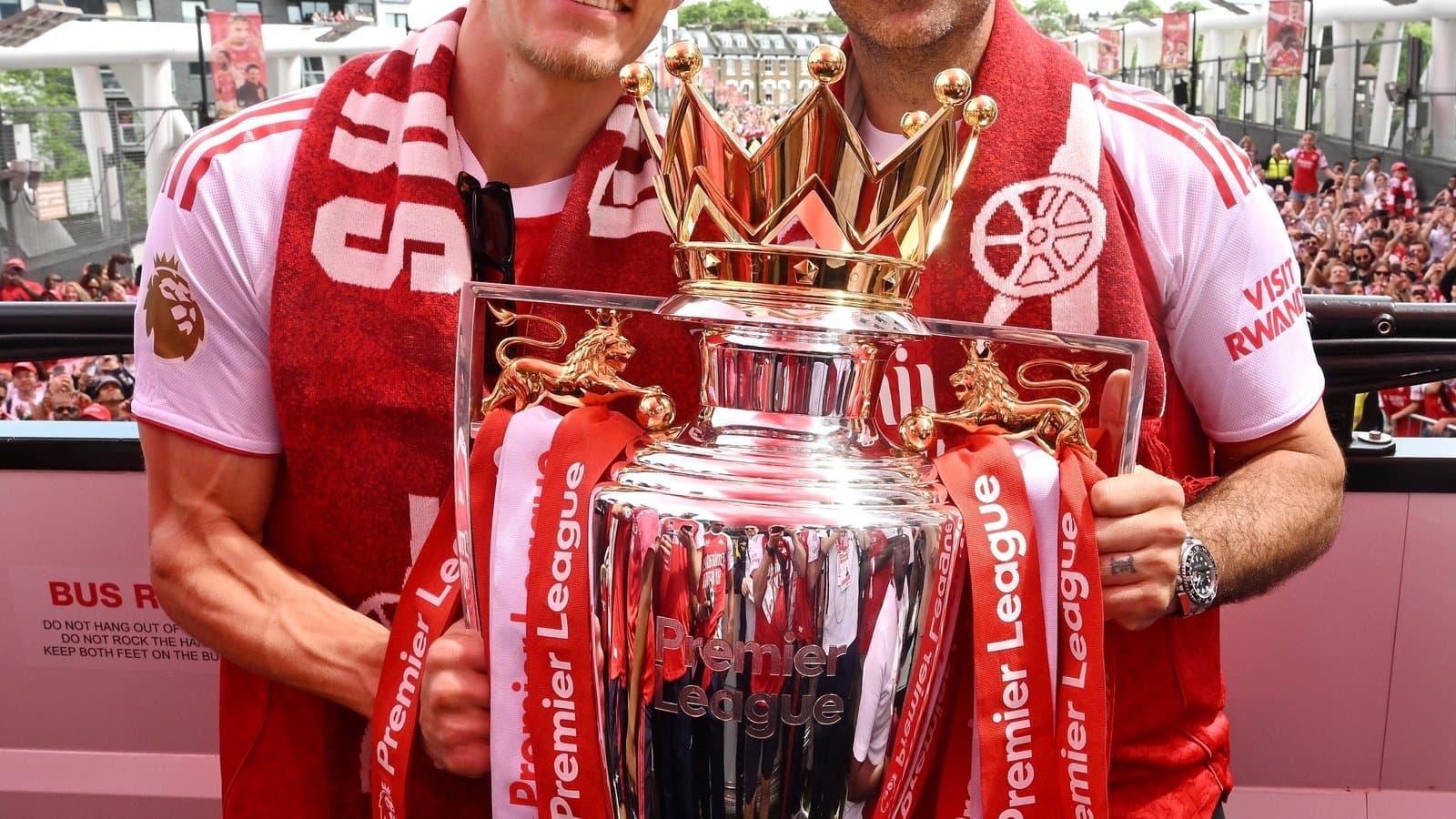
The Premier League trophy has finally come home, 22 years after this club last finished at the summit of English football. Under the lights at Selhurst Park last month, Martin Odegaard lifted it high into the south London sky, a captain framed in silver and gold. Days later, it rolled through the streets in a champions parade that will live long in the memory, the cup glinting above a sea of phones, flags and outstretched hands.
Now it sits in the cabinet. Solid. Heavy. Real. And it has a story of its own.
A heavyweight prize
Every player who stepped forward to claim their moment with the trophy felt the same thing first: the weight.
The Premier League trophy comes in at 9.5kg – around 1.4 stone – for the main piece alone. Add the engraved base, and the figure jumps to 25.4kg, or 4 stone. No wonder captains brace their core before that famous lift. This is not a prop or a replica for the cameras. It is a piece of engineering that demands respect every time it leaves its plinth.
Height of English football
Up close, the scale of it is striking.
From the bottom of the engraved base to the tip of the crown, the trophy stands 104cm tall – roughly 3ft 5in. Across, it measures 61cm, or about 2ft wide, a broad-shouldered symbol of domestic dominance.
And there isn’t just one. There are two identical Premier League trophies in existence. Both carry the roll call of champions around the base, both ready to be the centrepiece of a title celebration. One lives with the holders during the season; the other remains at the Premier League’s disposal.
Built like a crown jewel
Look down to the base and you see history carved into stone. Every champion from 1993 onwards is etched there, right up to the latest inscription: 2025/26.
That base is made from Malachite, a semi-precious stone sourced in Africa. Its deep green ring represents the pitch itself, a permanent reminder of the grass where titles are won and lost.
Above it rises the work of Asprey London, the Crown Jewellers. They cast the main body from solid sterling silver, while the crowns that sit on top are formed from 24-carat silver gilt. It is part trophy, part artwork, designed with a clear idea in mind.
The concept is “The Three Lions of English Football”. Two golden lions stand on either side of the cup. The third? That is the title-winning captain, arms locked around the handles, roaring into the sky as the trophy goes up.
Borrowed glory
For all its grandeur, the trophy is never truly owned. It is on loan from the league, a travelling symbol of supremacy.
One of the two trophies stays with the champions during the season, a constant presence at the training ground, the stadium, and on club duties. The other remains in Premier League hands, ready for official events and, eventually, the next coronation.
There is a deadline too. The holders must return their trophy to the Premier League at least three weeks before the final league match of the season. At that point, the engraving is updated, the logistics are set, and the stage is prepared.
Keep it long enough, and you build an era. Lose it, and it becomes the prize to chase all over again.