.svg&w=384&q=75 "GoalGist logo")
Premier League 2026/27: A Season of Change and New Challenges
The Premier League is back, and it has never looked stranger.
Guardiola is gone. Klopp is gone. Nine clubs have changed managers. Five of the traditional "Big Six" are effectively starting again. In the middle of all that turbulence sits something unfamiliar for modern Arsenal: stability, and a target on their back.
This is the season of new projects, comeback stories and tactical experiments. It might also be the season when the league’s old order finally cracks.
Arteta, the title, and a power vacuum
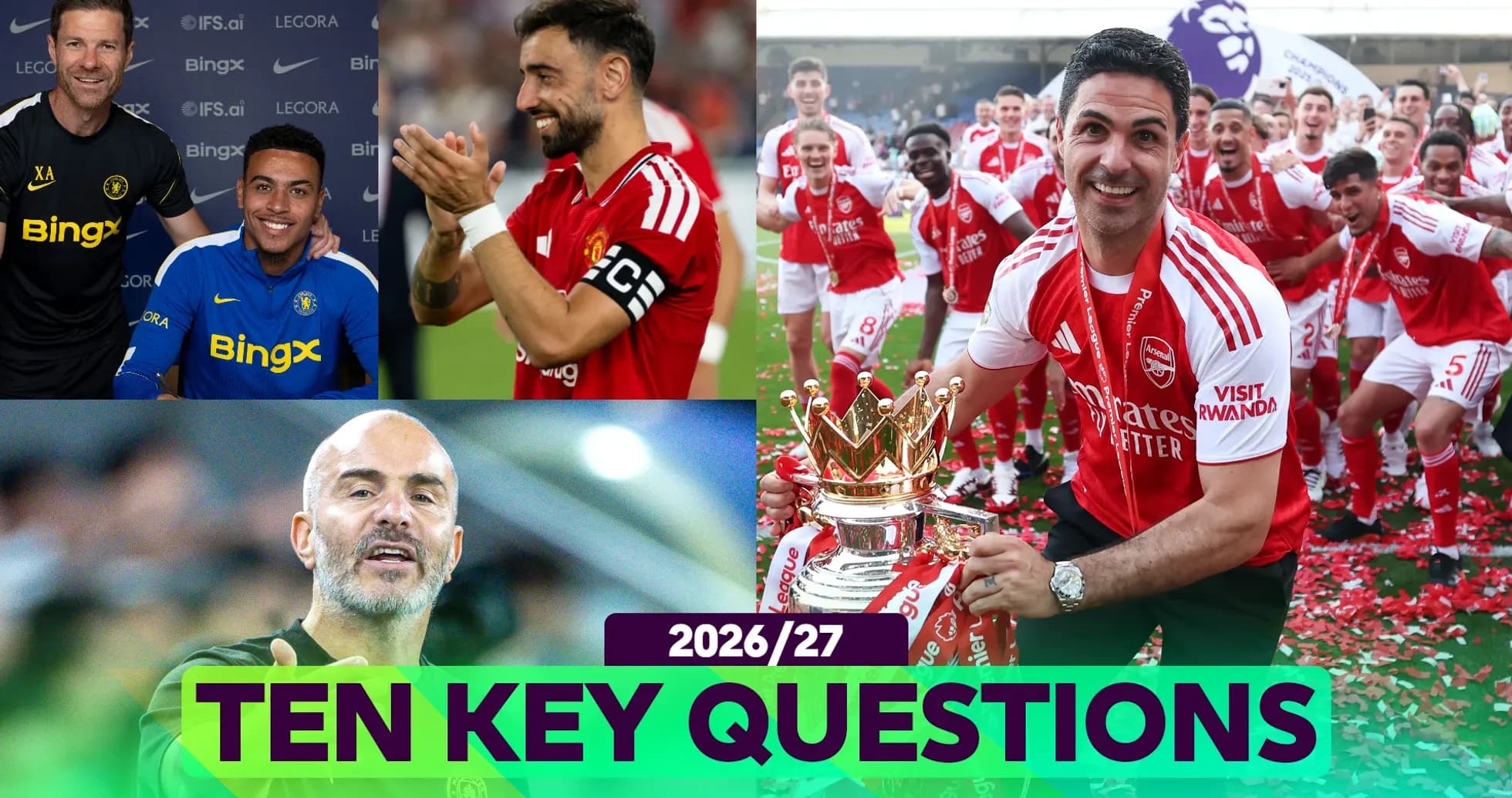
Only three managers have ever retained the Premier League title: Pep Guardiola, Sir Alex Ferguson and Jose Mourinho. That is the company Mikel Arteta now keeps in the record books – and the challenge that stands in front of him.
Keeping hold of the crown is usually harder than winning it. Squads get picked apart, rivals reset, the emotional high fades. Yet as 2026/27 kicks off, Arsenal find themselves in a rare position of calm.
The squad is settled. The system is embedded. The scars of near-misses have been replaced by the swagger of champions. Five years of work finally produced a title; the "monkey off the back" moment has already happened.
Around them, chaos.
Michael Carrick begins his first full campaign at Manchester United. Roberto De Zerbi does the same at Tottenham Hotspur. Liverpool, Chelsea and Manchester City have all dived into new eras with new men in the dugout.
That alone tilts the odds towards north London. Arsenal now have the only Premier League title-winning manager left in the division. Guardiola’s departure removes the shadow that has loomed over everyone for a decade. If there is to be a new domestic dynasty, this is Arteta’s chance to build it.
Life after Pep: Maresca at the crossroads
Manchester City stand on a knife-edge. This season could define what the post-Guardiola era looks like for years.
Enzo Maresca has inherited more than a job. He has inherited the legacy of a coach who rewrote the tactical language of the league and hoarded trophies at a historic rate. Step into that office and there are only two paths: smooth continuity or painful regression.
The recent past offers both templates. Arne Slot slotted into Liverpool and kept the Klopp machine humming. Unai Emery and David Moyes, in contrast, walked into the fading afterglow of the Wenger and Ferguson eras and struggled under the weight of what came before.
City’s hierarchy have tried to avoid that mistake. Rather than ripping up the blueprint, they have doubled down on it. Maresca is a Guardiola disciple, steeped in possession football, positional play and control. His ideas are as close to his mentor’s as any coach on the market.
But the dressing room has changed. Bernardo Silva and John Stones, two pillars of the Guardiola years, have gone. The question is not just whether Maresca can mimic Pep’s football. It is whether he can command a squad that has already climbed the mountain eight times. City will either glide into a seamless new era, or discover how brutal life after a dynasty can be.
Alonso at Chelsea: the next great Premier League coach?
Among the record-breaking influx of new managers, one name crackles with intrigue more than any other: Xabi Alonso.
He arrives at Chelsea carrying the glow of that invincible 2023/24 season with Bayer Leverkusen, a campaign that turned him into one of the most coveted coaches in world football. The timing feels symbolic. With Klopp and Guardiola gone, the Premier League is looking for its next defining figure. Alonso has the aura – and the tactical pedigree – to be that man.
He also has a major advantage: no European football. Chelsea’s midweeks will be empty, just as they were when Antonio Conte stormed to the title in 2016/17. Only six managers have ever won the Premier League in their debut season; three of them did it at Chelsea. That statistic will not be lost on anyone at Stamford Bridge.
The squad, often mocked for its age profile in recent years, has quietly shifted. Danny Welbeck and Jordan Henderson have become the first over-30 signings of the BlueCo era, a clear signal that the club has tired of fielding a team of prospects. It hints at a new seriousness, a new spine.
Give Alonso that time on the training ground, a more experienced core, and the freedom of a clear calendar, and Chelsea suddenly look like one of the most volatile forces in the league – capable of exploding upwards very quickly.
The return of chaos football?
Last season left some supporters cold. Corners, free-kicks, long throws – set-pieces felt like they were dictating the narrative. The goals-per-game number barely dipped, from 2.40 to 2.36, but the underlying story told a different tale. Open-play Expected Goals fell sharply, from 2.28 xG per match in 2023/24 to just 1.82 in 2025/26.
The league had become more controlled, more choreographed. Now, the new wave of coaches threatens to rip that up.
De Zerbi at Spurs wants pressing, risk and relentless attacking patterns. He never had the time to fully impose that vision at the end of last season. He does now.
At Liverpool, Andoni Iraola brings the same high-octane, "heavy-metal" style that turned Bournemouth into one of the league’s most watchable sides. The club’s support longed for a continuation of Klopp’s intensity; Iraola offers that in his own image.
Alonso’s Leverkusen and Real Madrid teams scored heavily. Marco Rose arrives at Bournemouth from the RB Leipzig/Borussia Dortmund school of front-foot German football. Pierre Sage at Crystal Palace is another evangelist for fast breaks and hard pressing.
Stack those ideas together and you get a clear pattern. The league looks ready to tilt back towards the wild, end-to-end feel of 2023/24. Defenders, brace yourselves.
Can Carrick really drag United back into the title fight?
Manchester United have flirted with false dawns for a decade. Carrick’s brief caretaker spell felt different – not because of noise, but because of numbers.
Appointed on 14 January, he beat Manchester City 2-0 three days later and never really looked back. Across 17 league games, almost half a season, United sat top of the form table:
- Man Utd: 17 played, 12 wins, 3 draws, 2 defeats, 39 points.
- Arsenal: 36 points.
- Man City: 35.
- Bournemouth: unbeaten, but with 7 wins and 10 draws.
- Liverpool: 25 points.
Stretch that sample over a full campaign and United would be champions for the first time since 2013. Football never obeys that kind of straight-line logic, but the evidence is hard to ignore.
Carrick does not need to reinvent anything. He needs to maintain it. If he can, the title race gains a new, old heavyweight.
The season of the comeback star?
With so many new managers, the reset button has been hit across dressing rooms up and down the country. That is bad news for some, but a lifeline for others.
Phil Foden and Cole Palmer, both coming off disappointing seasons and omitted from England’s World Cup squad, now stare at a clean slate. Marcus Rashford and Mason Mount must fight for relevance again at Manchester United.
Harvey Elliott, Omar Marmoush and Andy Robertson, all of whom endured limited minutes last season, can reasonably expect a bigger role. Yoane Wissa will hope a fresh voice on the training ground unlocks his best form.
Then there are the injured. Levi Colwill and Alexander Isak, both in danger of being filed under "forgotten", are fit again and walking into a league where nothing is fixed, no hierarchy is safe. If this is a season of new beginnings, it is also a season built for redemption arcs.
Villa, Newcastle and the cost of change
Twelve months ago, Aston Villa and Newcastle United were the continuity projects. Stable, upwardly mobile, well-coached, they were widely tipped as Champions League contenders.
That continuity has vanished.
At Newcastle, the upheaval is brutal. Eddie Howe has resigned. Matthias Jaissle, the new man in charge, must rebuild without three of the club’s biggest stars: Bruno Guimaraes, Anthony Gordon and Sandro Tonali. In their place come Lukas Hornicek, Bazoumana Toure, Aladji Bamba, Sean Steur and Ewen Jaouen – all expensive, all intriguing, none proven in this environment.
Villa’s transformation is softer but still significant. Unai Emery remains, but the squad around him has shifted. Youri Tielemans, Morgan Rogers and Lucas Digne have gone. Alejandro Garnacho, Johan Manzambi and Joao Gomes have arrived, bringing a sense of a new cycle beginning.
Both clubs now walk a tightrope. The ceiling remains high. The margin for error has shrunk.
Europe: launchpad or landmine?
Nine Premier League clubs tasted European football last season. For some, it was the making of them. For others, it dragged them under.
Aston Villa won the UEFA Europa League and still finished fourth. Crystal Palace tumbled to 15th in the table but lifted the UEFA Conference League, a trade-off their fans will happily accept. Nottingham Forest, Spurs and Newcastle, though, all dropped into the bottom half and looked stretched thin.
This year, Brighton & Hove Albion step into the Conference League for the first time, only their second European campaign ever. They will look at Palace’s run and see a roadmap, while Palace themselves now feel better equipped for a Europa League schedule in 2026/27.
Bournemouth and Sunderland, both in the Europa League, have more reason to worry. Squad depth will be tested, and Thursday nights have a habit of exposing shallow benches.
On the flip side, some clubs see opportunity in free midweeks. Leeds United, strengthened again, can smell a top-nine finish precisely because so many rivals will be juggling Europe. Brentford, who narrowly missed out last season, have the same advantage and the benefit of time to absorb Keith Andrews’ detailed work on the training ground.
The middle class of the Premier League has never been so ambitious – or so dangerous.
Mid-table no more?
Leeds and Brentford are not alone in aiming higher.
Fulham have turned to Alvaro Arbeloa, a former Real Madrid defender who has brought two Real players with him. That alone has injected optimism into a club that finished just a point outside the European spots last season. The expectation is not revolution, but refinement of Marco Silva’s base.
Nottingham Forest now have Oliver Glasner, the coach who delivered both the Conference League and FA Cup to Crystal Palace. Even after selling Elliot Anderson to Manchester City, Forest will feel they can emulate their seventh-place finish from two years ago.
Everton, at last, look settled. The move to their new home is behind them, and David Moyes offers the kind of continuity few clubs can match this season. Hayden Hackney, Christian Norgaard and Brennan Johnson all raise the level of the starting XI.
Put it all together and the league looks brutally strong. There are fewer obvious weak links than at any point in the Premier League era.
Are the new boys ready?
Coventry City, Ipswich Town and Hull City have not tiptoed into the division. They have spent, they have recruited aggressively, and they have largely looked abroad rather than raiding the usual pool of Premier League cast-offs.
Sunderland’s spending spree last summer set the template. It propelled them not just to safety but into Europe, and alongside Leeds they snapped a two-year run in which every promoted side went straight back down. Coventry, Ipswich and Hull have clearly taken note.
Coventry, runaway winners of the Championship, lean on the experience of Frank Lampard in the dugout. Ipswich, back in familiar territory, have hired Gary O’Neil, a coach with a proven track record of keeping Bournemouth and Wolverhampton Wanderers in the division.
Hull face the steepest climb. Opta’s "Expected Points" table had them 23rd out of 24 Championship sides last season on xG for and against. That underlying profile screams danger. Yet this is their first Premier League campaign since 2017, and optimism has its own momentum.
All three have opted primarily for established internationals from mainland Europe, with Ipswich adding Issa Diop and Sasa Lukic, and Hull bringing in Matt Targett and Jack Butland for some top-flight know-how. Predicting their fate is a fool’s game. Sunderland and Leeds were written off in 2025/26 and survived with style.
The Premier League has never entered a season with so many moving parts: nine new managers, a departing super-coach, a champion finally at peace with itself, and a middle tier that no longer accepts the label.
Someone will seize that chaos. Someone will be crushed by it.
The only certainty is that this version of the league – faster, deeper, more tactically restless – will be less forgiving than anything that came before.