.svg&w=384&q=75 "GoalGist logo")
Liverpool's Transition Under Iraola: A Solid Start to the Season
Twelve months ago, Liverpool flew out of the blocks, five wins from five in the Premier League and already looking like a side ready to defend their crown under Arne Slot. That surge began against Bournemouth, then coached by Andoni Iraola, under the lights on opening night.
No one in the stadium that evening would have seriously mapped out what came next: Slot gone, Iraola in, and the Basque coach now steering Liverpool back to the south coast as their unbeaten, but still scrutinised, new head coach.
Football does not wait for anyone.
From Bournemouth’s touchline to Liverpool’s hot seat
Liverpool are six points worse off than at this stage last season. The table says standards have dipped. The mood around the club says something different.
Iraola’s team have not lost. They have, though, traded some of last year’s chaos for something more controlled, more methodical. On Sunday, the 44-year-old walks back into Bournemouth, the club he led for three years, and into a very different dressing room.
Literally.
The away changing room at the Vitality Stadium has been revamped to meet Europa League regulations. It is still tight, still modest, but no longer the cramped, unforgiving space visiting teams used to endure. A small upgrade for a coach who has made a much bigger one in his career.
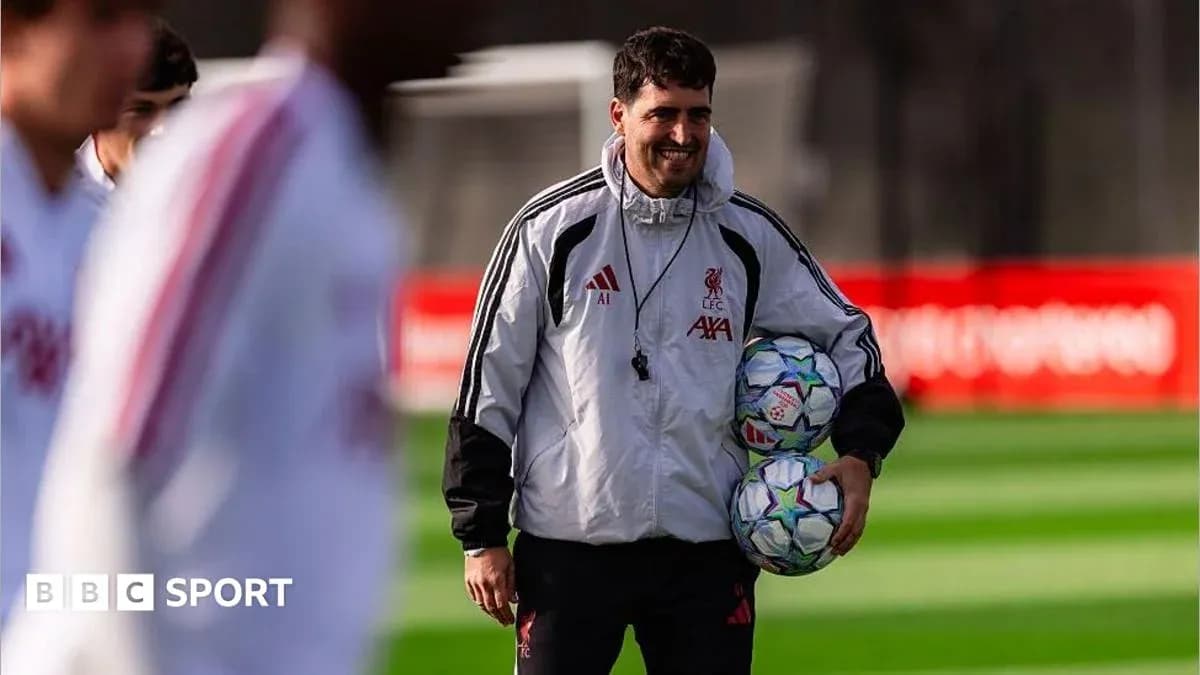
Iraola has swapped the south-coast seaside for Formby’s sand dunes, following the well-trodden path of Jurgen Klopp and Brendan Rodgers. He’s been spotted in Liverpool’s city centre, and as a keen cyclist, has taken to the coastal routes. But the place he truly lives is the training pitch.
Those at Liverpool describe him as a “six days a week” coach. He is often the first man out on the grass at the AXA Training Centre, setting out cones himself, shaping sessions with a hands-on intensity that has quickly become his trademark.
“It’s really intense. There’s a lot of hard work and no sort of light days. Everyone’s putting in 100%,” said forward Lewis Koumas. That is the daily standard now.
A quieter presence, the same relentless drive
Inside Kirkby, Iraola cuts a different figure to some of his predecessors. He rarely uses his own office. Instead, he prefers the coaches’ room, surrounded by his staff – Tommy Elphick, Shaun Cooper and long-time ally Pablo de la Torre.
He moves through the building in low-key fashion, but his ideas travel loudly.
De la Torre, who followed him from Rayo Vallecano to Bournemouth and now to Liverpool, is central to one of Iraola’s non-negotiables: physical standards. The demands are high, the running brutal, the expectation clear. Liverpool’s players must be able to sustain the intensity he craves.
The changes, though, are not as sweeping as some might imagine. The head coach role at Liverpool is heavily structured. Iraola’s appointment came off the back of his impressive work at Bournemouth, yet he is now wrestling with something new: the sheer weight of Liverpool’s schedule.
At least 49 games this season. Possibly into the 60s if cup runs stretch deep. That reality has forced him to open the door to the medical and fitness departments even wider, listening, adapting, and trying to keep a young squad fresh while still playing at full throttle.
Training times now bend around kick-off times. Late afternoon and early evening sessions are increasingly common, tailored to the next fixture. Under Slot, the rhythm was steadier, with training largely at the same time each day. Iraola is more flexible, more reactive.
He has also made sure the academy is locked into his blueprint. Rob Page, who leads Liverpool’s Under-21s, has been in regular dialogue.
“We have an understanding of how the first team play and key principles, like how we press, how he [Iraola] wants his number 10 to press, how he wants his number eight to press, how he wants his centre-backs to press – we mirror that absolutely,” Page explained.
The pathway is clear. The demands are, too.
Systems, standards and a young core
Earlier this week, Dominik Szoboszlai laid out the structure simply: Liverpool play with a number six, a number eight and a number 10. Supporters spent the summer calling for a specialist defensive midfielder, but Iraola believes his system can function if the collective improves and the roles are carried out with precision.
His approach to matchdays is equally defined. The starting XI is usually named on the morning of the game. The post-match debrief waits until the following day, once emotions have cooled and the footage has been dissected.
He has already had a lesson in Liverpool’s media glare. After a pre-season friendly against Monaco, his comments on LFC TV – that Liverpool had “run out of steam” after 30 minutes and did not yet have the energy levels for his intensity – were widely clipped and shared. It was meant as an honest assessment of fitness, not a criticism of his players.
The reaction underlined the reality: at Liverpool, every word can travel, and not always with its original meaning intact. Still, Iraola has come across calm and open in his press conferences, willing to explain, but careful not to overplay his hand.
This is not just a club adapting to a new coach. It is a coach adapting to the size and scrutiny of Liverpool.
One of the main reasons the club went for him was his record with young talent. The numbers back that up. The average age of Liverpool’s Premier League side this season is 25.3 – only five teams in the division are younger.
The next wave is already pushing through. Rio Ngumoha, 18, Trey Nyoni, 19, and Koumas, 20, all started against Tottenham in the Carabao Cup. None of them were bit-part stories. All three are expected to have bigger roles this season than last.
Intensity meets reality
“Intensity” has become the buzzword under Iraola. It is not a slogan. It is a demand. Liverpool have recorded the most sprints in the Premier League so far, a hard metric for a hard-running side.
Yet the schedule bites. Less than 72 hours after beating Atletico Madrid in the Champions League, they looked flat in a goalless draw with Fulham. Legs were heavy, the press blunter, the attacking patterns slower.
Sunday’s trip to Bournemouth will be their fourth game in 12 days. After the international break, they hit another brutal spell: four matches in 10 days. Between 11 October and 7 November, they will play nine times.
Iraola knows the numbers as well as anyone. He also knows something has to give. His ideal is a side that overwhelms opponents with running and aggression. Reality says Liverpool will sometimes need to lean on a set-piece routine or a flash of individual brilliance to get over the line.
That balance – between ideology and pragmatism – will define his first season.
Back to where it all turned
Bournemouth’s own story this week will not have been lost on him. Their Europa League debut ended in a win over Real Sociedad, in the Basque region where Iraola grew up. It was the kind of night he once dreamed of as a player and then as a young coach.
He will have seen the result, maybe smiled quietly, then turned back to the task in front of him. On the flight down from Liverpool on Saturday, there might be a moment to reflect on how far he has come in such a short time – from underdog coach on the south coast to the man in charge at Anfield.
Liverpool’s start under Iraola has not been spectacular. It has, however, been solid. They are yet to lose in the league, a significant shift after 12 defeats last term. They are harder to beat. That is progress.
But not enough. Not here.
As vice-captain Alisson said last week, draws are not good enough for Liverpool. Not for what this club expects, not for what this squad believes it can be.
Iraola, unbeaten in the Premier League since January across Bournemouth and Liverpool, walks back into familiar territory on Sunday knowing exactly what a win would mean. Not just three points, not just a neat narrative twist.
It would send Liverpool into the international break with something more powerful than any statistic: the feeling that this new era is finally starting to move at their pace.