.svg&w=384&q=75 "GoalGist logo")
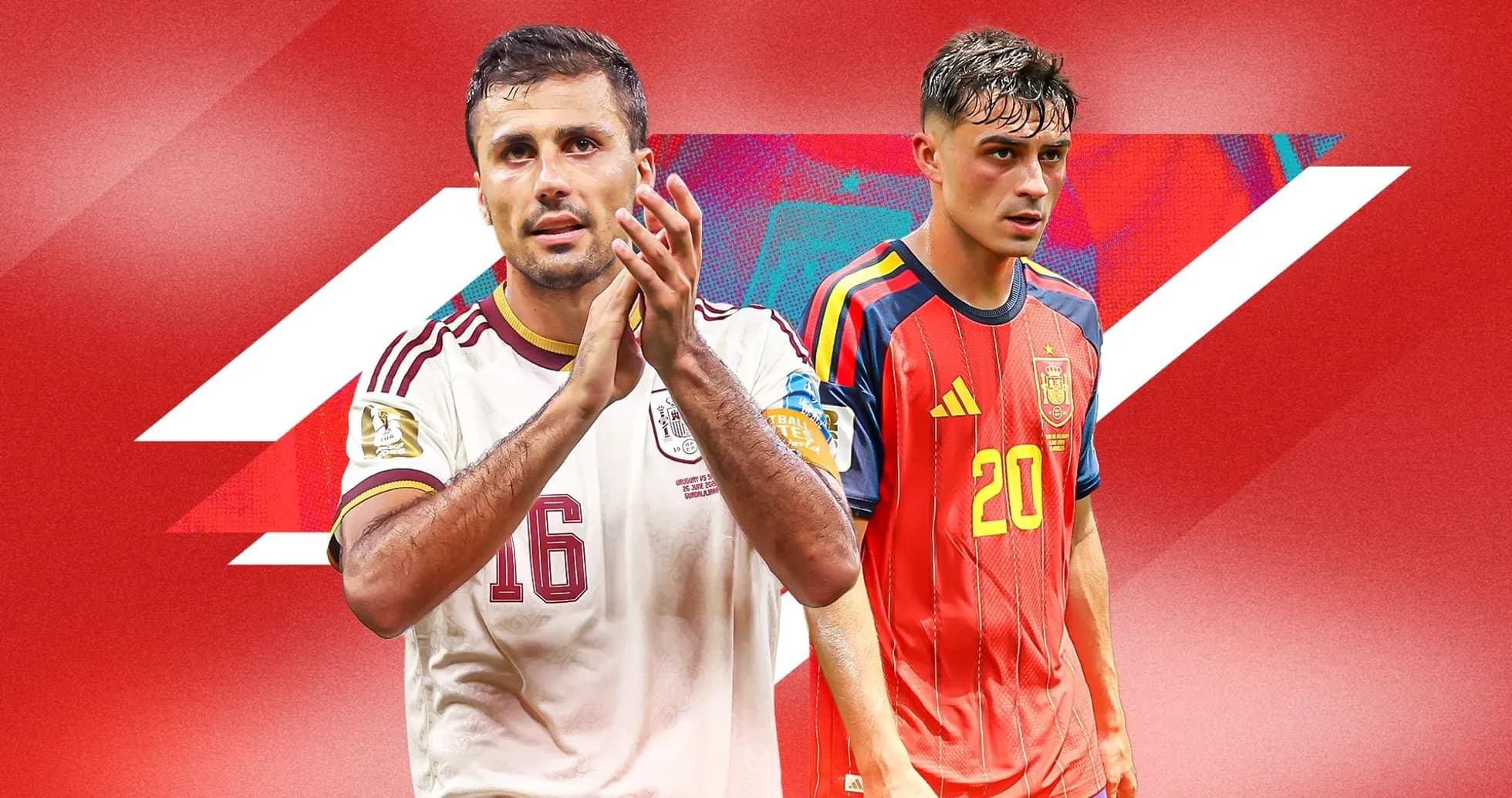
Pedri's Role in Spain's Midfield: From Star to Tactical Option
Rodri has spent this World Cup reminding everyone why he owns a Ballon d'Or. Pedri, meanwhile, has spent it under the microscope.
Two summers ago in Germany, the idea of that pairing at the heart of Spain’s midfield felt like a cheat code. Win the Euros, then roll into a World Cup with the same axis and a deeper, more mature squad? It sounded like the foundation of a new golden era.
Rodri has held up his end. Pedri has become a national argument.
From golden boy to lightning rod
It started innocently enough. Against Cape Verde in Spain’s drab, goalless opener, Pedri created five chances – more than anyone else on the pitch. On paper, that’s a solid night’s work. For most players, it would be a headline.
For Pedri, it was ammunition.
The criticism rolled in. Not sharp enough. Not decisive enough. Not the player who once seemed to glide through major tournaments like he was playing a different sport. Cape Verde’s strong follow-up results softened the view on Spain’s 0-0, but they didn’t quiet the questions around Pedri’s lack of tangible output.
No goals. No assists. And as the tournament has gone on, the contrast with Jude Bellingham has been thrown in his face.
The comparison is crude, and everyone knows it. Bellingham and Pedri play different roles, in different systems, at different heights of the pitch. Yet every time Bellingham drags England forward with another match-defining moment, a corner of Spain – and a large chunk of Real Madrid’s fanbase – points at Barcelona’s playmaker and asks: where’s your contribution?
The modern game cares about the bottom line. Bellingham is scoring and creating. Pedri is not. The debate writes itself.
The shock of the bench
So when Luis de la Fuente finally dropped Pedri, it still jolted the conversation. This was a player who had started five straight games at this World Cup, nine in a row stretching back to Qatar. A pillar, suddenly on the outside looking in.
The coach’s explanation was logical enough. This Spain squad is overflowing with midfield talent. Someone important has to sit.
If anything, De la Fuente argued, Mikel Merino had more reason to be frustrated. The Arsenal midfielder had come off the bench to score a dramatic late winner against Portugal, then found himself among the substitutes again. He didn’t sulk. He simply came on and did it again in the 2-1 win over Belgium.
“It’s unfair that Mikel doesn’t play from the start, but it would also be unfair if someone else were left out,” De la Fuente said. Only 11 can start. The rest have to accept their roles and be ready when the door opens. So far, they have.
Pedri, by all accounts, has fallen in line. No tantrums, no sulking.
“He’s taken it well,” goalkeeper Unai Simon said after the Belgium match. “We all want to play but, in the end, there isn’t room for everyone. How must David (Raya) and Joan (Garcia) feel knowing they’re world-class goalkeepers? Everyone wants to play, but everyone wants to win the World Cup. So, when it’s your turn to accept that role, you do it.”
Spain’s dressing room has built its identity on that kind of selflessness. It might be their biggest weapon.
Two Pedris, one decision
Yet the question won’t go away: what exactly is Pedri’s role now?
His cameo against Belgium did little to strengthen his case. Spain had a late break, the kind of situation he usually scripts to perfection. Instead, he misjudged the key pass and the chance fizzled. An uncharacteristic mistake at a delicate moment.
Fabian Ruiz, on the other hand, has muscled his way into the conversation with authority. He scored Spain’s opener in Los Angeles and, as Simon reminded everyone, arrives in camp as a midfielder who has just “won two Champions Leagues in a row” with Paris Saint-Germain. His blend of control, power and timing fits the way De la Fuente wants this Spain side to play.
So the coach has drawn a distinction that cuts to the heart of the issue: there is a Pedri for Barcelona, and a Pedri for Spain.
“Pedri is a class player, one of the best in the world, if not the best,” De la Fuente said. “But Fabian is also one of the best players in the world if not the best.
“But Pedri can’t play like he does for Barca, because we play differently. We have similarities, but it’s not the same. We don’t have the same players either.
“We have Rodri, so of course his partner in midfield is different. For me, Pedri could play as a 6, 8, or 10, but we have to make decisions that are always very elaborate, very analysed, very tailored to the opponent.”
In other words: the Barcelona version of Pedri doesn’t simply plug and play.
Load the midfield, or trust the No.10?
France now loom, with a front line capable of ripping apart any side that lets the game become stretched. If Spain have one obvious area of superiority, it’s in midfield. That raises the temptation: why not unleash Rodri, Fabian and Pedri together, as De la Fuente did against Cape Verde, and try to suffocate France with the ball?
Three gifted technicians, endless passing angles, a match played at Spain’s tempo, not Kylian Mbappé’s.
The trade-off is brutal. To fit both Pedri and Fabian in, Dani Olmo probably drops out. The RB Leipzig man has quietly stitched together an impressive run in the No.10 role since the knockout rounds began. His final ball still frustrates at times, but his movement and intelligence between the lines have been vital in linking midfield to attack.
De la Fuente has been clear about one thing: he sees Pedri as a “special talent” who does his best work “closer to the opposition box”, where his feints, flicks and quick combinations can cut teams open. Even when he’s not in top form, the coach insists, Pedri “always sets a very good tone”.
Yet his recent comments hint at a different plan for France. He spoke about Pedri as the man who could “benefit from Fabian’s work” later in games, when opponents tire and spaces appear. That sounds like a coach leaning towards using Pedri as a high-impact substitute rather than a guaranteed starter.
Teamwork, he called it. Not just in the way they play, but in the way they accept their place in the rotation.
A luxury problem with a sharp edge
Spain’s depth in midfield would be the envy of almost every nation at this World Cup. Rodri dictating, Fabian surging, Merino arriving late, Olmo knitting things together, Pedri hovering between conductor and creator. It’s a puzzle with no wrong answers, only different shapes.
Yet there is something jarring about seeing Pedri, once the symbol of Spain’s new generation, reduced to a tactical option rather than an automatic name on the teamsheet. The logic is sound. The emotion is not so easily tamed.
De la Fuente, though, cannot afford to be sentimental. “France have already shown some extraordinary, exceptional potential, but we have too,” he said. “So I think the game is very open. It will require fresh, energetic players, and it will require us to be the best version of ourselves.”
That best version may involve Pedri from the first whistle. It may involve him walking into the storm on the hour, with tired French legs in front of him and space finally appearing between the lines.
What it cannot be, for Spain’s sake and his own, is another night where the Barcelona Pedri stays hidden from view.

