.svg&w=384&q=75 "GoalGist logo")
Netherlands and Japan Battle to 2-2 Draw in World Cup Opener
Netherlands and Japan shared a 2-2 draw at AT&T Stadium in a World Cup Group Stage opener that evolved into a tactical arm-wrestle rather than a chaotic shootout. Netherlands, in a 4-3-3 under Ronald Koeman, imposed themselves with 60% possession, sharper passing and more shots on goal, but Japan’s 3-4-2-1 under Hajime Moriyasu proved resilient, opportunistic and structurally disciplined. The xG figures – 0.79 for Netherlands and 0.54 for Japan – underline how few true premium chances either side created despite the four goals. The match ultimately hinged on how each team manipulated its shape after taking or conceding the lead, and how substitutions reshaped the final phase.
The opening hour belonged structurally to Netherlands. Their 4-3-3 was textbook positional play: Virgil van Dijk and Jan Paul van Hecke split as the first line, with Micky van de Ven holding the left lane and Denzel Dumfries very high on the right. Frenkie de Jong operated as the central organiser, with Ryan Gravenberch and Tijjani Reijnders stepping into the half-spaces to connect with the front three of Cody Gakpo, Donyell Malen and Crysencio Summerville.
The passing numbers capture this control: 525 total passes with 464 accurate (88%) compared to Japan’s 342 passes, 287 accurate (84%). Netherlands circulated the ball methodically, using the full width to drag Japan’s back three and double pivot from side to side. All 10 Dutch shots came from inside the box, a clear sign of their insistence on working the ball into advanced zones rather than relying on long-range efforts. However, the relatively modest xG of 0.79 suggests those touches in the area were often under pressure or from suboptimal angles.
Japan’s 3-4-2-1 was designed less to dominate the ball and more to compress central spaces. Shogo Taniguchi anchored the back three with Hiroki Itō and Tsuyoshi Watanabe stepping out aggressively when Dutch forwards dropped between the lines. In front of them, Kaishu Sano and Daichi Kamada screened passes into De Jong and Gravenberch, while the wing-backs – Keito Nakamura on the left and Ritsu Doan on the right – had to manage the dual task of tracking Dutch full-backs and jumping to press wide centre-backs.
With only 40% possession, Japan accepted long defensive phases but remained structurally compact. Their 10 total shots were more evenly split (6 inside the box, 4 outside), reflecting a game plan built around quick breaks and transitional surges from Takefusa Kubo and Daizen Maeda rather than sustained territory. The 0.54 xG aligns with this: few extended attacks, but enough dangerous moments when they could attack a disorganised Dutch rest defence.
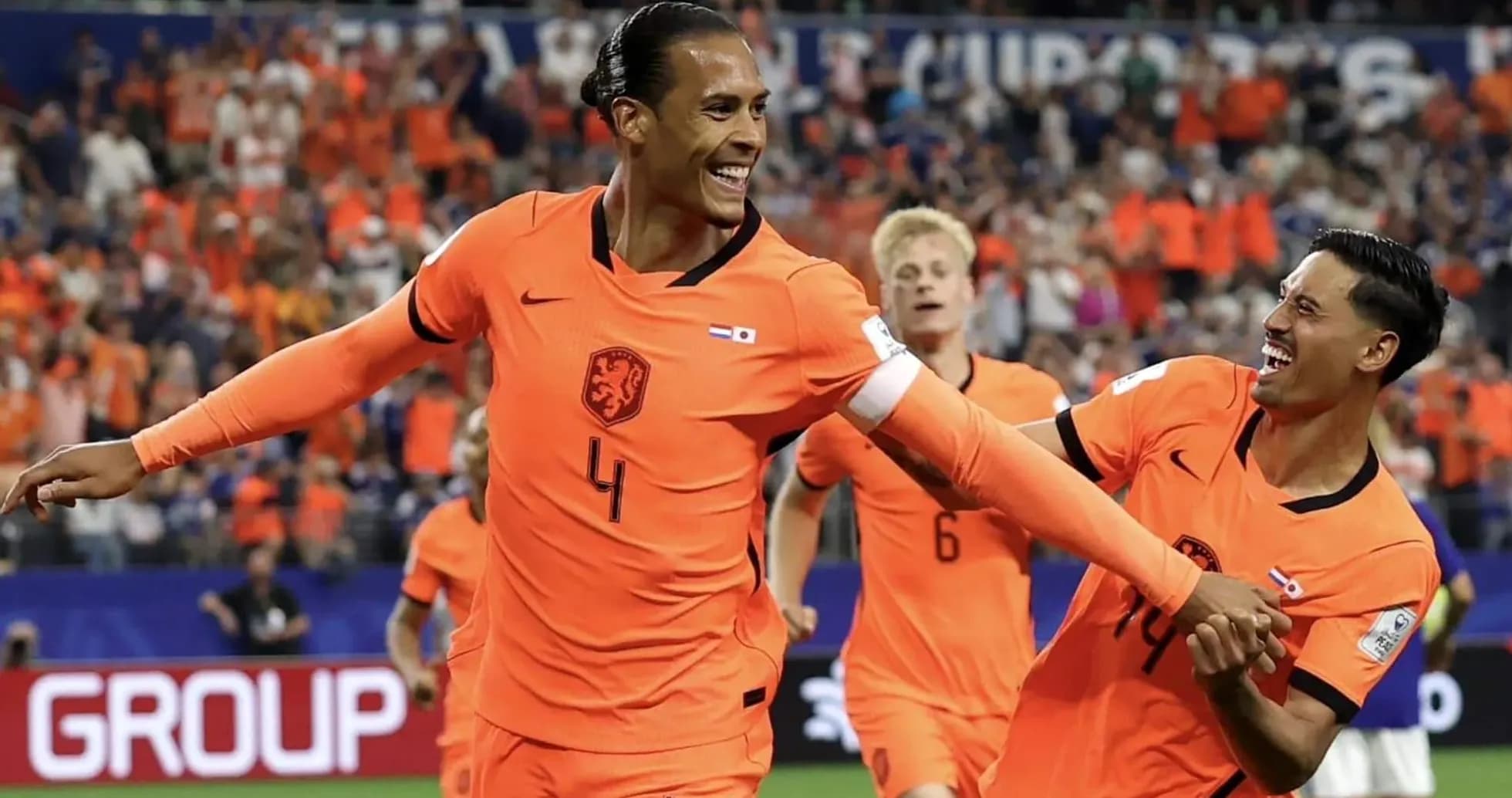
The set of goals tells the story of how these structures interacted. Virgil van Dijk’s opener at 51’ from a Gravenberch assist was a classic product of Dutch territorial dominance: centre-back stepping into a decisive moment in the box after sustained pressure. Japan’s response at 57’, through Keito Nakamura assisted by Kubo, exposed Netherlands’ vulnerability when their full-backs and eights were high; once Japan broke the first line of pressure, they could run at a backpedalling defence.
Crysencio Summerville’s goal at 64’, again from a Gravenberch assist, showcased the 4-3-3’s ability to overload wide zones and then attack the half-space. His earlier yellow card at 61’ for “Foul” did not blunt his aggression; tactically, he remained a vertical threat attacking the gap between Japan’s wide centre-back and wing-back. That said, the Dutch failed to convert their structural superiority into a decisive margin, leaving the door open for Japan’s late equaliser at 89’ by Daichi Kamada, assisted by Koki Ogawa, which stemmed from fresher legs and more direct play after multiple substitutions.
The substitutions around 70–75’ were a key tactical pivot. For Netherlands, Teun Koopmeiners (IN) came on for Tijjani Reijnders (OUT), Quinten Timber (IN) for Crysencio Summerville (OUT), and Memphis Depay (IN) for Donyell Malen (OUT) all at 70’. This trio subtly shifted the Dutch from a more dynamic, vertical midfield to a slightly more control-oriented yet less explosive unit. Koopmeiners offers distribution and structure, but the removal of Summerville and Malen reduced the ability to constantly attack depth, making Netherlands more possession-heavy but less threatening in transition.
Japan’s changes were more about injecting pace and altering reference points in the front line. At 66’, Junya Ito (IN) came on for Daizen Maeda (OUT), adding a more direct wide runner. At 75’, Koki Ogawa (IN) for Takefusa Kubo (OUT), Takehiro Tomiyasu (IN) for Ritsu Doan (OUT), and Yukinari Sugawara (IN) for Tsuyoshi Watanabe (OUT) collectively nudged Japan towards a slightly more conservative back line with fresher legs, but also a clearer target in Ogawa for crosses and knockdowns. This combination directly influenced the late equaliser, with Ogawa providing the assist for Kamada.
The final wave of substitutions – Nathan Aké (IN) for Ryan Gravenberch (OUT) at 81’, Kento Shiogai (IN) for Ayase Ueda (OUT) at 84’, and Brian Brobbey (IN) for Cody Gakpo (OUT) at 85’ – further underlined the tactical trade-offs. Koeman’s decision to withdraw Gravenberch, who had two assists and was a key vertical connector, in favour of Aké signalled a tilt towards game management and defensive solidity. In practice, this slightly blunted Netherlands’ ability to play through midfield in the closing minutes, contributing to Japan’s opportunity to strike late.
Discipline also shaped the match’s rhythm. Netherlands collected three yellow cards, all for specific interventions that reflected their increasingly reactive defending as the game wore on: Crysencio Summerville (61’) — “Foul”, Memphis Depay (83’) — “Foul”, and Micky van de Ven (90+1’) — “Professional foul”. Japan, by contrast, finished without a single booking, consistent with a compact, positionally disciplined approach that relied more on collective shifting than on last-ditch challenges.
In goal, Bart Verbruggen (Netherlands) faced relatively little sustained pressure, registering 1 save, which aligns with Japan’s 3 shots on goal and the Dutch defence generally keeping attempts from less dangerous zones. Zion Suzuki (Japan) made 4 saves, a reflection of Netherlands’ 6 shots on goal and the degree of territorial control they exerted, especially between minutes 45 and 75. The goals prevented metric – 0.62 for both teams – is revealing: both Verbruggen (Netherlands) and Suzuki (Japan) broadly performed to expectation, with neither goalkeeper dramatically overperforming or underperforming relative to the quality of chances faced.
From a statistical verdict, Netherlands’ 60% possession, superior passing volume and accuracy, and a 6–3 edge in shots on goal suggest they controlled the macro-structure of the game. Their 5 corner kicks to Japan’s 4 and matching foul count (7–7) point to a contest that was territorially tilted but not wildly unbalanced in physical duels. Yet the xG margin of 0.79 vs 0.54 is far narrower than the territorial data might imply, underscoring that Japan’s compact block effectively limited the quality of Dutch chances.
For Netherlands, the draw will feel like two points dropped: a structurally dominant display that lacked a ruthless edge and perhaps over-cautious late-game substitutions. For Japan, it validates Moriyasu’s 3-4-2-1 as a system capable of absorbing pressure, staying within one action of parity, and then exploiting late-game moments through targeted changes and direct running. In a group-stage context, both sides leave AT&T Stadium with a point and with clear tactical lessons: Netherlands on how to convert control into higher-quality chances, and Japan on how to add a bit more on-ball ambition without compromising their defensive organisation.