.svg&w=384&q=75 "GoalGist logo")
Miami's Messi Era: Reality Check After Nashville Loss
Nashville didn’t just beat Miami. They exposed them.
The 4-1 hammering on Saturday night was brutal in its clarity. Miami had the ball, they had the territory, they had the names. Nashville had the plan. Sit, spring, slice them open on the break. It worked again and again.
Hany Mukhtar, one of MLS’ sharpest No.10s, tore through them with ease. He scored twice, drifting into the gaps Miami kept generously offering. Sam Surridge added another. Andy Najar, a right back in name only on this evidence, stormed forward to grab the fourth as Miami’s defensive shape simply disintegrated.
In midfield, Eddi Tagseth and Matthew Corcoran didn’t just compete. They dominated. They ran Miami’s central trio into the ground, turning what should have been a contest into a chase. For the Herons, it was a miserable night that felt uncomfortably familiar.
A simple blueprint to beat Miami
The formula is out there now, and it isn’t subtle: limit Lionel Messi and everything else falls apart.
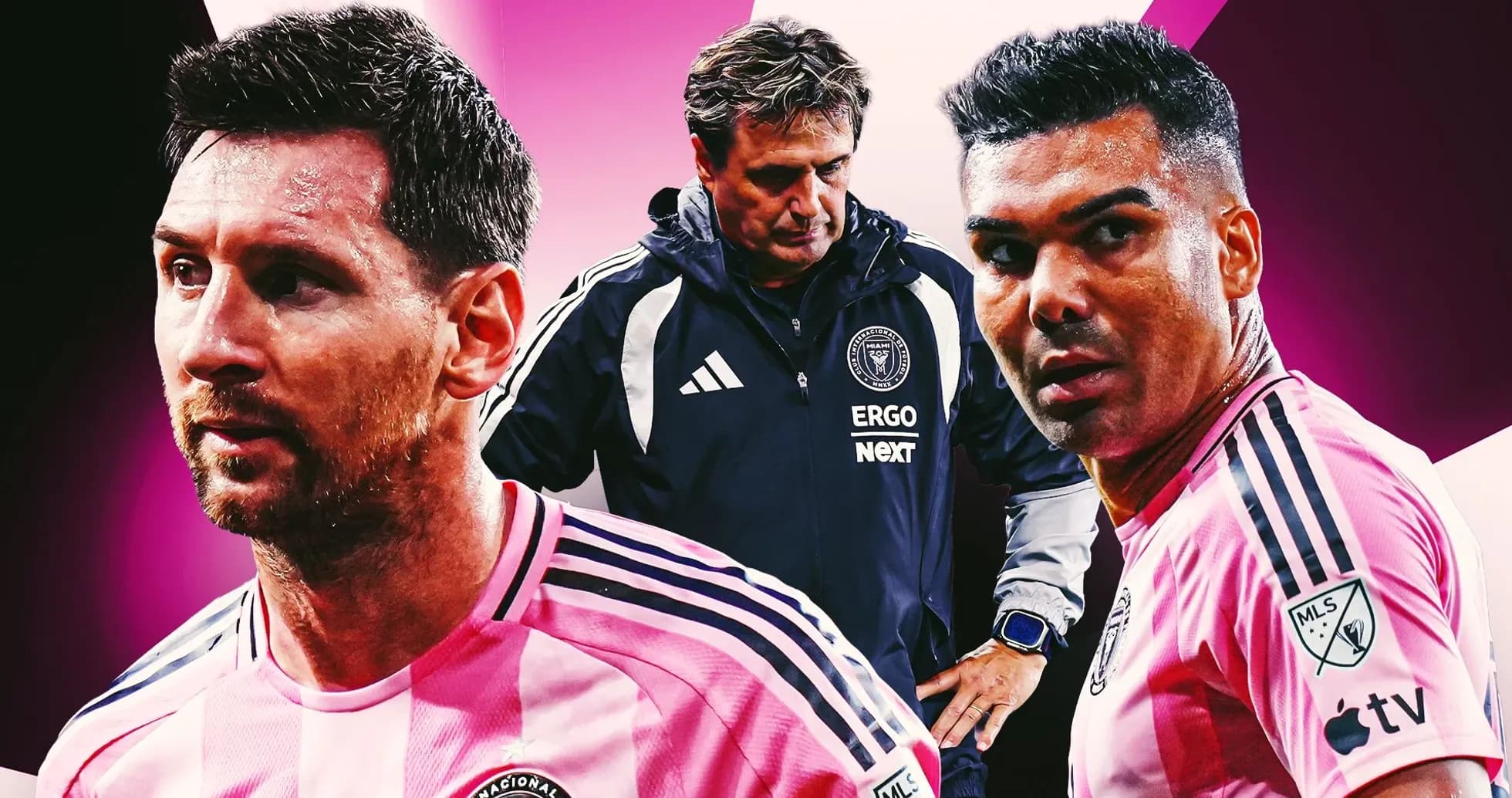
Messi doesn’t defend. That has never been his game, and at 37, it never will be. Luis Suárez, 39 and genuinely straining to keep up, no longer has the legs to press or stretch teams. Rodrigo De Paul covers ground on the right and never stops working, but Casemiro, the marquee post-World Cup signing, looks like he’s running through mud in the middle of the pitch.
The left side tells its own story. The drop from Jordi Alba to Sergio Reguilón — who hasn’t played regular football since 2022 — is as stark as it is predictable. The result is a team with big names and bigger spaces between them, one that can’t compress the field or control transitions.
There are no clever tactical tweaks that solve this. Right now, Miami are an average playoff team being dragged toward relevance by one extraordinary player.
Built for Messi, not built to last
On paper, the fix seems obvious. Identify the flaws, recruit smarter, rebalance the squad. MLS has its salary-cap constraints, but Miami have already shown they’re willing to bend and contort within the rules to land stars.
They need legs in attack. They need energy and intelligence in central midfield. Elite midfielders don’t just appear, and they don’t usually choose MLS in their prime, but there was a world in which N’Golo Kanté might have been an option instead of Casemiro.
There were other choices too. The club spent around $15 million on Germán Berterame, a forward who doesn’t truly excel in any one area. Benjamin Cremaschi, a homegrown talent, publicly admitted he felt misused under Javier Mascherano. With more care, he might have been the young, dynamic midfielder Miami could have built around.
The thread running through all of this: Messi.
This squad has been assembled around his preferences and his orbit. It started in 2023, when Sergio Busquets and Alba arrived in part to help lure him to South Florida. De Paul has said his desire to play alongside Messi and stay sharp for the World Cup was central to his decision to leave Atlético Madrid; the two were reportedly doing extra sessions together before the tournament.
Even Casemiro, once Messi’s great rival in Clásicos, framed his move in those terms.
“For me, without a doubt, I am coming only to play with the best player of all time,” he said at his introductory press conference. “I want to enjoy, I want to help him to keep winning because he is a winner. Another player is joining who wants to win, who wants to compete.”
Whether Messi is literally making the calls or simply inspiring them doesn’t really matter. The outcome is the same: this is a squad built to please him, not necessarily to outlast him.
A new MLS era, an old Miami problem
All of this is happening as MLS prepares to change shape. The league is set to move to a Fall-Spring calendar in 2027-28, a shift that will place clubs in the thick of the global transfer market. Owners have already been presented with proposals to loosen salary rules and allow more spending.
This is the moment where serious clubs start planning their next act.
Messi’s contract runs through the end of the 2028 season. On paper, that keeps him in Miami for next year’s shortened “sprint season” and the first full Fall-Spring campaign. At minimum, the Herons have what’s left of this year, an abbreviated season, and one full year after that with their main attraction.
But if Messi were to walk at the end of this year? The picture turns bleak very quickly.
Miami would be left with expensive Designated Players who don’t quite fit together. De Paul is on DP money through 2029. Berterame is tied down on the same terms. Casemiro is not currently occupying a DP slot, but Miami have already shown with De Paul that they’re willing to structure deals creatively, starting on lower money before bumping up the salary later.
That kind of flexibility could easily become a trap.
The dream successor who may never come
What Miami truly need is not just another elite player. They need someone who can become the sporting and commercial face of the club once Messi is gone.
Julián Álvarez is the dream. He has the quality. He has the age profile. He has the work rate and the Argentine connection that would resonate with Miami’s current identity. He would never match Messi’s box-office power — nobody can — but he is the one name who looks like a genuine succession plan.
The problem: his reality is a long way from MLS fantasy.
Atlético Madrid paid an initial €75 million, plus up to €20m in add-ons, to sign him from Manchester City in 2024. This summer, they reportedly turned down a €150m offer from Real Madrid. For Miami to even get to the table, they would need a transfer package far beyond anything the league has ever seen, and that’s before negotiating wages.
Strip away Álvarez and the options thin out quickly. If that kind of move is simply too expensive, the next logical step is to chase an American star.
Christian Pulisic and Weston McKennie are the only realistic fits. Pulisic is the most recognizable active American player. McKennie brings quality, charisma and a profile that plays well in the U.S. market. Both could be pillars of a post-Messi Inter Miami.
Neither comes close to replacing Messi as a global event.
And that is the heart of the problem. Miami are not just tied to Messi the player. They are tied to Messi the business model.
A club built on one man’s shadow
Messi drives sponsorships. He drives ticket demand. He drives international attention. A stand at Nu Stadium bears his name. His compensation reportedly includes ownership shares. This is not a typical DP signing; it is a structural bet on one superstar.
Messi is the foundation of the project. Miami have yet to show what the building looks like without him.
The warning signs are already there. Before he arrived, Miami were one of the league’s worst teams. They had tried the star route with Blaise Matuidi and Gonzalo Higuaín, but neither shifted the needle in the same way. Attendance was bottom-third. The team was drifting.
By July 2023, when Messi joined, Miami were effectively out of the playoff race and still waiting for their first trophy. Phil Neville had been sacked. The roster was full of holes. The club felt directionless.
Messi changed all of that overnight. But he didn’t erase the underlying issues. He just covered them.
The looming comedown
The danger is obvious: Miami could easily slide back into that pre-Messi pattern once the curtain falls. The transition is coming, whether in a year or in four, and it will be brutal if the club doesn’t have a coherent plan.
So far, their sporting and commercial identity has been built almost entirely around one man. Messi, quite understandably, will decide when his time in Miami ends. That leaves the club with very little control over the timing of their own reset.
On the field, there is still a scenario where he produces one last Herculean push and drags this flawed team to another trophy. He has done it before, for club and country. But the 4-1 collapse in Nashville, and a string of similarly disjointed displays, suggest that asking him to do it again with this supporting cast is a massive demand.
For now, Miami live in the in-between. A superstar still capable of magic, a squad that can’t consistently support him, and a future that no one at the club seems ready to define.
Every time Messi walks down the tunnel after another frustrating night, the same question hangs in the air: when he disappears for the final time, what exactly will be left behind?