.svg&w=384&q=75 "GoalGist logo")
Manchester United's Struggles in Domestic Cup Competition
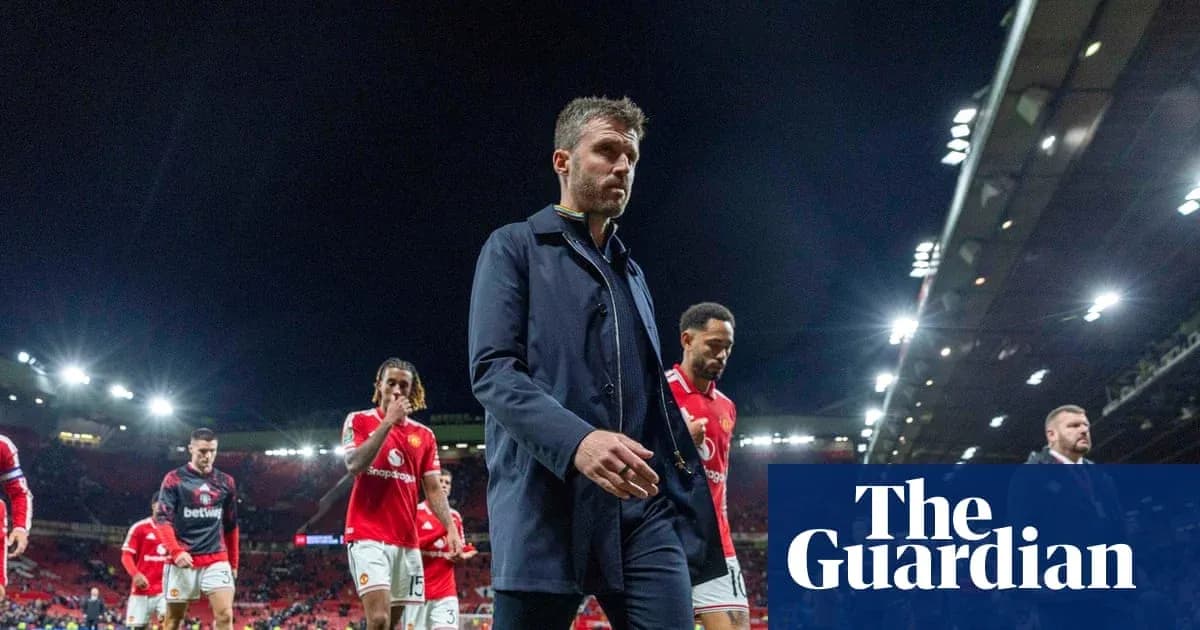
The boos came first. Then the numb silence. Manchester United’s latest Carabao Cup exit on Wednesday was met with a mixture of anger and apathy, a grim soundtrack to a club drifting through another bleak chapter in domestic cup competition.
Michael Carrick, expression fixed and sombre, walked towards the tunnel as the jeers rained down. His players absorbed the rest. Up in the directors’ box, Jason Wilcox did not look impressed either, but the director of football and those above him cannot pretend this is somebody else’s mess.
Supporters know the drill. They see what is good, what is bad, and they deliver instant judgment on the people whose wages they feel they fund. Carrick and his squad front the club in every sense: facing journalists, fronting sponsors, carrying the weight of a global brand. They are the ones on the posters, so they are the ones in the firing line.
Yet the reality is more tangled than the simple notion that the head coach is to blame for everything from the shape of the midfield to the shape of the balance sheet.
Carrick only came back to United in January. The broader plan – such as it is – has been in other hands for much longer, with the head coach effectively slotted into a pre‑built framework. Even so, the pressure is his to bear. Lose at Fulham on Sunday and that pressure will jump another level.
United’s supporters are not naïve about who runs their club. Protests against the Glazer family and Sir Jim Ratcliffe are now a recurring feature. They understand that not every misplaced pass or limp 90 minutes can be pinned solely on the man in the dugout or the players on the pitch. The boos are for the night’s performance. The apathy is aimed at the wider project.
It stings all the more that United, back in the Champions League, were outspent in the summer by promoted sides. That is the cost of years of financial mismanagement. The money that is left has to be used with precision. It hasn’t been.
The 3-2 defeat by Brighton told its own story. Two goals up inside 10 minutes, then barely present for the remaining 80 and deservedly beaten. That is not just a bad day; it is a sign something is badly off within the team. Carrick does not need telling.
Brighton rotated heavily yet still fielded an exciting, varied squad built through smart scouting and fearless recruitment. This summer they signed players from clubs in seven different countries. United? Four signings, all from fellow Premier League sides. Where Brighton have embraced calculated risk and energy, Old Trafford has felt cautious, unimaginative. The irony is that last summer’s most effective signing, in terms of fee and consistency, was Senne Lammens from Royal Antwerp – a rare nod to a broader market.
Carrick and Wilcox cannot be fully judged until Carlos Baleba, the most expensive of the three summer recruits, is available. On paper, his athleticism should address United’s chronic lack of mobility in midfield. Targeting central midfielders made sense after Casemiro’s departure and Manuel Ugarte’s shortcomings. But it was never the only area crying out for attention.
Inside the club, there was no illusion about the squad’s overall weakness. Yet the narrow focus in the market felt naïve and is now being exposed. Buying from within the Premier League often means paying a premium, but it does reduce adaptation time. Even so, with a left‑back shortage and Joshua Zirkzee struggling, the decision to spend £50m on Andrey Santos instead of finding a cheaper option to spread resources looks questionable for the balance of the team.
Somebody needs to explain why £155m went on three players in essentially the same position. Until they do, the outside world will keep guessing, while Carrick scrambles for a plan B with Luke Shaw – as many feared – sidelined again.
Wilcox has spoken publicly, but only on his terms. On 30 October 2025, after three straight wins, he laid out the long‑term vision in an in‑house interview. Within ten weeks, Ruben Amorim was sacked and that plan was in pieces. Since then, beyond formal statements on dismissals, Wilcox has stayed quiet when results have turned.
Across Europe, sporting directors routinely front up to the media. In the Premier League, that culture has barely taken root. At United, the silence grows louder with the team sitting 13th.
Wilcox arrived from Southampton in 2024, initially as technical director, and played a key role in retaining Erik ten Hag after an eighth‑placed finish. Ten Hag was then removed after a poor start to the following campaign. Amorim came in from Sporting with a clear tactical identity that never truly aligned with the squad he inherited. There was no serious budget to reshape it. The outcome was predictable: 15th in the league and a tame Europa League final defeat to Tottenham.
When Amorim was sacked after 14 underwhelming months, Wilcox was given another shot to get it right. Carrick was that second chance.
Carrick has not delivered enough to escape scrutiny. United are underperforming. Heavy wins over promoted Ipswich and Azerbaijani side Sabah do not disguise an unconvincing start.
The defence has leaked seven goals in four league matches. Against Brighton, the central pairing of Leny Yoro and Ayden Heaven veered towards calamitous. Up front, the attack has looked disjointed, lacking cohesion and clarity.
Wilcox’s reputation from his time as Manchester City’s head of academy was glowing. Those who worked with him praised his eye for talent and suitability for youth‑focused roles. At United, higher up the food chain, his work is being pulled apart. Many supporters will be furious if JJ Gabriel leaves, but on that front Wilcox has pushed hard to keep him, including through conversations with the teenager’s inner circle.
At United, power comes with a heavy burden. Yet only the head coach seems required to carry it. Ten Hag and Amorim paid with their jobs. Others have moved on unscathed.
Carrick and Wilcox are both deeply invested in making this project work. Right now, though, it feels like only one of them will pay the price if United keep sliding.