.svg&w=384&q=75 "GoalGist logo")
Manchester United's Chaotic 2-2 Draw at Everton: Another Lead Slips
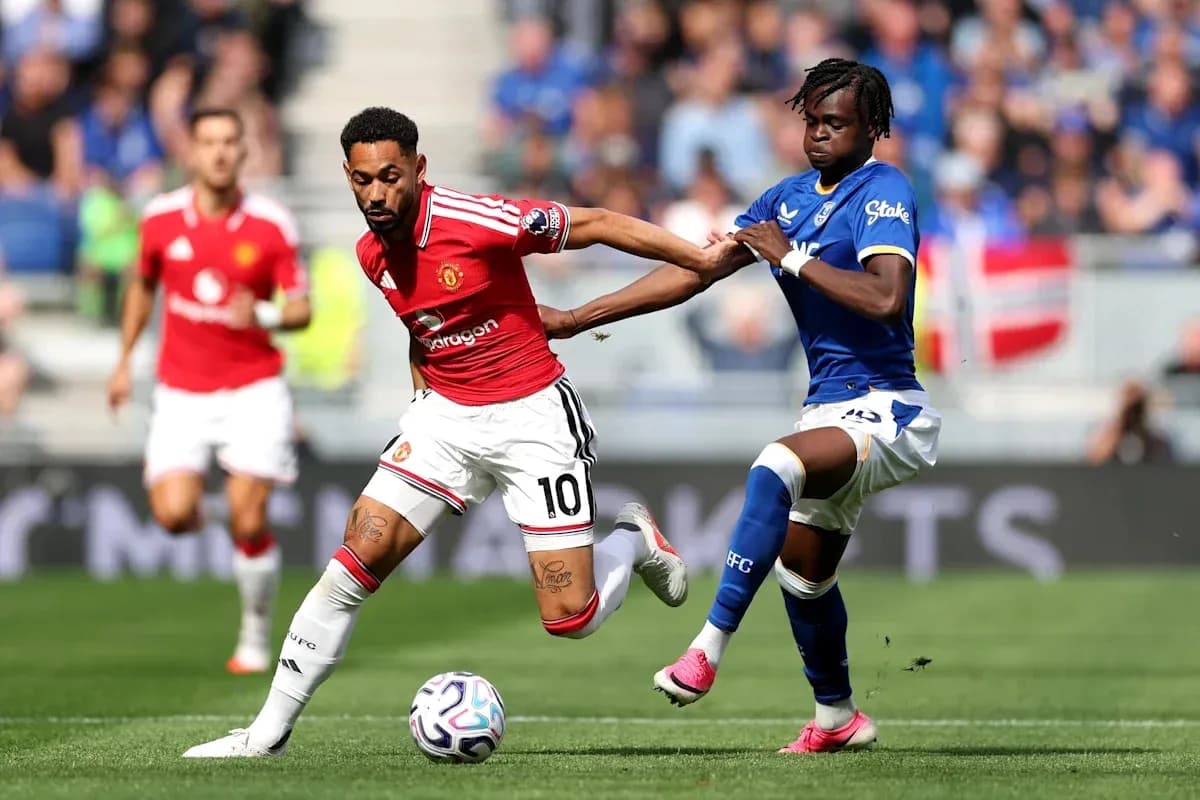
Manchester United left Goodison Park with a point and a familiar feeling: they had the game where they wanted it, twice, and still couldn’t see it through.
They created. They led. They even thought they’d won it in the 88th minute.
They didn’t finish the job.
Everything but the finish
United’s performance had structure and intent. The first half brought controlled possession and two well-worked goals from restarts across the game, the sort of moments that usually tilt tight away fixtures. The attacking patterns were there. The end product, again, wasn’t ruthless enough.
Three creative forwards knitted moves together and dragged Everton’s back line into uncomfortable areas, but the box often felt empty at the crucial moment. United lacked that striker who lives between the posts, who makes the blindside runs and turns half-chances into tap-ins.
Benjamin Sesko’s late header briefly looked like the answer. His return to fitness offers one obvious solution. Bryan Mbeumo moving back into a central role is another. The ongoing absence of Amad on the right is being felt too, with no clear, natural replacement. Shea Lacey may be a talent for tomorrow rather than today, and Matheus Cunha out wide on the right does not appear to be part of the current plan.
United still scored twice away from home. On most days, that should be enough.
Right now, it isn’t. They have conceded two goals in each of their opening three matches of the season. That pattern is no longer an early-season quirk; it’s a tactical problem that needs shoring up until injured or missing personnel return to restore some balance.
An unstable back four
The numbers are damning. Six goals conceded to Hull City, Ipswich Town and now an Everton side that has struggled to threaten anyone consistently. This isn’t a one-off bad afternoon; it’s a trend.
There were bright spots. Luke Shaw, heavily criticised for his first two outings at left back, produced a far more convincing display. He blocked, overlapped Marcus Rashford, and delivered several dangerous crosses. One of them, late on, was perfect: Sesko rose and powered home what looked like the winner in the 88th minute.
Yet Shaw’s day still carried a sting.
At 1-0, Tyrique George’s 83rd-minute equaliser exposed a recurring flaw. Shaw drifted too narrow, leaving George the space he wanted on the left edge of the box. The Everton forward didn’t hesitate, hammering a shot into the near-post top corner. Arne Lammens got a hand to it, enough to raise the question of whether he should have kept it out, but not enough to change the outcome.
He wasn’t alone in his struggles. Across the back line, Harry Maguire, Lisandro Martinez and Diogo Dalot all had moments they will not enjoy in the video review.
Maguire lost Thierno Barry in the 42nd minute, and only the forward’s poor header spared him from being the culprit in what should have been a straightforward Everton goal. Deep in first-half stoppage time, Dalot tried to clear but passed the ball straight to Jarrad Branthwaite, who fired directly at Lammens. Later, a misplaced Dalot cross in midfield left Shaw and Martinez scrambling to recover against Brennan Johnson, just about managing to deflect his effort over the bar.
The bigger issue came with game state. Protecting a 1-0 lead for most of the second half, United retreated. They stopped hunting the ball, stopped putting their foot on it. Everton began to dictate possession, wave after wave, as United sat off and invited pressure.
That passivity opened the door for the spectacular. Both Everton goals came from distance and high difficulty, but United allowed the home side the territory and time to try their luck.
Michael Carrick’s changes didn’t help. After George’s first strike, he turned to Noussair Mazraoui at left back and Leny Yoro on the right. The reshuffle only added to the unease.
On 90 minutes, Mazraoui lost George again, allowing him another crack at the near post. Lammens saved this one, and the flag went up anyway, but the warning signs flashed. United didn’t heed them.
Deep into stoppage time, with United seconds away from victory, Hayden Hackney glided past Yoro far too easily and fed Kiernan Dewsbury-Hall. Mazraoui’s attempted clearance fell straight to Ainsley Maitland-Niles, who unleashed a stunning strike worthy of any goal-of-the-season reel. Everton stole a point; United surrendered two.
Would keeping Dalot and Shaw on have changed anything? On this evidence, that’s not a simple yes.
Matthijs de Ligt is edging towards his first appearance since November 2025, and his return will offer another option, another personality at the back. But one player alone rarely fixes a systemic issue. Ayden Heaven is another name in the frame, a possible beneficiary if Carrick decides he has to shake up his defensive hierarchy.
Right now, the uncomfortable truth is this: regardless of the combination, United cannot keep teams out.
Structural fault line
The theme is becoming impossible to ignore. United’s midfield looks more coherent than it has in years. They move the ball with more purpose, they carve out chances, they carry a genuine threat in transition and in settled possession.
None of that will matter if the back line continues to crumble whenever it’s stretched.
The fullbacks sit at the heart of the problem. Shaw still reads the game well and offers quality on the ball, but he no longer has the recovery burst to bail himself out when United push high. Dalot faces similar issues on the opposite side. When both are advanced, the centre-backs are left to defend huge spaces, exposed to pace and direct running.
Better sides will see this immediately. They’ll drag United’s fullbacks upfield, then sprint into the gaps behind them. They’ll isolate the centre-backs, turn every turnover into a foot race, and test a structure that doesn’t yet look ready for that level of stress.
The squad rebuild over the summer focused heavily on midfield. That part looks like time and money well spent. The problem is what was left undone. The defensive unit, especially in the wide areas, feels like an afterthought.
Carrick now faces a tactical puzzle with little time to solve it. He can’t sign new fullbacks. He has to adjust the shape, the line, the pressing triggers, or the risk is clear: United will score enough to win matches, and still spill points because of what happens in their own third.
The timing could hardly be more brutal. Their first Champions League match of the season is days away. Europe will not be as forgiving as Hull, Ipswich or this Everton side.
If United don’t find a way to stop the bleeding at the back, how long before their attacking progress starts to feel irrelevant?