.svg&w=384&q=75 "GoalGist logo")
Korea's World Cup Hopes: A Team in Turmoil
Thirty days from a World Cup, a football nation is usually humming with anticipation. In Korea, the noise is different. It is anger, doubt, and a low, persistent murmur: can this team actually be ready?
A coach under fire, and empty seats
The storm began the moment Hong Myung-bo took the job in the summer of 2024. His appointment was controversial, his popularity thin. The stands made that clear.
Supporters who once turned national team games into festivals turned on their own. They booed Hong relentlessly. Banners demanded the resignation of Korea Football Association President Chung Mong-gyu. The Taegeuk Warriors, long a point of pride, suddenly looked like a battleground.
Then came something even more damning than jeers: apathy.
On Oct. 14, only 22,206 fans walked through the gates of Seoul World Cup Stadium for a friendly against Paraguay. In a 66,000-seat arena, it felt like an accusation. It was the lowest attendance for a men’s international in a decade. A month later against Ghana, the crowd ticked up to 33,256, still well short of what used to be routine for this team.
Korea won both games, with another victory over Bolivia in Daejeon squeezed in between. Three straight wins, about 33,000 fans in the stands in Daejeon, and yet no sense of momentum. Performances were scratchy, disjointed, unconvincing. The results said “fine.” The eye test said “trouble.”
The new year removed any illusion.
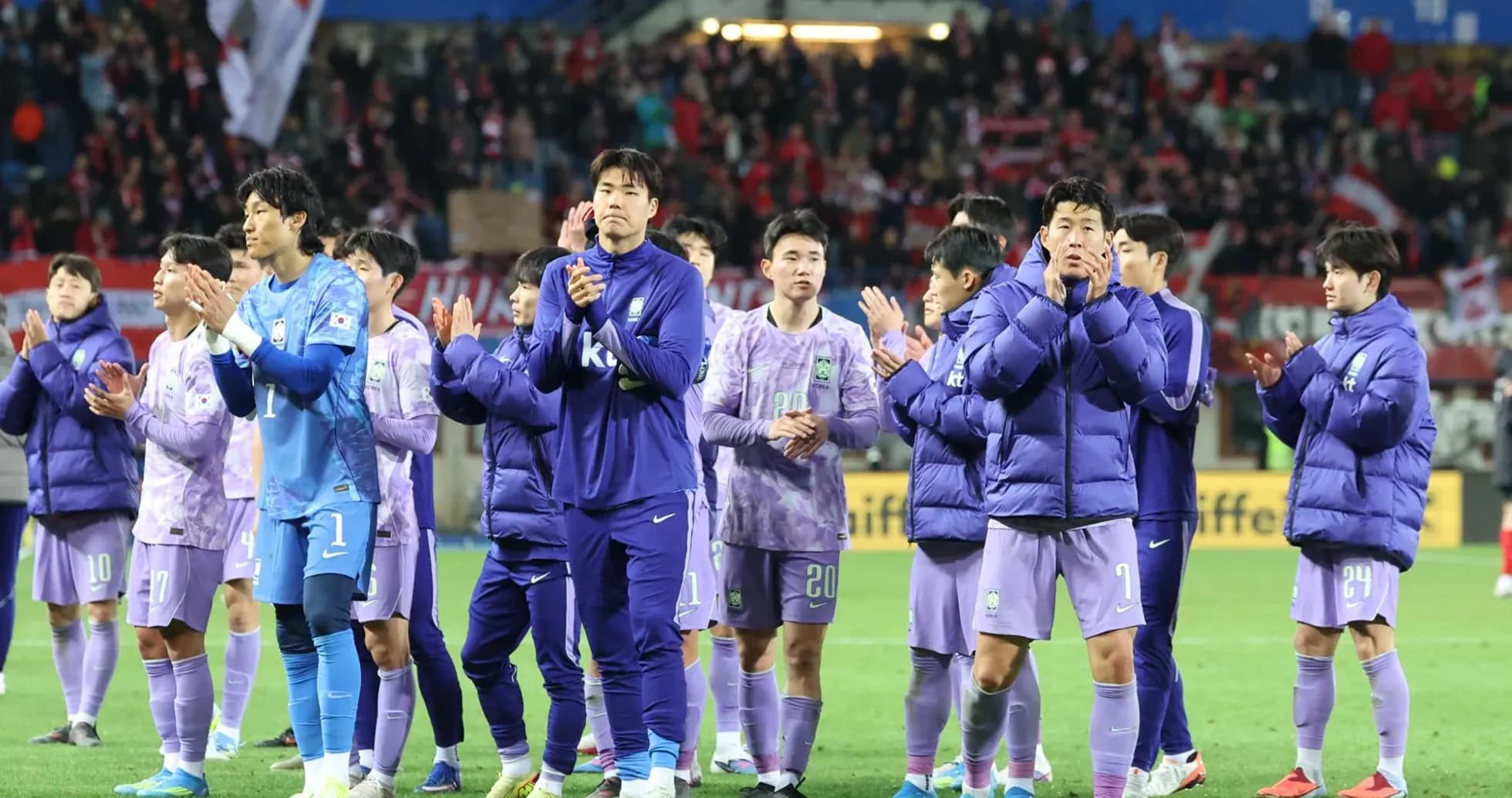
Korea opened their World Cup year with a 4-0 hammering by Ivory Coast on March 28, then a 1-0 defeat to Austria three days later. Two away friendlies, two losses, one heavy. Confidence, already fragile, sank further.
A soft group, on paper
Strip away the emotion and one fact still stands: the draw has been kind.
World No. 25 Korea landed in what many pundits are calling one of the softer groups. Group A pairs them with 15th-ranked Mexico, 41st-ranked Czechia and 60th-ranked South Africa. No Brazil, no France, no Argentina. No superpower casting a shadow over the group.
The schedule is forgiving too. Korea open against Czechia in Guadalajara at 8 p.m. on June 11 (11 a.m. June 12 in Korea), stay in the same city to face Mexico at 7 p.m. on June 18 (10 a.m. June 19 in Korea), then move to Monterrey for South Africa at 7 p.m. on June 24 (10 a.m. June 25 in Korea). All three matches in Mexico, two in the same city. Minimal travel, maximum stability.
This is also a new kind of World Cup. Forty-eight nations, up from 32. The knockout stage begins with a round of 32. The top two teams from each of the 12 groups advance, joined by the eight best third-placed sides. The door to the knockouts has never been wider.
Put all of that together and the logic is simple: Korea should get out of the group. The debate starts after that.
This will be Korea’s 11th consecutive World Cup appearance. Away from home soil, they have reached the knockout stage twice – in South Africa in 2010 and in Qatar in 2022. The expectation now is to at least match that.
Belief in game changers, concern about depth
Television analyst Kim Dae-gil sits on the optimistic side of the fence.
“I think Korea will get to at least the round of 16,” he said. For him, the group offers a clear path. “Just looking at the group stage opponents, Korea won't have to expend as much energy as in some previous tournaments. We can beat Czechia and South Africa six times out of 10. And if we qualify for the knockouts as the top seed or No. 2 seed, then we will meet a beatable opponent in the round of 32.”
His confidence leans heavily on two names: Son Heung-min and Lee Kang-in.
Son, now with Los Angeles Football Club, remains the face and heartbeat of this side. Lee, the Paris Saint-Germain midfielder, brings the flair and imagination between the lines. Kim sees them as pure “game changers,” players who can conjure chances from nowhere, who can tilt tight matches with a single moment.
That is the upside. The downside sits right behind them.
“The gap between the starters and backups is substantial,” Kim warned. He worries that once you move beyond the first-choice attackers, the drop-off is steep. To go beyond the round of 16, he argues, Korea will need more than just a handful of stars. They will need a supporting cast ready to step in without shrinking the team’s level.
“It is imperative for the likes of Son Heung-min to stay healthy,” he said. In a compressed tournament, that is less an observation than a demand.
Injuries, form, and a thinner golden generation
Not everyone sees a smooth path.
Analyst Seo Hyung-wook initially had Korea penciled in for the round of 16. Then came an injury that changed his mind.
Midfielder Hwang In-beom, a key two-way presence, damaged his right ankle in March while playing for Feyenoord. He is now rehabbing with the help of the national team medical staff. His status looms over every projection.
Seo has downgraded his expectations to an exit in the round of 32.
Hwang is not the most famous player in the squad, but within the team he is as irreplaceable as anyone. He knits play together, covers ground, links defense and attack. Lose him, or even get a diminished version of him, and the balance of the side tilts dangerously.
“Other mainstays have not been playing well,” Seo noted. He pointed to Lee Kang-in and defender Kim Min-jae of Bayern Munich, both of whom have seen limited action at club level. Rhythm, sharpness, confidence – all of it can erode on the bench.
Seo still sees a strength: the chemistry among the Europe-based core. Son, Lee, Kim and others have been together for years, forming a spine that understands each other’s movements and habits.
“The problem is there just aren't many of them,” Seo said. For all the talk of a golden generation, the pool of truly top-level Korean players remains small. “At this moment, I don't think you could say anyone can play at a world-class level at the World Cup.”
It is a harsh assessment, but it cuts to the heart of the unease. Korea have stars, but do they have enough of them? And are those stars at their peak right now?
A team that struggles to create
Analyst Park Chan-ha lands in the same place as Seo: Korea to go out in the round of 32.
“Hong Myung-bo's team has some talented players,” Park said. The individual quality is not in doubt. The collective idea is.
“And yet, they often have trouble creating scoring chances.” That sentence may haunt Korea more than any ranking.
Under Hong, the team has leaned heavily on individual brilliance. The structure in the final third looks loose, the patterns of play unclear. The plan often seems to be: get the ball to Son, to Lee, to one of the few creative sparks, and hope they can make something happen.
“The team relies on players' individual skills to try to capitalize on those few opportunities,” Park said. “But you can only do so much of that at the World Cup. I think we already saw problems with this approach in the two losses in March.”
Those defeats to Ivory Coast and Austria did not just dent morale; they exposed the fragility of a system that struggles to manufacture chances against organized opponents.
Park believes that if Hwang In-beom cannot play, or is clearly limited, these issues will only deepen. One more link in the chain missing, one more creative responsibility pushed onto already overloaded shoulders.
The match that could define everything
Inside this expanded World Cup, the margins of a group stage remain brutal. One match can still shape an entire campaign. For Park, that match is clear.
“I think the first match against Czechia will be the most important one,” he said. “This is the one Korea must win, and they will be in trouble if they don't get it done. Czechia are not an offensive-minded team, and Korea may have difficulty breaking through their defense.”
Czechia will likely sit compact, disciplined, patient. That is exactly the kind of opponent that has frustrated Hong’s Korea so far. Fail to break them down, drop points, and the pressure will spike instantly.
Seo agrees on the weight of the opener.
“In our World Cup history, the outcome of the first match often determined the fate for the rest of the tournament,” he said. Mexico, he pointed out, will be a far tougher test in the second match. Go into that game without three points in the bank, and the group can quickly turn hostile.
Kim Dae-gil, though, looks at it differently. For him, the hinge of the group is not Czechia, but Mexico.
He believes Korea and Mexico will fight for the top spot. Win that duel, and the route through the round of 32 could open up. Lose it, and the path becomes steeper, the opponent in the knockouts more daunting.
“I think Korea and Mexico will battle for the top spot in the group,” Kim said. The implication is obvious: if Korea are serious about a deep run, they must think beyond just scraping through.
Thirty days to change a mood
So the picture is this: a favorable group, reduced travel, an expanded knockout field, a core of Europe-based talent, and a captain in Son Heung-min who can still bend games to his will. On the other side, a skeptical public, a coach under constant fire, key players short of form or fitness, and a team that too often looks short of ideas in front of goal.
The countdown clock in Korea is not just ticking toward a tournament. It is ticking toward a verdict on Hong Myung-bo, on this generation, on whether a team that has made the World Cup its habit can make progress its standard.
The fixtures are set. The analysts have made their calls. The fans, bruised and wary, are waiting.
When the ball rolls in Guadalajara against Czechia, will this feel like the start of another familiar struggle, or the moment a doubted team finally snaps back into life?

