.svg&w=384&q=75 "GoalGist logo")
Ibrahim Mbaye: Senegal's Young Star Shines at World Cup
There is a version of 16 June 2026 that never makes the highlight reel.
France 3, Senegal 0. Eighty-five minutes gone at MetLife Stadium, the noise thick and unforgiving, the contest apparently over. A teenager steps off the Senegal bench into a game that has already slipped away. It looks like a footnote. It doesn’t feel like one.
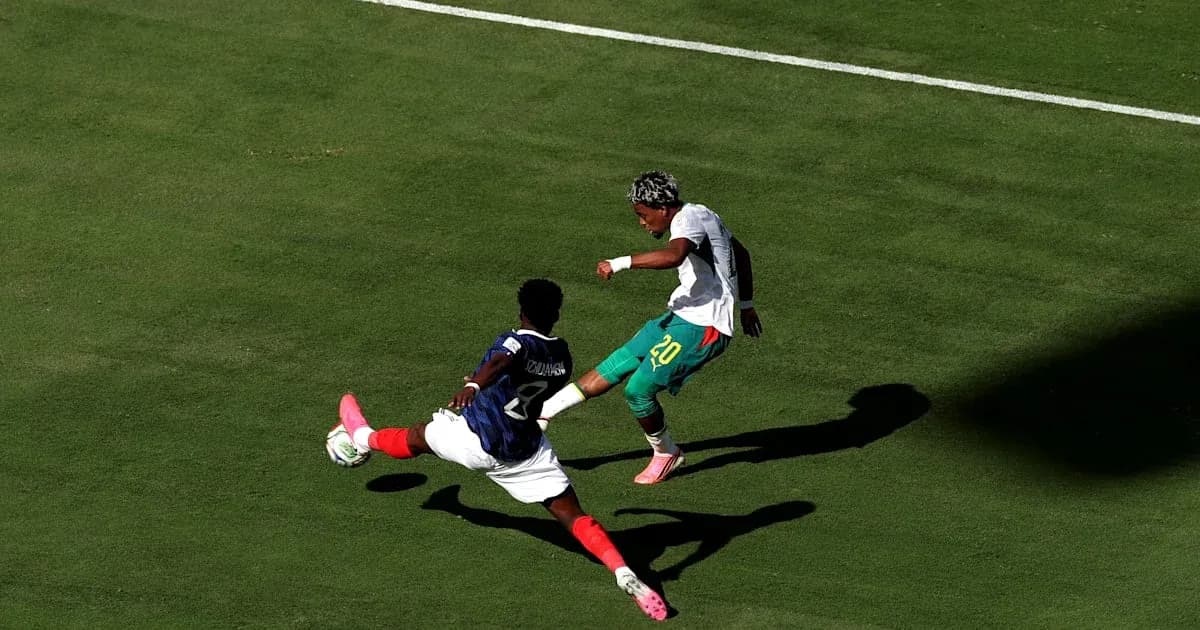
Ibrahim Mbaye collects the ball wide on the right. One touch to settle, another to square up Théo Hernandez. A feint, a roll of the foot, Hernandez leaning the wrong way, and suddenly the angle opens. Mbaye doesn’t hesitate. He whips a shot past Mike Maignan and into the far corner.
Stoppage time, minute 95. France 3, Senegal 1.
The scoreline screams damage limitation. The record books disagree. At 18 years and 143 days, Mbaye becomes the youngest African ever to score at a FIFA World Cup, edging past Moussa Wagué’s mark from 2018. Stretch the lens across history and the list he joins is absurd: Pelé, Manuel Rosas, Gavi, Lamine Yamal. That’s the neighbourhood he has walked into.
C’est du sérieux. And the truth is, Mbaye has been operating in serious territory for a long time.
Books before Ballon d’Or
Rewind ten months.
Paris Saint-Germain are boarding a flight to Marseille for a Ligue 1 game. The usual cast, the usual routine. One notable absentee. Mbaye, then 17, isn’t with them. He is in an exam hall, sitting his baccalauréat, the rite of passage every French teenager must clear before the country will call them educated.
While his team-mates stretch and sleep, he is solving equations. PSG arrange a separate journey. He finishes his paper, travels down, and joins the squad in time for an 8pm kick-off.
For most players, that story would become the defining anecdote of a career. For Mbaye, it barely registers. Just another day.
This is how PSG’s academy works now. The conveyor belt that has already produced Warren Zaïre-Emery and Senny Mayulu treats algebra and pressing drills with the same weight. Director Yohan Cabaye points to a 95 per cent baccalauréat pass rate among academy players and calls academic discipline non-negotiable.
In Mbaye, that philosophy finds its purest case study. The nutmeg on Hernandez and the ice-cold finish past Maignan are not flashes of street improvisation; they are problems processed and solved in real time. The same calm that carries him through an exam hall carries him through the 95th minute of a World Cup opener.
The stage changes. The tempo does not.
The boy from Trappes who said no to France
Mbaye’s story begins in Trappes, a Paris suburb that knows how to produce footballers. Nicolas Anelka came from here. So did the idea that a kid from these streets could bend the football world to his will.
His father is Senegalese. His mother Moroccan. His footballing education is entirely French. He comes through the national youth teams, one of those prospects coaches talk about in lowered voices. Inside Clairefontaine, nobody really imagines he will wear another shirt.
Then, in November 2025, he does.
Mbaye chooses Senegal. No pressure campaign. No ultimatum. His decision, his call. Months later, with an Africa Cup of Nations winner’s medal around his neck, he tells Senegalese broadcaster RTS: “I will never regret choosing to play for Senegal because it was a decision from the heart.” A teenager, surrounded by senior professionals twice his age, speaking like someone who has already lived a full international career.
Reflecting again later, he strips it back even further: “If only you knew… it’s the best decision I’ve ever made in my life. The Senegalese have such huge hearts; it’s incredible.”
That is why his goal against France lands differently. A boy raised in the banlieues, schooled in France’s most prestigious academy, scoring his first World Cup goal against the nation that shaped him — and doing it in Senegal green. Quelle histoire. If you pitched it to a producer, they’d tell you to tone it down.
A career on fast-forward
Look at the numbers and the pattern is clear: Mbaye does not wait his turn.
He makes his Ligue 1 debut at 16 years, 6 months and 23 days, becoming PSG’s youngest-ever league starter, nudging Warren Zaïre-Emery’s name out of the record books. In February 2025, he signs his first professional contract. Weeks later, he scores his first senior goal. By August, he is the youngest Frenchman ever to appear in a UEFA Super Cup, taking down a record Ryan Giggs set back in 1987.
Then comes May 2026. Lens away, title race still alive. Deep into stoppage time, Mbaye arrives again, his late strike sealing PSG’s 14th Ligue 1 crown. Another decisive moment, another cold finish, another date circled in club history.
Senegal get the same accelerated version. Debut against Brazil in November 2025. A goal three days later on his second cap. The youngest player ever to feature at the Africa Cup of Nations in December. A month later, he breaks his own mark as Senegal’s youngest AFCON goalscorer, on the way to lifting the trophy before CAF later rules to award the victory to Morocco after the match.
Strip away the legal wrangling and the numbers speak for themselves: four goals in twelve caps before his nineteenth birthday. The comparisons with Kylian Mbappé do not feel lazy; they feel inevitable.
Coaches, though, keep coming back to something else. Not the speed. Not the swagger. The decisions. When to carry. When to release. When to slow the game down to his rhythm. His choices look like those of a player with hundreds of senior games in his legs, not a teenager still finding his way around dressing rooms.
Mbaye doesn’t need twenty touches to leave a mark. He often needs just one.
“Mbaye is world class, and he is ours, he did not choose France – he chose Gaindeyi,” Senegalese journalist Wahany Johnson Sambou told Olympics.com in January, invoking the Wolof name for the national team. “He’ll do great things, just watch.”
The evidence keeps stacking up.
Dakar, Los Angeles, and a generation’s stage
Senegal’s Olympic football story is still a thin chapter. One appearance, at London 2012, but what an appearance: Sadio Mané, Idrissa Gueye, Cheikhou Kouyaté all used that tournament as a launchpad.
They have not been back since. That absence is starting to feel out of step with the talent they produce.
This October, the Youth Olympic Games arrive in Dakar. For the first time, the Olympic flame will burn on Senegalese soil. The country’s relationship with the Games — and with Olympic football — is about to deepen.
Mbaye sits right in the middle of that future. Born in January 2008, he will be 20 when LA 2028 kicks off, perfectly placed for an Under-23 tournament that has already carried Lionel Messi, Neymar and Mohamed Salah onto the global stage. Olympics.com has already highlighted him as one of Africa’s brightest prospects for those Games. It does not take a scouting badge to understand why.
The medals and milestones matter, of course. Ligue 1 titles, AFCON glory, World Cup records — they all stack up. But what makes the idea of Mbaye under the Californian lights so compelling is the temperament behind them. The same unflustered clarity that got him through a baccalauréat exam on a matchday afternoon. The same stillness that allowed him to toy with Théo Hernandez and beat Mike Maignan in the dying seconds of a lost cause.
He keeps arriving early to moments everyone else thinks belong to the future.
For now, Ibrahim Mbaye remains what he has always been: the kid who treats a World Cup chance like a maths problem, who sees chaos and calmly rearranges it to his liking. The game keeps throwing bigger stages at him.
He keeps walking onto them as if he’s been there for years.