.svg&w=384&q=75 "GoalGist logo")
Harry Kane's Missed Opportunity at the World Cup
For an hour, England went toe-to-toe with the world champions and didn’t blink. Thomas Tuchel’s side might not have outclassed Argentina, but they matched them stride for stride, tackle for tackle, in a contest that felt balanced on a knife edge. When Anthony Gordon lashed home in the 55th minute, it did not feel like a robbery. It felt like the first clean punch in a heavyweight bout.
Argentina were expected to answer. England looked ready to swing back.
They didn’t.
Once ahead, England shrank. The line dropped, the passes grew hurried, and the white shirts retreated into their own fear. Argentina, sensing the change, surged. Lionel Scaloni spoke afterwards about his team “smelling blood in the water”. Tuchel, by then, might as well have been tossing buckets of it off the side.
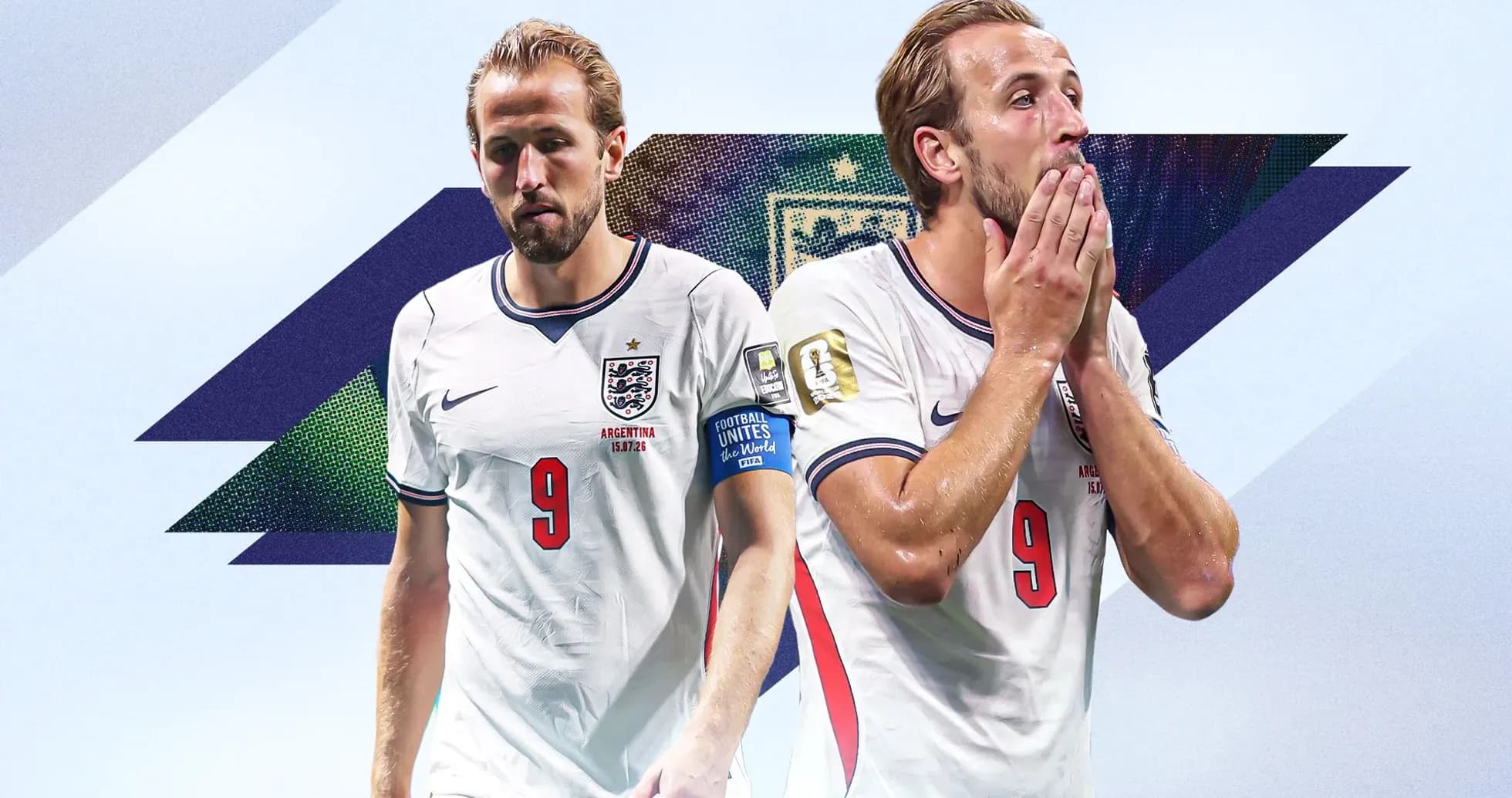
In the middle of it all, Harry Kane drifted through the chaos like a misplaced extra in his own film. His numbers are brutal: 26 touches, nine completed passes, one blocked shot, not a single touch inside Argentina’s penalty area. On paper, it reads like a no-show.
It wasn’t that simple.
This was a dirty, scrappy semi-final, and Kane embraced the filth. The first half was a series of collisions rather than combinations, and he hurled himself into all of them. He contested more duels than Lisandro Martínez and Alexis Mac Allister, flinging his body into challenges with a recklessness that felt more Sunday league than Ballon d’Or contender.
In that opening spell, it mattered. England couldn’t build much, so Kane turned himself into a battering ram.
But when the game flipped, he didn’t.
Once Gordon scored, the match demanded something very different from England’s captain. The second half posed a tactical question Tuchel never really answered. He was in an awkward place, shaped by what came before. Days earlier at the Azteca, England had produced a heroic, backs-to-the-wall display to edge Mexico, a defensive siege that will live long in memory. Kane played 89 minutes that night, scrapping, kicking, fighting for every clearance.
He was still in that mode on Wednesday.
He even said as much afterwards, insisting England needed to get higher, to press, to keep the ball.
“For one reason or another, we struggled to be on the ball, we struggle to put pressure on the ball and it allowed them to create more momentum and created more attacks for them in our final third,” Kane admitted.
The sting? He was part of the reason they couldn’t get out.
What England needed after taking the lead was an escape route: a striker to pin one of Argentina’s hulking centre-backs, offer a long ball, buy a foul, let the team breathe. Kane can do almost everything as a No 9. Almost. The one thing he cannot conjure is raw pace. So he did what he always does when the storm comes — he dropped deeper, trying to plug holes and knit play.
Wave after wave broke in front of him anyway. Argentina poured forward. England’s out ball never arrived.
This was no longer a game for Kane. Tuchel should have dragged him off. Instead, he left his captain marooned, watching the collapse unfold in slow motion.
In isolation, it was just a bad night. In context, it felt like something heavier: a door slamming shut on a season that had carried Kane to the edge of football’s highest individual honour.
For Bayern Munich, he was outrageous. He shattered the single-season goal record for a Bundesliga player with 58 in all competitions. No one in Europe’s top five leagues matched his 36 in domestic play. He became the fastest Bayern player ever to hit 100 goal contributions. Bayern strolled to the title, 16 points clear, even after easing off late on.
The numbers were so wild that the Ballon d’Or conversation had to include him. These were heights even Robert Lewandowski hadn’t reached in Bavaria. Statistically, Kane edged into Messi-Ronaldo territory. On sheer output, the case was obvious: why not the first English winner since Michael Owen?
The answer lay in the biggest games. Bayern fell short where it mattered most. They traded blows with eventual champions PSG but failed to turn the second leg. A 6-5 semi-final defeat left Kane’s season looking spectacular on paper, thin in medals.
The World Cup, then, offered a reset. Kane knew it. He said it.
“I’d be one of the favorites, definitely,” he said before the tournament. “Given the trophies I’ve won this season and the number of goals I’ve scored, I’d be in the running. Especially as, should England win the World Cup, one could imagine the trophy going to an English player.”
For five games, he played like a man chasing history. Two goals against Croatia, one against Panama, two more against Congo, plus an assist at the Azteca. He and Jude Bellingham dragged England forward; everyone else filled in around them.
The Golden Boot was in play. It usually is for the Ballon d’Or contenders. Heading into the semi-final, Kane sat two behind Lionel Messi and Kylian Mbappé. Logic was simple: if England were going to reach the final, they would need their No 9 to score. He was perfectly placed to strike.
He didn’t. And with that, the Golden Boot all but vanished. Even if he were to somehow rattle in a hat-trick against France in a third-place game he has no real business playing, it would be fantasy to expect Messi not to score against Spain in the final.
Kane will return to Germany without the World Cup, without the Golden Boot, and almost certainly without the Ballon d’Or. The door that was ajar is now slammed shut.
The cruel twist? This might have been his last real shot at it.
His move to Bayern felt like a professional rebirth. With hindsight, he probably stayed at Tottenham a year or two too long. He was superb there, season after season, one of the Premier League’s most complete forwards. But the supporting cast was always flawed, the investment always half-measured — only for Spurs to finally throw money at the problem after he’d gone.
His first two seasons in Munich did more than fill a trophy cabinet. They validated him. They proved that, in the right environment, Kane wasn’t just a flat-track bully in north London; he was an apex predator at the very top of the European game. He spoke often about studying other sports, borrowing from athletes who extended their primes by treating their bodies like laboratories. He wanted to push back against time. At club level, he has.
International football plays by different rules. There are no long arcs, no slow-burn tactical evolutions, no carefully managed rest blocks. A World Cup is a sprint at the end of a marathon. England stretched their camp as far as they could, but it was still less than two months. After a long season, this tournament became a blur of flights, sessions, and 90-minute verdicts.
When it mattered most, Kane came up short.
So what, exactly, is his England legacy becoming?
On one hand, the numbers are staggering. He is, by any sensible measure, England’s greatest ever striker. If he stays fit and stays interested, 100 international goals is within reach. Peter Shilton’s 125-cap record is there to be hunted down; Kane is already on 121. He has scored more penalties at World Cups than any player in history and owns the 2018 Golden Boot.
On the other hand, the empty shelf glares back at him. Major tournaments have left scars. Euro 2024 passed him by. Qatar 2022 brought that shanked, decisive penalty. Earlier campaigns offered mitigation — weaker squads in 2018 and at the delayed Euro 2021 — but not absolution. Players who sit at his statistical table — Messi, Ronaldo, Pelé, Maradona, Henry — can all point to a gleaming international prize.
Kane cannot.
And England? They have a problem of their own. Look beyond him and the striker depth chart is alarmingly thin. Tuchel went to this World Cup with a 30-year-old Ollie Watkins and a 30-year-old Ivan Toney as his alternatives. There is no prodigy waiting in the wings, no 21-year-old phenom ready to rip the shirt from Kane’s back.
Which means the story is unlikely to change quickly. England will almost certainly line up at Euro 2028 with Kane still at the tip of the attack. They will probably be competitive again. But by then, their captain will be 34, edging beyond his physical peak, asked to carry the same burden with a little less spring in his legs.
Who replaces him? Right now, there is no answer.
Kane, predictably, has no intention of stepping aside.
“The national team is my pride and joy,” he said. “It’s what I love to do most more than anything. Obviously four years is a long way away, I’m 33 this summer but it never ended with Leo [Messi] there, he’s still performing at the highest level. I never want to put a limit on these things.”
He won’t. The limits will be imposed by time, by tournaments, by moments like this one that slip through his fingers.
Kane has stood at this crossroads before, with a chance to turn numbers into immortality. Each time, the opportunity has faded into what-ifs. This World Cup, with its brutal ending and wasted platform, feels like the biggest miss of all — and perhaps the last time he will stand so close to the game’s summit without ever quite stepping onto it.