.svg&w=384&q=75 "GoalGist logo")
Argentina Triumphs Over England in World Cup Semi-Final
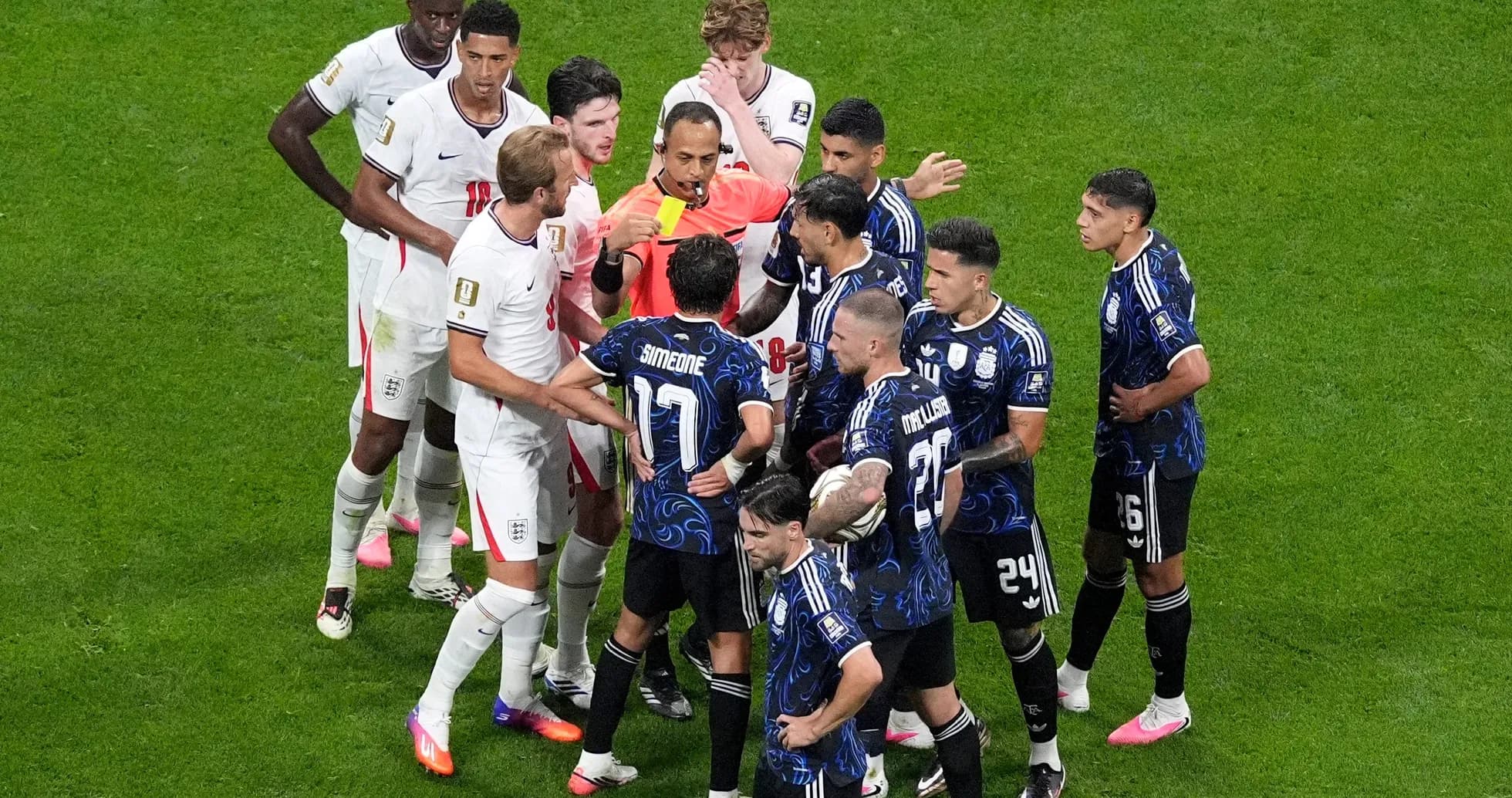
The lights had barely cooled at Mercedes-Benz Stadium when the story of this semi-final began to harden into something more permanent: England 1–2 Argentina, a classic decided not just by stars, but by structure, discipline and tiny tactical tilts that went Argentina’s way.
I. The Big Picture – Two Different Machines Collide
Both sides arrived in Atlanta with near-perfect World Cup résumés. In total this campaign, England had played 7 matches, winning 5, drawing 1 and losing just once before this semi-final. Their attacking profile was balanced: in total this campaign they scored 14 goals, split evenly between home and on their travels (7 and 7), with a total average of 2.0 goals per game. Defensively, they conceded 8 in total, at 1.3 per home match and 1.0 on their travels, for a total average of 1.1.
Argentina’s numbers were even more ruthless. In total this campaign they were perfect: 7 wins from 7, no draws, no defeats. In total they had scored 19 goals, 14 at home and 5 on their travels, averaging 2.7 goals per match overall. At the other end they had conceded just 7 in total, with a total average of 1.0 goals against. Two sides with positive goal differences, two sides used to dictating the terms.
That context framed the night: England, under Thomas Tuchel, in a familiar 4-2-3-1; Argentina, under Lionel Scaloni, in a 4-1-4-1 that tilted into something more fluid whenever L. Messi drifted between the lines.
II. Tactical Voids – The Missing Piece and the Disciplinary Edge
England’s only officially listed absentee was J. Quansah, suspended through sports court action. On paper, he is a depth defender; in practice, his absence narrowed Tuchel’s options to reshape the back line mid-game, especially once the tempo rose and the match demanded fresh legs and a different profile at centre-back.
Declan Rice carried a disciplinary shadow into the tournament’s latter stages. In total this campaign he had collected 2 yellow cards, a reflection of his role as England’s primary firefighter in midfield. At team level, England’s yellow-card distribution showed a particular vulnerability to emotional spikes just before the break and in the early second half: 25.00% of their yellows came between 31–45 minutes, and another 25.00% between 61–75. Add a single red card in the 46–60 band in total this campaign and you get a picture of a side that occasionally frays just as the tactical screws are being tightened.
Argentina’s disciplinary profile was more curious than chaotic. In total this campaign they had no red cards, but their yellows clustered late: 44.44% of their cautions arrived between 91–105 minutes and 22.22% between 106–120. In a semi-final that stayed within 90 minutes, that pattern hinted at a team that usually manages regulation time well and only stretches into risk once fatigue and extra time set in. Here, with the job done in normal time, that late-game volatility never had to be tested.
III. Key Matchups – Hunter vs Shield, Engine Room vs Enforcer
The headline duel was always going to be L. Messi against England’s defensive structure. Messi entered this semi-final as the World Cup’s top scorer: in total this campaign he had 8 goals and 4 assists from 7 appearances, with 28 shots and 18 on target. His creative volume was just as frightening: 314 total passes at 81% accuracy, with 26 key passes. Even his defensive work – 10 tackles and 1 interception – underlined how central he is to Argentina’s pressing triggers.
Tasked with standing in his path were J. Stones and M. Guehi at the heart of England’s back four, shielded by Rice and E. Anderson in the double pivot. Rice’s tournament numbers told the story of his importance: 240 total passes at 91% accuracy, 15 key passes from deep, 4 tackles, 2 blocks and 2 interceptions in total this campaign. He is both metronome and safety net.
But Argentina’s shape made that job almost impossible to isolate. With L. Paredes sitting as the single pivot and E. Fernandez, A. Mac Allister and G. Simeone forming a fluid band of four ahead of him, Messi could drop into pockets that forced Rice to choose: step out and leave the back four exposed, or hold his line and allow Messi to turn.
On the other side, England’s attacking “hunter” was a two-headed threat. H. Kane and J. Bellingham both arrived with 6 goals in total this campaign. Kane, with 18 shots and 12 on target, plus 2 penalties scored from 2 taken, was the penalty-box reference point. Bellingham, with 6 goals, 1 assist, 15 total shots and 11 on target, and 21 dribble attempts (13 successful), was the chaos agent between the lines.
Argentina’s answer was the Romero–L. Martinez partnership in central defence, backed by N. Molina and N. Tagliafico. With L. Paredes screening, their task was to compress the space that Bellingham loves, while trusting that C. Romero could step out aggressively without leaving Kane unmarked. The 4-1-4-1 gave Scaloni the luxury of a spare man around the ball more often than not; England’s 4-2-3-1, for all its balance, could be outnumbered centrally when Messi dropped into midfield.
On the flanks, A. Gordon’s presence was a key part of Tuchel’s plan. In total this campaign he had 1 goal and 3 assists, with 25 dribble attempts and 8 successes, plus 6 key passes. His duel numbers – 63 total, 24 won – showed a winger willing to engage repeatedly. Up against Molina and the right-sided interior, his job was to stretch Argentina’s compact block and create room inside for Bellingham and Kane.
IV. Statistical Prognosis – Margins, Moments and xG Logic
Strip away the emotion and the numbers still pointed to a knife-edge. In total this campaign, England’s attack at 2.0 goals per game and Argentina’s at 2.7 suggested both would find chances. Defensively, both hovered around 1.0–1.1 goals against per match. The statistical equilibrium was always likely to be broken by individual brilliance or a lapse in discipline rather than systemic collapse.
Argentina’s one obvious blemish in the data was from the spot: in total this campaign they had taken 3 penalties, scoring just 1 and missing 2, a conversion rate of 33.33%. L. Messi himself had missed 2 penalties in total, a rare vulnerability for a player otherwise operating at a 9.07 average rating. England, by contrast, had been flawless from the spot in total this campaign, scoring 2 from 2, both via Kane. If this semi-final had tilted toward a penalty shootout narrative, the numbers might have favoured England.
Instead, Argentina’s superior form line – 7 wins from 7 in total, with a biggest away win of 1-3 and a biggest home win of 3-0 – translated into the kind of control that keeps matches out of the lottery zone. Their ability to score freely while maintaining a total goals-against average of 1.0 meant that even when England inevitably created, the South Americans always carried the heavier punch.
Following this result, the story of the semi-final is one of two finely tuned machines, but only one with a true outlier: Messi. England had structure, numbers and multiple scorers; Argentina had all of that plus the tournament’s defining individual. In a contest this balanced on paper, that single asymmetry was always likely to decide who walked out of Atlanta bound for the World Cup final.