.svg&w=384&q=75 "GoalGist logo")
Haiti vs Scotland: Tactical Analysis of World Cup Opener
Haiti’s 0-1 defeat to Scotland at Gillette Stadium unfolded as a classic contrast between territorial control and structural efficiency. In this World Cup Group Stage opener, Haiti’s 4-4-2 under Sebastien Migne produced more volume and possession (54%) but struggled to convert that platform into clear, repeatable chances, finishing with 1.21 xG from 15 shots. Steve Clarke’s Scotland, mirroring the 4-4-2 shape, accepted a smaller share of the ball (46%) yet managed the decisive moment through John McGinn’s first-half strike and then turned the game into a controlled defensive exercise, generating 1.07 xG from just 9 attempts.
Team Structures
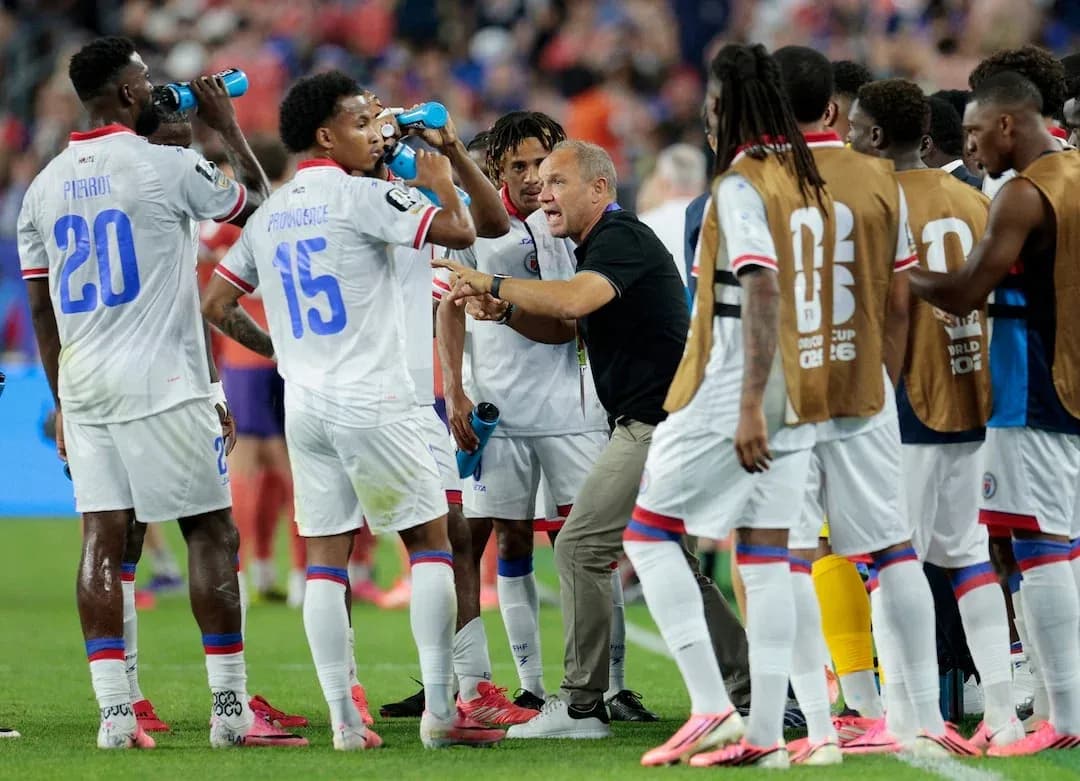
Structurally, Haiti’s 4-4-2 was quite orthodox: Johny Placide in goal behind a back four of Carlens Arcus, Ricardo Adé, Hannes Delcroix and Martin Expérience. The double pivot of Danley Jean Jacques and Jean-Ricner Bellegarde sat behind a fluid band of wide and half-space operators in Louicius Don Deedson and Ruben Providence, with Bellegarde also stepping higher at times, supporting the front pair of Frantzdy Pierrot and Wilson Isidor. The plan was clear: use the extra central bodies and superior pass volume (431 passes, 367 accurate at 85%) to progress methodically and pin Scotland back.
Scotland’s 4-4-2 was more transitional by design. Angus Gunn in goal was protected by a back line of Aaron Hickey, Grant Hanley, Jack Hendry and Andy Robertson. In midfield, Ben Gannon-Doak and John McGinn worked the flanks, with Scott McTominay and Lewis Ferguson central, supporting the front duo of Lawrence Shankland and Che Adams. Scotland’s 373 passes (306 accurate, 82%) reflected a more vertical approach: fewer phases, but more intent to break Haiti’s structure quickly rather than sustain long spells of circulation.
Tactical Analysis
The key tactical hinge was how each side used its wide zones. Haiti’s full-backs, especially Arcus, pushed high to create 2v1s with Deedson and Providence, contributing to 8 shots inside the box and 4 corners. However, Scotland’s wide midfielders and full-backs defended those areas with discipline, accepting crosses but protecting the central lane. Hanley and Hendry dealt with Pierrot and Isidor primarily through positioning rather than aggression, helping keep Haiti to just 2 shots on goal despite their territorial advantage.
McGinn’s 28th-minute goal encapsulated Scotland’s offensive idea: win the ball, connect quickly through midfield, and exploit Haiti before their block could reset. Once ahead, Scotland were content to compress space in their own half, with McTominay and Ferguson screening passes into Pierrot and Bellegarde. Haiti’s response was to increase their passing tempo and volume, but too often the final action was rushed or forced, reflected in the imbalance between total shots (15) and shots on target (2).
Substitutions
The substitutions further clarified both teams’ intentions. At 61', Josué Casimir (IN) came on for Louicius Don Deedson (OUT), signalling Haiti’s desire for more direct running and penalty-box presence from the right side. Later, at 76', Lenny Joseph (IN) replaced Wilson Isidor (OUT), adding fresh legs to attack Scotland’s central defenders. Yassin Fortune (IN) for Ruben Providence (OUT) at 85' was another attacking tweak, prioritising one-on-one threat and late box entries over initial build-up security.
Scotland’s changes were almost entirely about game management. At 75', Ryan Christie (IN) came on for Ben Gannon-Doak (OUT), adding a more possession-oriented profile on the flank. In the same minute, Nathan Patterson (IN) replaced Aaron Hickey (OUT), a like-for-like swap that maintained defensive balance while injecting energy at right-back. Lyndon Dykes (IN) for Che Adams (OUT) gave Scotland a more direct outlet to relieve pressure and win fouls. At 83', Findlay Curtis (IN) for John McGinn (OUT) and Kenny McLean (IN) for Lawrence Shankland (OUT) further tilted the side toward defensive solidity and ball retention rather than attacking ambition.
Goalkeeping and Discipline
In goal, Johny Placide (Haiti) was statistically quiet, credited with 1 save, a reflection of Scotland’s low shot volume rather than any lack of involvement in build-up or sweeping. Angus Gunn (Scotland) made 2 saves, and with 0.22 goals prevented for both keepers, the data suggests that neither was required to perform high-difficulty heroics; the game was decided more by structural control and shot quality than by goalkeeping exploits.
Defensively, both sides walked a fine disciplinary line. Haiti committed 23 fouls to Scotland’s 21, and their higher foul count was partly a function of aggressive counter-pressing once possession was lost. Bellegarde’s 39' yellow card for “Tripping” underlined Haiti’s willingness to break up Scottish transitions at source. Scotland’s 3 yellows — Hickey for “Holding” at 46', Curtis for “Roughing” at 90+1', and McLean for “Roughing” at 90+5' — reflected late-game strain as they protected the lead under mounting Haitian pressure.
Statistical Overview
Statistically, the match paints a picture of Haiti as the more proactive, possession-heavy side: more shots (15 vs 9), more blocked efforts (4 vs 2), more corners (4 vs 3), and a slight xG edge (1.21 vs 1.07). Their passing efficiency at 85% also indicates a technically sound performance. Yet Scotland’s defensive structure and compact 4-4-2 block successfully funnelled Haiti into less efficient shooting positions, keeping most of the danger manageable for Gunn and his back line.
Conclusion
From a tactical lens, Scotland executed a classic tournament away-style game: score first, then compress space, manage tempo through substitutions, and accept a lower share of the ball. Haiti, despite controlling possession and territory, lacked enough variation in their final-third patterns to consistently disrupt Scotland’s settled block. The narrow 0-1 scoreline and near-par xG values suggest a tight contest, but in terms of game-state management and structural clarity, Scotland’s plan proved marginally more coherent and ultimately decisive.