.svg&w=384&q=75 "GoalGist logo")
Granit Xhaka Under Criminal Investigation for Forged Vaccine Certificate
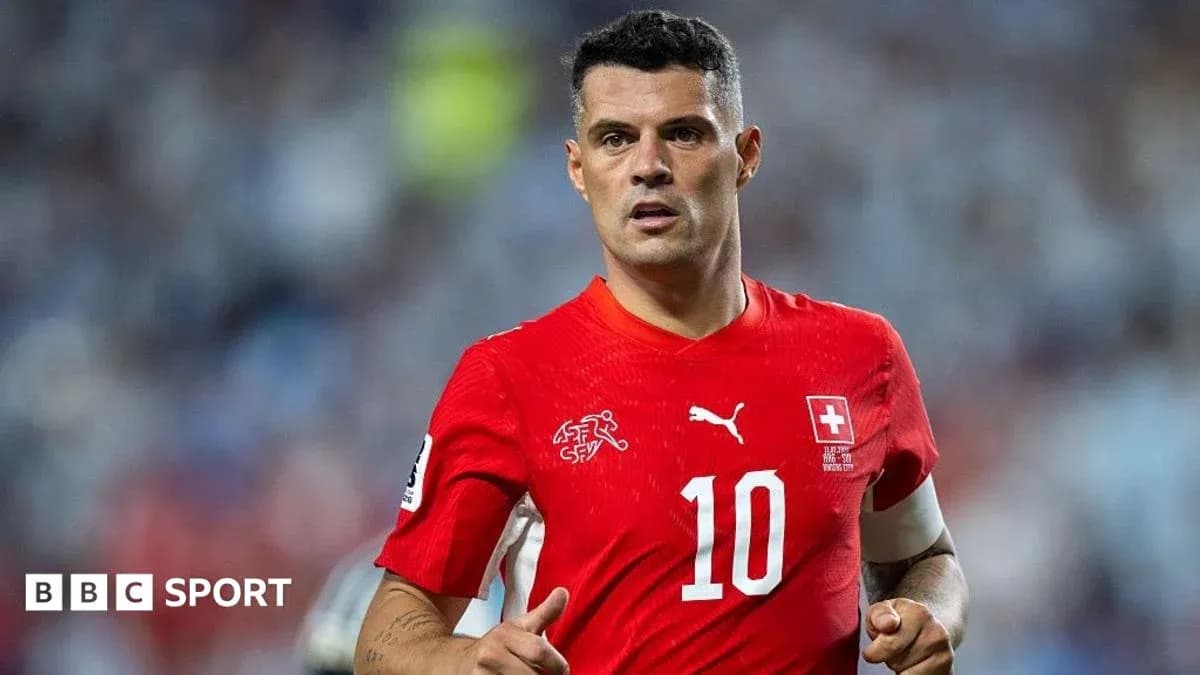
Granit Xhaka, the captain and standard-bearer of Swiss football, is under criminal investigation in his home country over allegations he obtained a forged Covid-19 vaccination certificate.
Prosecutors in Lucerne confirmed they are examining whether the 33-year-old Sunderland midfielder, who was still at Arsenal at the time, broke the law in 2022 by acquiring what they describe as a “false or forged” certificate. At that point, proof of vaccination was not universally mandatory in Switzerland, but it was a gateway to large parts of public life and, crucially for an international footballer, to travel abroad.
Xhaka admits “mistake” and mistrust of vaccine
The story burst into the open on Monday when Xhaka posted a lengthy statement on social media. He did not dispute that he had obtained a certificate without being vaccinated.
He wrote that he had a “mistrust” of the Covid-19 vaccine and said he had been “influenced by worries and uncertainty”. Instead of seeking medical advice and clarity, he admitted, he took a shortcut.
“In this troubled state of mind I acquired a vaccine certificate, instead of clarifying my unanswered questions in the proper way,” Xhaka said. “Today I see clearly, that this way was not correct. It was a mistake. I'm sorry.
“I take responsibility for this decision, will engage with the process of establishing the facts and fully co-operate with the relevant authorities.”
The Office of the Public Prosecutor in Lucerne will now determine whether that “mistake” amounts to a criminal offence.
Swiss health rules and a changing landscape
Switzerland’s Federal Office of Public Health underlined the context. There was never a blanket legal requirement for every citizen to hold a Covid certificate. But for a period, it was effectively a key to normal life: needed for access to certain venues, events, activities and, in many cases, for crossing borders.
Those domestic measures were in force until spring 2022. After that, the certificates did not disappear. They continued to be issued, mainly to allow people to meet foreign entry rules when travelling.
For a footballer like Xhaka, constantly on the move with club and country, that document was more than a formality. It was a passport to his profession.
Switzerland’s captain steps away
The fallout has already reached the national team. The Swiss Football Association announced that Xhaka, their record appearance holder with 152 caps, has withdrawn from the squad for the upcoming Nations League fixtures against Scotland, North Macedonia and Slovenia.
The decision, the association stressed, was taken jointly by the player and the national-team management after his public admission.
Switzerland face away trips to North Macedonia and Scotland on 26 and 29 September, then host Slovenia and North Macedonia in early October. Xhaka will not be involved, and his longer-term role is suddenly uncertain.
The federation made it clear that conversations about his future with the team will take place only after this international window closes. For a player who captained his country at the World Cup earlier this year, leading them to the quarter-finals before defeat by eventual runners-up Argentina, it is a stark turn.
Silence at Sunderland
At club level, Sunderland have closed ranks. Head coach Regis le Bris, speaking after the Black Cats’ defeat at Manchester City on Sunday, refused to be drawn into the controversy.
“It is not my area to speak about those problems or situations,” he said. “My area is football. About football, he is really good.”
For now, that is the split-screen reality of Granit Xhaka’s career: a key figure on the pitch, a national icon off it, and a central character in a legal investigation that could shape the next chapter of his life with Switzerland.