.svg&w=384&q=75 "GoalGist logo")
Germany's Tactical Dominance in 7-1 Victory Over Curaçao
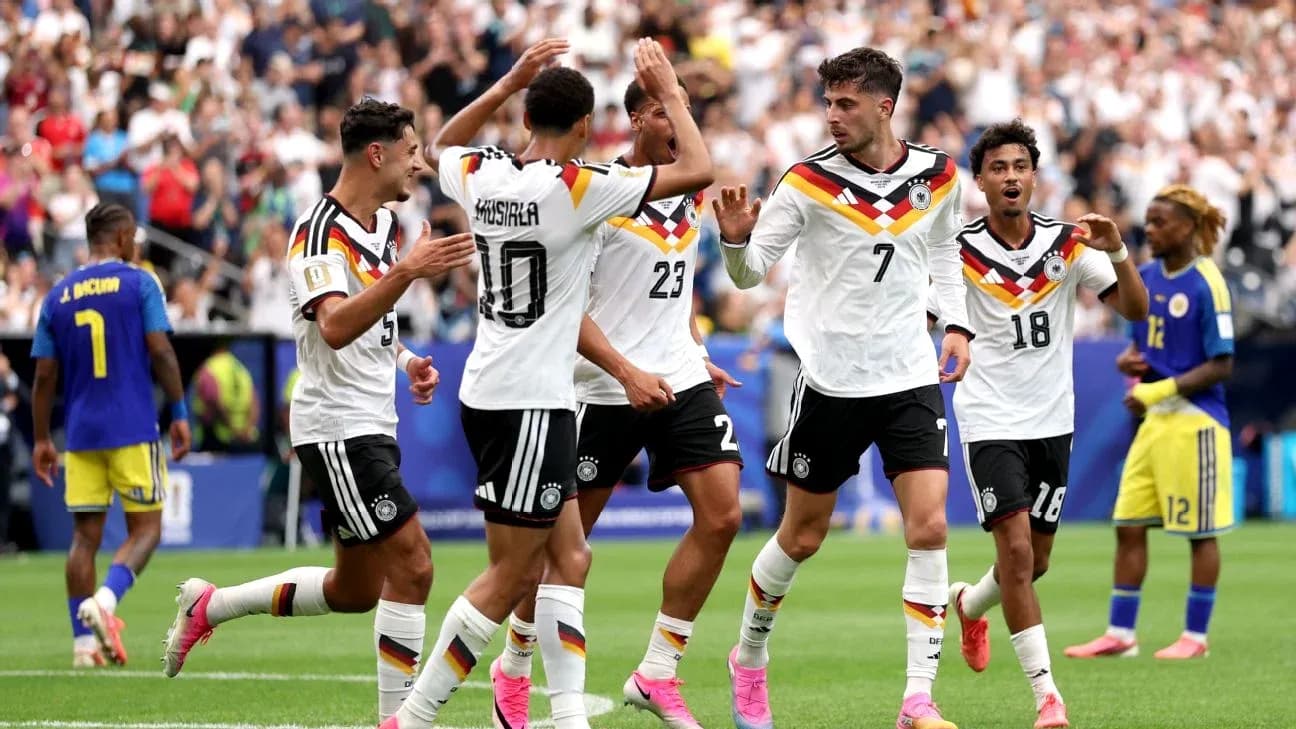
Germany’s 7-1 dismantling of Curaçao at NRG Stadium was a tactical demonstration of control and vertical aggression from Julian Nagelsmann’s 4-2-3-1 against Dick Advocaat’s 4-3-1-2. Germany combined heavy territorial dominance with relentless occupation of the half-spaces, turning 65% possession and a 27–8 shot advantage into a scoreline that actually exceeded their already high 3.91 xG. Curaçao’s compact midfield three and narrow front two were repeatedly stretched by Germany’s full-backs and No.10, while Germany’s high rest-defense structure left Curaçao with only isolated transitions and an xG of 0.4.
Germany’s attacking structure was built on a clear positional grid. In the 4-2-3-1, Joshua Kimmich and Nathaniel Brown provided width from full-back, with Felix Nmecha and Aleksandar Pavlović forming a double pivot behind an aggressive line of three: Leroy Sané wide, Florian Wirtz drifting inside from the left, and Jamal Musiala as a central playmaker behind Kai Havertz. The pattern was consistent: Kimmich and Brown advanced early, pinning Curaçao’s wide defenders and forcing the visitors’ midfield three to shift laterally, opening central lanes for Musiala and Wirtz to receive between the lines.
First Goal
The opening goal on 6 minutes captured that mechanism. Germany had already established sustained possession, and when Nmecha arrived from deeper zones, he was found by Wirtz, whose assist underlined his role as the primary connector in the left half-space. Curaçao’s 4-3-1-2, with Tahith Chong initially listed as the advanced midfielder and Sontje Hansen and Jürgen Locadia up front, struggled to track Nmecha’s late run from the double pivot. Their midfield line was pinned by Germany’s width and the constant threat of Havertz between the centre-backs, leaving the edge of the box unprotected.
Curaçao’s Equaliser
Curaçao’s equaliser on 21 minutes through Livano Comenencia showed their best attacking pattern: direct, vertical, and exploiting brief German disorganisation. From a 4-3-1-2 base, Comenencia, nominally a midfielder, stepped into advanced zones to support the front two. When Germany’s rest defense was momentarily stretched, Curaçao managed to find Comenencia in a pocket, and he converted one of only two shots on target. That was the exception rather than the rule; with just 8 total shots and 0 blocked efforts, Curaçao rarely sustained pressure.
Germany’s Second Goal
Germany’s second goal, Nico Schlotterbeck’s strike on 38 minutes, was a pure set-piece of structural superiority. Brown, the left-back, provided the assist, underlining how high and aggressively the full-backs were used. Germany repeatedly created overloads on the left, with Brown overlapping Wirtz and Musiala drifting toward that side. Curaçao’s back four were forced to compress, leaving Schlotterbeck with space to attack the delivery. The pattern of Germany’s 8 blocked shots and 22 efforts inside the box shows how often they reached deep crossing and cutback zones.
The penalty at 45+5, converted by Havertz, came as the logical outcome of continuous pressure. By half-time Germany led 3-1, having translated their 65% possession into 12 shots on goal over the full match and already forcing Curaçao into deep, reactive defending. Havertz’s role as a flexible No.9 was central: he frequently dropped to combine with Musiala and Wirtz, dragging Riechedly Bazoer and Armando Obispo into uncomfortable areas and opening channels for wide runners.
Second Half
Nagelsmann’s in-game management further tilted the tactical balance. Immediately after the interval, Germany struck again at 47 minutes, Musiala finishing a move assisted by Kimmich. Here, the right-back’s advanced positioning was decisive; with Curaçao trying to adjust after a half-time substitution (Jeremy Antonisse (IN) came on for Sontje Hansen (OUT) at 46'), Kimmich exploited the right flank, received high and wide, and delivered for Musiala arriving centrally. Curaçao’s midfield could not compress quickly enough, and their 4-3-1-2 became a flat 4-4-2 out of possession, losing central compactness.
From 64 minutes onward, Germany’s substitutions turned dominance into a rout. Jamal Musiala (OUT) made way for Deniz Undav (IN), adding a second penalty-box presence while Havertz continued to roam. On the Curaçao side, Jürgen Locadia (OUT) was replaced by Jearl Margaritha (IN), but this did little to change their inability to retain the ball against Germany’s counter-press. Brown’s goal on 68 minutes, assisted by Undav, again came from full-back inversion and overloads: Undav’s presence pinned the centre-backs, while Brown attacked the space from deep.
Nagelsmann then refreshed his back line and midfield without losing structural integrity: Nathaniel Brown (OUT) for David Raum (IN), Jonathan Tah (OUT) for Antonio Rüdiger (IN), and Felix Nmecha (OUT) for Leon Goretzka (IN), all at 73 minutes. Raum replicated Brown’s high-and-wide role, while Goretzka added late box runs from midfield. This continuity of roles explains why Germany’s attacking volume never dipped; they finished with 27 total shots and 8 corners, sustaining pressure until the final whistle.
Final Goals
Undav’s goal at 78 minutes, set up again by Kimmich, typified the late-game pattern: Germany recycling possession around the box, full-backs high, and multiple forwards occupying the last line. Kimmich’s assist numbers were a product of his dual role as both first builder and final-third playmaker. After that, Kimmich (OUT) was replaced by Waldemar Anton (IN) on 83 minutes, with Germany effectively locking the game while still pushing forward. Curaçao’s response, bringing on Gervane Kastaneer (IN) for Tahith Chong (OUT) at 83 minutes, aimed at adding pace up front, but by then they were too deep and too isolated to threaten.
The final flourish came at 88 minutes: Havertz’s second goal, assisted by Undav, underlined Germany’s vertical ruthlessness even in the closing stages. Undav dropped off the line to receive, then released Havertz attacking the channel between full-back and centre-back. Curaçao’s defensive block, already exhausted, could not track the coordinated movement of two central forwards.
Defensive Structure
Defensively, Germany’s structure was built on aggressive counter-pressing rather than deep protection. With 18 fouls to Curaçao’s 11, they were prepared to stop transitions early. Manuel Neuer (Germany) faced only 2 shots on goal and made 1 save, reflecting how rarely Curaçao reached dangerous zones. At the other end, Eloy Room (Curaçao) was under siege: Germany’s 12 shots on goal and 3.91 xG against only 4 saves highlight how often their finishing found the corners or exploited close-range positions. Curaçao’s goals prevented figure of -2.47 underlines that they conceded significantly more than a standard shot-stopping performance would predict.
Possession Stats
In possession, Germany’s passing structure was clean and efficient: 633 passes, 550 accurate (87%), with the centre-backs and double pivot circulating before finding Wirtz, Musiala, and later Goretzka between the lines. Curaçao, with 336 passes and 276 accurate (82%), tried to build but were repeatedly forced long or wide, where Germany’s full-backs and centre-backs won duels early. The 65–35 possession split and 8–1 corner count are the statistical reflection of a game played almost entirely in Curaçao’s half.
Ultimately, this was a tactical mismatch: Germany’s layered attacking structure, full-back usage, and depth of options off the bench translated territorial control into a ruthless 7-1, while Curaçao’s 4-3-1-2 never found a stable way to protect central spaces or launch consistent transitions.