.svg&w=384&q=75 "GoalGist logo")
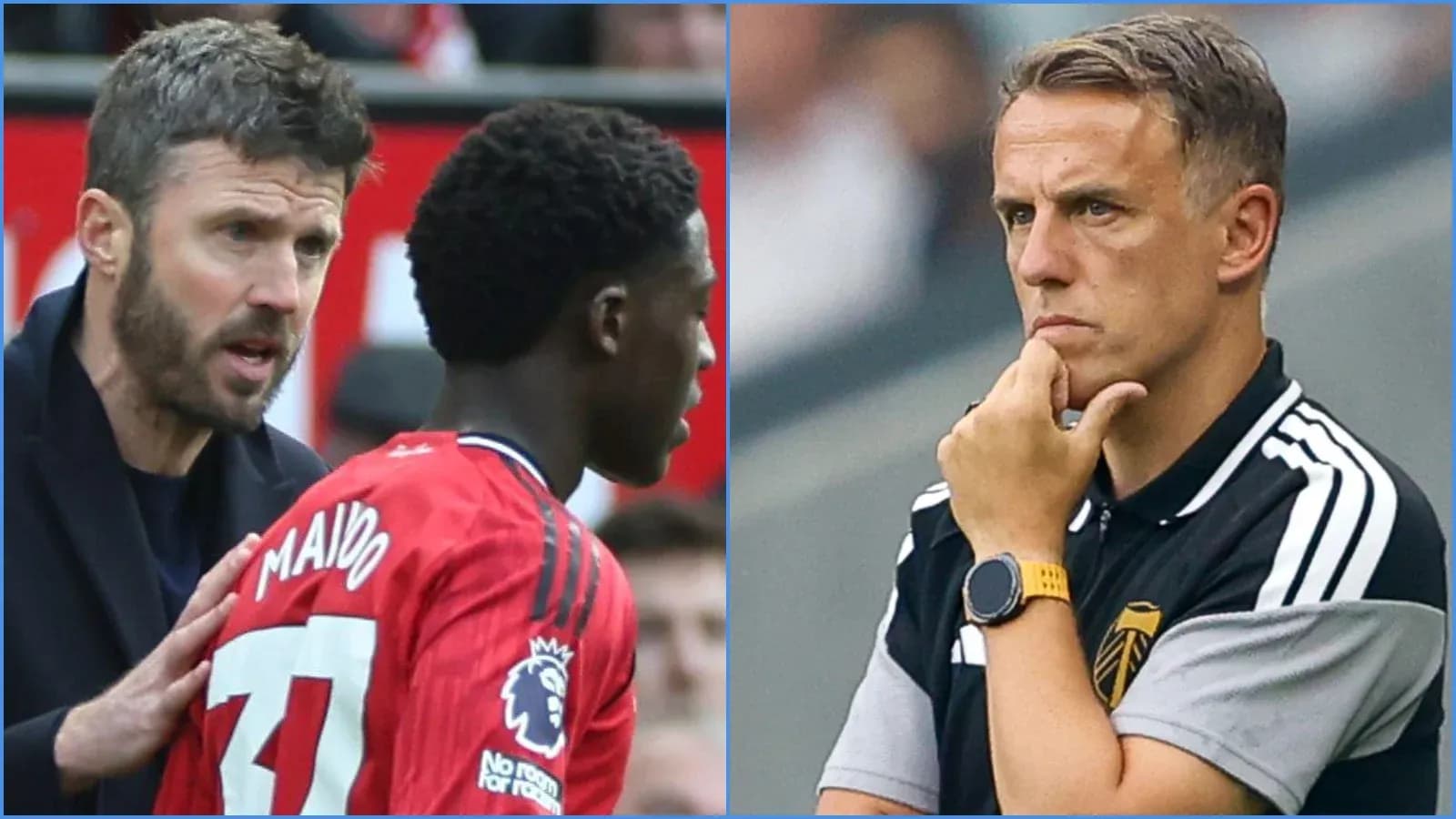
England's World Cup Preparation: Supercomputer Insights and Phil Neville's Role
World Cup noise is building. England are tweaking, plotting, consulting. And, inevitably, being told by a computer they’re doomed.
Somewhere in the middle of it all, Phil Neville is apparently at the heart of a “shock role”, a Sun columnist is wandering around Manhattan looking for Harry Kane on a back page, and Manchester United are trying to reverse‑engineer Paris Saint‑Germain’s midfield by shunting a few magnets on a tactics board.
Welcome to the warm‑up act to a World Cup summer.
England, a supercomputer and a familiar warning
England’s chances have already been fed into The Sun’s “mysterious supercomputer”, which has spat out a number that is supposed to crush the nation’s dreams: an 11.3% probability of winning the tournament.
Third favourites. Behind Spain and France. In line with what the bookmakers think.
In other words, about as good a position as a serious contender can realistically expect heading into a 48‑team World Cup. Yet the headline message is a warning that the “wait for an international trophy may not end this summer”, as if anyone genuinely believed every entrant gets a medal and a parade.
The machine has essentially confirmed the obvious: England are one of the leading candidates, but the sport still operates on jeopardy. Not that “decent chance, could go either way” quite carries the same sting as doom dressed up as data.
Phil Neville, “shock role” and a very normal phone call
The real intrigue, we’re told, lies in Neville’s supposed “shock role for England at World Cup”, breathlessly framed just a fortnight after he was sacked by an MLS club.
Strip away the drama and the story is almost disarmingly straightforward.
Thomas Tuchel and the FA wanted insight into the specific challenges of staging a World Cup in the United States: climate, time zones, travel, even traffic. So they spoke to two English coaches who have actually worked there – Neville and John Herdman – to understand how to manage the logistics and acclimatisation.
Neville, a former England international, has already been part of the national-team coaching structure. He managed the England women’s side for three years, taking them to two tournaments in the US. He has spent the last five years coaching in the country. If you were drawing up a shortlist of people to ask about life on the American football circuit, he would be on page one.
The best part? Neville has already laid the whole thing out himself. In a column for The Times last week, he detailed how it began:
“Last year I took a call from John McDermott, the technical director at the FA. I was managing Portland Timbers at the time and John said he wanted to pick my brain about the challenges England may face during a World Cup in the United States.”
A technical director calls an experienced coach in that market. They talk for 90 minutes on Zoom. The information feeds into planning. It’s diligent, methodical, entirely unsurprising.
So that “shock role” is neither shocking nor new. It’s just England doing their homework.
Manhattan, MLB and a missing World Cup buzz
While the FA quietly ring around for expertise, Martin Lipton is pacing Manhattan, searching for World Cup fever in the city’s newspapers and not finding much.
His conclusion in The Sun: “New York has NO appetite for World Cup fever.”
His evidence? On a Monday morning, the sports pages of three New York papers contained no mention of Harry Kane, Lionel Messi or Ronaldo. Instead, they were full of the NBA playoffs and the New York Yankees and New York Mets, both deep into their MLB seasons.
So the sports pages in a US city covered the NBA and baseball actually being played, rather than a tournament that hasn’t kicked off yet. The absence of wall‑to‑wall World Cup coverage weeks out is framed as a lack of passion, when it looks suspiciously like a simple editorial decision: lead with the games on tonight, not the ones on next month.
England’s base and a very different kind of scouting
Back in England’s own camp, another Sun piece zeroes in on the team’s training base being next to what is described as a “notorious dogging spot loved by randy couples”.
The location? Swope Park. The reporting? A trawl through adult websites, social media apps and Facebook posts.
We’re told the park is popular enough for “dogging and cruising” to feature on various platforms, including one Facebook user asking: “Anyone know what goes on at Swope Park at night?” The answer, according to the piece, involves frisky adults parking by a golf course and meeting near the Grecian‑style Thomas H. Swope Memorial, a short walk from the football pitches.
It’s lurid colour rather than sporting insight, but it illustrates the strange gravitational pull of an England World Cup base: every blade of grass, every nearby landmark, every after‑dark rumour is suddenly part of the story.
Manchester United’s “PSG-style” midfield vision
While England’s preparations revolve around climate, logistics and the occasional tabloid sideshow, Manchester United are dreaming of something altogether more glamorous: a “PSG-style midfield”.
The pitch from Samuel Luckhurst is that United are “set to create” a Paris Saint‑Germain‑inspired engine room by signing Ederson for £35m, shifting Bruno Fernandes deeper and giving Kobbie Mainoo licence to roam further forward.
Three midfielders. One slightly back, one slightly forward, one new signing. The template, we’re told, is the trio of Vitinha, Fabian Ruiz and Joao Neves, who have powered PSG to back‑to‑back Champions League titles and the status of best team in the world.
It’s certainly true that Michael Carrick, watching from a distance, “considers the Iberians to be the benchmark amid United’s midfield overhaul”. He’s hardly alone in admiring them. But the leap from admiration to imitation is doing some heavy lifting.
Vitinha, Ruiz and Neves are not simply three bodies in central areas. They are an integrated, technically exquisite unit, honed at the highest level. To suggest United can replicate that by dragging Fernandes a few yards back, pushing Mainoo on and plugging in Ederson – a player who did not make Brazil’s World Cup squad ahead of a 32‑year‑old Fabinho and is replacing a 34‑year‑old at club level – is an extraordinary simplification.
The “breaking news” here is less that United rate PSG’s midfield, and more that they appear to believe it can be recreated by rearranging the magnets and writing a cheque.
A headline twist in Liverpool and Madrid
The headline craft isn’t confined to Manchester.
“Trent Alexander-Arnold Liverpool reunion to be announced as four-year deal is signed,” screams the Liverpool Echo.
The reality? Ibrahima Konaté is joining Real Madrid.
The “reunion” in question is not Alexander-Arnold returning to Anfield, but rather the prospect of him potentially facing his former team-mate in the white of Madrid somewhere down the line. It’s an audacious piece of headline gymnastics, using one Liverpool star’s name to frame another player’s move to a different giant.
Arteta’s review and the doctor who paid the price
At Arsenal, the language is equally dramatic.
“Mikel Arteta rocked as key staff member leaves Arsenal just weeks after stunning Premier League title win,” declares The Sun.
The detail tells a different story. Arsenal have sacked their head doctor, the decision emerging from an Arteta‑led review into the club’s injury problems over the season.
This is not a bolt from the blue that has blindsided the manager. It is a direct consequence of a process he commissioned, a structural change born of frustration at fitness issues undermining a title‑winning campaign.
“Rocked” suggests a destabilising shock. What actually happened looks far more like a ruthless, premeditated response from a manager intent on stripping out anything he believes is holding his squad back.
England will step into this World Cup with a supercomputer rating, a carefully researched acclimatisation plan, and a training base with a colourful local reputation. Around them, clubs like United and Arsenal are trying to reshape the future in midfield magnets and medical departments.
The question now is simple: when the football finally starts, whose grand plans will survive contact with reality?

