.svg&w=384&q=75 "GoalGist logo")
Dortmund's New Hope: Konstantelias and Karetsas Shine in Bundesliga Opener
Borussia Dortmund had been crying out for this. Not just a win to open the Bundesliga season, but a jolt of electricity, something to make Signal Iduna Park lean forward again.
On Saturday evening, two 18-year-old Greeks supplied it.
Giannis Konstantelias and Konstantinos Karetsas lit up Dortmund’s 2-0 victory over Hamburger SV, turning a routine opener into a statement about how this team might look in the months ahead.
"These are two lads who can and will give us a different dimension here, and they showed that today," coach Niko Kovac told Sky. He had promised “spectacular things” from his new technicians before kick-off. Within 45 minutes, they had delivered.
A New Axis Between the Lines
The idea behind Dortmund’s summer rebuild was clear: replace Julian Brandt’s creativity without losing tempo, and ideally add more. Konstantelias and Karetsas, both signed from smaller European leagues, are cut from a similar cloth to the departed playmaker. But they bring a sharper edge.
Both can do what Brandt did – drift between the lines, receive under pressure, pick passes. The difference lies in how they move from stillness to chaos. From a standing start, they explode. They don’t wait for the game to come to them; they grab it, especially in those tight spaces where matches are often decided.
Against HSV, that quality was unmistakable.
For 45 minutes, Dortmund’s attacking play revolved around the two Greeks. They constantly rotated, showed for the ball, then turned and drove. The tempo between the lines was suddenly higher, the football cleaner and more incisive. Passes zipped, defenders twisted, gaps opened.
Konstantelias, who had already teased his potential in the Super Cup defeat to Bayern Munich, took another clear step. His close control at full speed stood out, as did his agility and the fluidity of his movement. He didn’t just dazzle with the ball, either. Around the half-hour mark he thundered into a midfield challenge, won the ball, and was roared on by the Südtribüne. It felt like a player introducing himself properly to his new home.
Then came the moment that sent the stadium into full celebration.
Shortly before half-time, Konstantelias made it 2-0, marking his Bundesliga debut with his first goal for BVB. The shot took a deflection off a Hamburg defender, but the idea behind it summed him up: a no-look finish aimed at the near corner, full of imagination and audacity. Defensive leader Waldemar Anton raved on Sky: "First half top, it was perfect. We implemented everything we wanted to implement."
After barely 100 competitive minutes in black and yellow, Konstantelias already looked like a future fan favourite. The verve, the courage, the joy in his game – it all fit this stadium.
Then, just as the story seemed to be writing itself, it turned.
From Euphoria to Anxiety
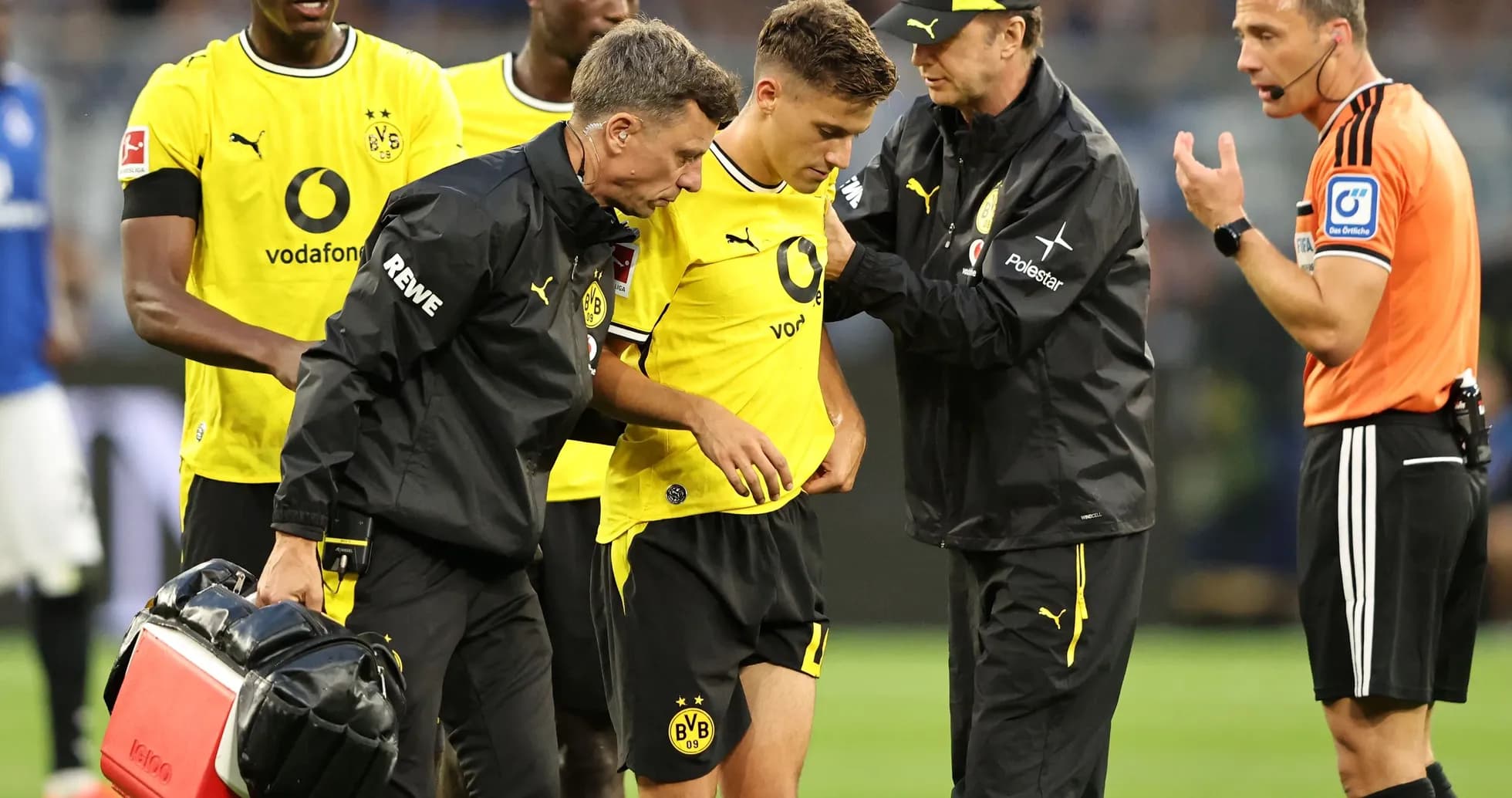
Early in the second half, Konstantelias almost had his second. Moments later, he was on the turf, clutching his knee after an awkward movement in a challenge. He stayed down. The noise inside the stadium changed instantly.
When he left the pitch in the 54th minute, his expression said enough: fear, frustration, disbelief. The party atmosphere gave way to concern.
"Of course, we should be a little bit careful today about what we communicate. But we are certainly concerned about a more serious injury," sporting director Ole Book admitted on Sky. Asked directly whether there was a fear of a cruciate ligament tear, he did not dodge it: "That concern is there."
Kovac’s tone after the game matched that worry. "We have to talk about something more than that. We will have the examination on Sunday. But at least it doesn't sound good from what the doctor told me," the coach said.
If the detailed tests confirm the initial fears and Konstantelias is ruled out for months, it would be a brutal blow – for the player, who had just arrived and immediately convinced, and for a Dortmund side that already looked different with him on the pitch.
The impact of his absence was visible immediately. Without him, BVB’s dominance faded. HSV improved after the break, but it was also clear that a large portion of Dortmund’s mobility and inventiveness had left the field with their new No. 10.
"When Dortmund play from right to left, play into the spaces in between, then first of all you do a lot of chasing and don't really manage to get into the press. That was our problem," Hamburg captain Nicolai Remberg explained on Sky. He was talking about the first half, and about Konstantelias and Karetsas in particular.
Two Greeks, One Big Promise
Those two were the heart of Dortmund’s best football on the night. Constant movement, tight control, fast decisions – they made the spaces between HSV’s lines feel enormous.
"Brutal," was Anton’s verdict on the pair. "The mobility they have, how dangerous they are, that is a great quality at that age and we need that for the future as well. I am glad we have them with us."
That is precisely what makes the possible long-term absence of Konstantelias so painful. Karetsas suddenly risks losing his ideal partner just as their understanding was beginning to click in competitive matches.
Inside the club, the sense of frustration is obvious. "I felt incredibly sorry for the lad," Book stressed. "He has had a great presence here from day one, also in the dressing room. We all already like him very much. When you then play such a good first half and have to be substituted and something more serious is feared, it is just unbelievably annoying."
On Saturday, Kovac turned to Marcel Sabitzer as a replacement. The Austrian, more defensively minded and more structured in his game, naturally could not replicate Konstantelias’ unpredictability. The rhythm changed. Dortmund became more controlled, less explosive.
In pure profile terms, 18-year-old Samuele Inacio would be the closest like-for-like option in the squad. But his evening against HSV lasted only a flash – a lightning red card after coming on, a brutal way to make an impression. Whether he is already ready to shoulder the creative burden at Konstantelias’ level is highly doubtful.
Maximilian Beier is the more experienced alternative, but using him centrally between the lines would force Kovac to abandon his plan of deploying the Germany international on the flanks. That, in turn, would open up a new gap out wide.
So the question hangs in the air: can Dortmund really replace what Konstantelias appeared ready to bring?
Transfer Clock Ticking – and a Familiar Name
Time is not on their side. The summer transfer window closes on Tuesday, 1 September, at 8pm. Officially, there is no panic.
"Depending on how serious the injury actually is, we will align our next steps accordingly. But one thing is certain: over the next three days, we are not planning anything," said sporting managing director Lars Ricken.
The caveat was clear: that stance depends entirely on the medical report. Ricken himself assumed the worst-case scenario was a real possibility.
Some of the obvious names are already off the table. Said El Mala, once Dortmund’s preferred option before the Konstantelias deal, has extended his contract at 1. FC Köln and is no longer available.
So attention naturally drifts back to a player whose name has never truly disappeared from Dortmund’s orbit: Jadon Sancho.
The Englishman would fit the profile. Like Konstantelias and Karetsas, Sancho can create dynamism from a standing start, break open compact blocks and live between the lines and the flanks. Speculation about a third spell at BVB had cooled after the arrivals of the two Greeks. It may not stay that way.
Sancho enjoyed the best football of his career in Dortmund colours. Since his contract at Manchester United expired, the 26-year-old has been without a club and would be available on a free transfer. Financially, that keeps the risk low, although Sancho would have to accept a significant pay cut to return.
The bigger question is sporting. Can the former super talent ever rediscover his old level? His recent loan spells at Chelsea and Aston Villa were largely disappointing, a far cry from the fearless winger who once tore up Bundesliga defences.
For now, everything at Dortmund hinges on a scan result. If Konstantelias’ season is interrupted almost as soon as it began, BVB will be forced into an answer: trust the kids already in-house, reshape the system again – or call an old friend and ask him to revive both his own career and their suddenly fragile new attacking blueprint.