.svg&w=384&q=75 "GoalGist logo")
Darwin Nunez: Liverpool's Future at a Crossroads
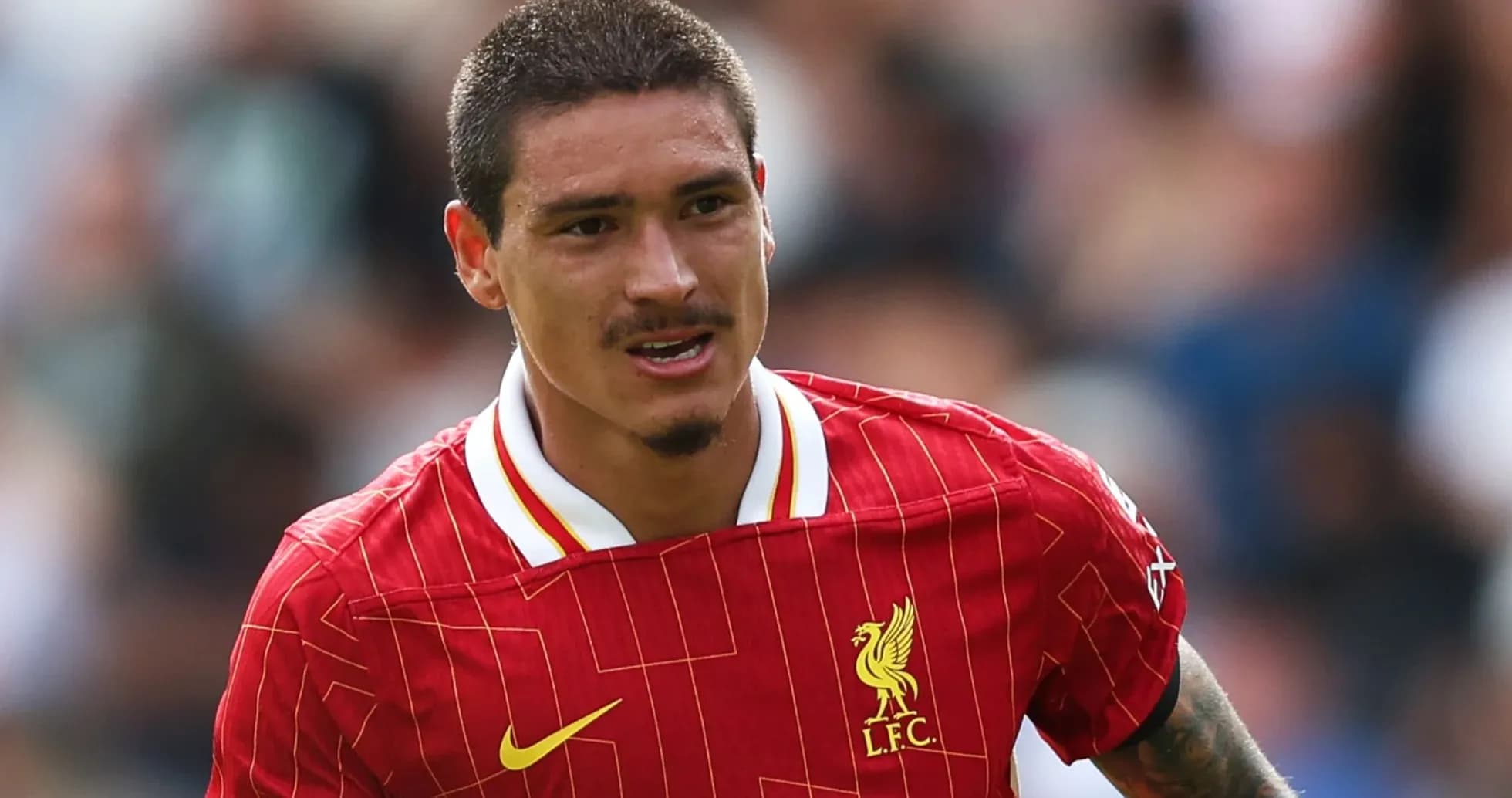
When Jurgen Klopp’s Liverpool were at full volume, rattling through England and Europe with what he gleefully called “heavy metal football”, Darwin Nunez was supposed to be the next great soloist in that wild, attacking band.
Liverpool paid £64 million to prise him from Benfica in 2022, a statement fee for a raw, explosive South American forward who seemed built for chaos. Across 143 appearances he delivered 40 goals, flashes of brilliance and relentless running. Yet he never quite became the ruthless, reliable finisher Anfield craves. He was adored by some, indulged by others, and ultimately filed under “cult hero” rather than “undisputed star”.
By the summer of 2025, with Klopp gone and Liverpool evolving, Nunez moved on as well, taking a lucrative deal in Saudi Arabia to join Cristiano Ronaldo and the growing cast of European exports in the Middle East.
The move has not gone to script.
Nunez in limbo, Liverpool questions return
At Al-Hilal, foreign-player limits have bitten hard. Nunez has been dropped from the club’s domestic squad and told he can find a new employer. Suddenly, at 26, with a World Cup on his CV and a braided look at the 2026 tournament, his career is at a crossroads.
Talk of a return to England has inevitably surfaced. Liverpool’s name always appears in that conversation. But John Barnes, who knows as much as anyone about what it means to carry the No. 10 shirt at Anfield, is clear: any Nunez reunion depends entirely on the man now in charge.
Speaking to GOAL in association with viagogo’s “World Cuts” campaign, the Reds legend did not duck the question of whether Nunez could still have a role at Liverpool.
“Not if Iraola doesn't want to play in that way,” Barnes said. “If he says, ‘I want to play in that way’, which Darwin Nunez will fit, then maybe so. But if he says, ‘I don't want to play in a chaotic fashion’, then Darwin Nunez is not meant to come back.”
That is the crux. This is no longer Klopp’s Liverpool. The club have moved from the man who turned chaos into a weapon to a new manager with his own blueprint.
“It's not Jurgen Klopp,” Barnes stressed. “If Jurgen Klopp was there, he may say we want him back. Then maybe that would be the situation. In fact, he left when Jurgen Klopp was there anyway. So I don't know what the situation is with him.”
The message is unmistakable: stop looking backwards.
Letting go of Klopp’s shadow
For Barnes, Liverpool’s biggest challenge is not just replacing players or debating whether Nunez deserves a second act. It is breaking free from the gravitational pull of Klopp’s era.
“What we have to do, the new manager, however he wants to play, quick, slow, chaotic, non-chaotic, slow in possession, dynamic, heavy metal, we have to do what the manager wants and back him. We can't live on the Jurgen Klopp legacy and say we have to go back to that.”
He even took aim at the notion of “non-negotiables” in style, a pointed reference to Mohamed Salah’s comments about how Liverpool should always play.
“So Mo was wrong in terms of what he said about non-negotiables, we have to play in this particular way,” Barnes argued. “We have to give the manager his chance and say, however he wants to play, he's going to pick the players and we're going to back him.”
Barnes reached for a powerful example. Arsenal stuck with Mikel Arteta through some grim league finishes before the project caught fire.
“Arteta finished eighth in his first year, eighth in his second year, fifth in his third year. They backed him. You can see the outcome,” he said.
Then came the line that will sting every impatient fanbase: “Owners and chief executives and hierarchy don't sack managers, fans do. And the fans, unfortunately, lost faith in Arne Slot. So the decision had to be taken.”
Slot’s brief tenure underlines the volatility of the modern dugout. Barnes is already looking ahead to the next storm.
“Now if Iraola loses two or three matches in the first month, are we then going to sack him?” he asked, before turning his gaze to Manchester United’s post-Ferguson carousel.
“When Man United got David Moyes, who's a good manager, went to Man United, because he didn't do what Fergie did, they got rid of him. Then Louis van Gaal, ‘Fergie would have done it this way’, they got rid of him. Jose Mourinho, ‘Fergie would have done it this way’.”
The warning for Liverpool is obvious.
“If you're going to hold on to Jurgen Klopp’s legacy, we're not going to get a manager who is going to come to Liverpool and be successful. Forget about that,” Barnes said. “Whichever manager comes in, we back him in whichever way he wants to play - slow, fast, quick, heavy metal, chaos, whatever. He makes the decisions, not the legacy of the past.”
Departures, dilemmas and the transfer trap
The backdrop to all of this is a squad in transition. Mohamed Salah has gone. So have Ibrahima Konate and Andy Robertson, all leaving as free agents. These are not peripheral figures; they are pillars of an era.
Logic says reinforcements must follow. Barnes is not so sure that simply throwing money at the problem will fix anything.
“When Arne Slot came, we signed [Federico] Chiesa and [Wataru] Endo, who didn't play and we won the league. So is the solution to sign players?” he asked.
Liverpool have already learned the hard way that big fees do not guarantee harmony.
“We signed four players, £400 million, but that didn't work. Is the solution to the problem signing players? We have enough players. We have good enough players. Now, if we need a centre-back, we get a centre-back.”
Barnes’ concern is that every new signing blocks a pathway. Every shiny arrival has a cost that is not just financial.
“I don't see the solution to this problem being signing players. If we sign a player and we talk about [Yan] Diomande coming, what's going to happen to [Rio] Ngumoha? We're going to set him back.”
He is not preaching austerity, just restraint and trust.
“So for me, we've got enough players now. If we can get better players and the manager wants more, fine. But for me, I think the players we have are good enough. We have to trust them. We have to trust the manager and get on with it.”
Nunez and the next chapter
And so Nunez waits. Frozen out in Saudi Arabia, visible on the world stage at the 2026 World Cup, and hovering on the fringes of Liverpool’s transfer conversation.
His fate will not be decided by nostalgia for Klopp, or by the memory of those wild, erratic nights when Anfield roared his name after a missed sitter and a thunderous goal in the same half. It will be decided by a new manager, a new idea of what Liverpool should be, and a club trying to step out of its own past.
Whether that future includes Darwin Nunez is no longer about what he once promised, but whether his chaos still fits the plan.