.svg&w=384&q=75 "GoalGist logo")
Chelsea Edges Fulham in Premier League Opener
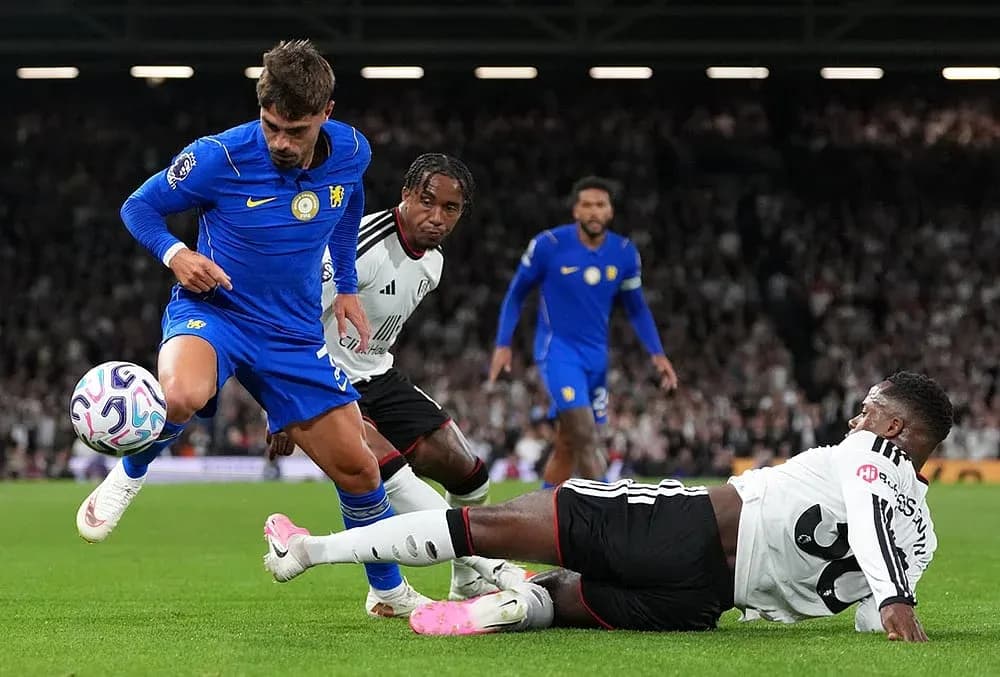
Under the Craven Cottage lights, the first Monday of the new Premier League season closed with a reminder of how thin the margins will be for Fulham and how sharp Chelsea already look under Xabi Alonso. A 3-2 away win leaves Chelsea sitting 6th with 3 points and a goal difference of 1, while Fulham open in 12th, pointless and with a goal difference of -1 after a frantic, open contest that exposed both sides’ early‑season identities.
I. The Big Picture – Structures and Seasonal DNA
The numbers from this single league outing are stark. At home, Fulham have played 1, scored 2 and conceded 3, an average of 2.0 goals for and 3.0 against at Craven Cottage. There is no clean sheet, no failure to score, but already a sense of volatility. Their biggest result so far is that 2-3 defeat, and the data confirms it: one match, one loss, and a defensive unit still being stitched together.
Chelsea’s away profile is the mirror image. On their travels they have played 1, won 1, scored 3 and conceded 2, averaging 3.0 goals for and 2.0 against away from home. It is not yet the record of a defensive fortress, but it is the footprint of an aggressive, front‑foot side comfortable trading blows.
Tactically, the formations tell the story of the night. Alvaro Arbeloa set Fulham in a 4-2-3-1: Bernd Leno behind a back four of Timothy Castagne, Calvin Bassey, Jorge Cuenca and Antonee Robinson; Sander Berge and Alex Iwobi as the double pivot; with Oscar Bobb, Josh King and Cristian Palacios supporting forward G. Garcia. It is a structure built for layered possession and wide overloads, but it demands precision from the two holding midfielders and solidity from a centre-back pairing that, without J. Andersen, is still learning each other’s movements.
Alonso’s Chelsea came in a 3-4-2-1, with Robert Sanchez protected by a back three of J. Acheampong, Maxence Lacroix and Levi Colwill. Malo Gusto and Reece James operated as aggressive wing-backs, Roméo Lavia and Jorrel Hato patrolled central midfield, while Cole Palmer and Morgan Rogers floated behind Joao Pedro. It is a shape that compresses the middle, invites counter-pressing and relies on the front three to interpret space intelligently.
II. Tactical Voids – Absences and Discipline
The absentees framed both game plan and outcome. Fulham were without J. Andersen through suspension and T. Cairney with a knee injury. Andersen’s absence forced Bassey–Cuenca as the central axis; neither lacks quality, but neither offers Andersen’s blend of aerial dominance and organisational authority. That void was visible whenever Chelsea attacked the channels, pulling the line wide and asking questions of Fulham’s communication.
For Chelsea, the list of missing names was longer: A. Anselmino (inactive), M. Caicedo and M. Sarr (injuries), E. Emegha (hamstring), W. Fofana (red card suspension) and J. Henderson (wrist injury). The absence of Caicedo in particular pushed responsibility onto Lavia as the single true holding presence, and onto Hato as a hybrid midfielder. Fofana’s suspension kept Alonso committed to Lacroix as the central pillar of the back three – a decision that paid off.
Disciplinary patterns hint at how each side suffered without key leaders. Fulham’s yellow-card distribution shows a late-game surge: 100.00% of their bookings arrived between 76-90 minutes. That is the profile of a team chasing, stretching, and then fouling under fatigue and emotional strain. Chelsea’s cautions skewed early: 66.67% of their yellows came in the opening 0-15 minutes, with another 33.33% between 61-75. It paints a picture of an aggressive, front-loaded press that occasionally spilled over, then a second wave of tactical fouling as Fulham pushed back.
III. Key Matchups – Hunter vs Shield, Engine Room Battles
The “Hunter vs Shield” duel centred on Chelsea’s attacking trident and Fulham’s makeshift defence. Palmer, Joao Pedro and Rogers all scored once in this fixture and already sit among the league’s early top scorers. Palmer’s profile from this match is devastating: 1 goal, 1 assist, 4 shots (2 on target), 32 passes at 87% accuracy, 3 key passes, 8 dribbles attempted with 5 successful, and 16 duels contested, winning 10. He operated in the half-spaces between Berge and the Fulham centre-backs, constantly forcing Castagne and Robinson to tuck in and leaving space for Gusto and James outside.
Rogers, too, was a problem between the lines. With 1 goal, 5 key passes and 3 successful dribbles from 3 attempts, he repeatedly isolated Cuenca and Bassey, driving at the inside shoulders of Fulham’s centre-backs. Joao Pedro’s contribution – 1 goal, 1 assist, 3 shots, 2 key passes – completed a front three that rotated fluidly and punished any hesitation.
On the defensive side of this matchup, Lacroix was the “shield” that enabled Chelsea’s risk-taking. He completed 50 passes at 94% accuracy, added 5 tackles, 2 interceptions and blocked 1 shot. Whenever Fulham tried to find Garcia early or slide Palacios into pockets, Lacroix stepped in front, either winning the duel or forcing Fulham to recycle wide.
For Fulham, Castagne was both outlet and firefighter. He produced 40 passes at 85% accuracy, 2 key passes, 1 shot on target, and defensively chipped in with 1 tackle, 1 interception and 1 blocked shot. Yet he was also booked, emblematic of a right flank that was constantly stretched by Rogers’ drifting and Gusto’s overlapping.
In the engine room, Lavia’s duel with Berge and Iwobi was pivotal. Lavia, booked once and therefore walking a disciplinary tightrope, still managed 22 passes at 95% accuracy, 3 tackles and 1 interception in 65 minutes. He screened passing lanes into King and Bobb, allowing Chelsea’s back three to hold their line. Berge and Iwobi, meanwhile, were asked to be both screen and springboard; too often, they were pinned, forced backwards by Chelsea’s press and unable to progress the ball consistently through the centre.
IV. Statistical Prognosis – What This Result Tells Us
Following this result, the statistical contours are clear. Fulham at home are open, creative enough to score 2.0 goals per match but conceding 3.0. Their late-card spike between 76-90 minutes hints at a side that fades physically and structurally under pressure, particularly without a leader like Andersen marshalling the back line. If that pattern persists, opponents will target the final quarter of games, increasing tempo and forcing errors as legs tire and discipline frays.
Chelsea, conversely, have announced themselves as a high-ceiling, high-intensity away side. On their travels they are averaging 3.0 goals for and 2.0 against, driven by a front three that already populate the league’s scoring and assisting charts. There are no penalties taken, no misses – the chance creation is all from open play, which underlines the coherence of Alonso’s attacking design.
Defensively, Chelsea are not yet watertight – conceding 2.0 goals away from home shows there is vulnerability, especially when wing-backs push high and Lavia is left exposed. But with Lacroix anchoring, Colwill and Acheampong flanking, and a midfield that can foul tactically without tipping into red-card territory, the structure looks robust enough to support the attacking ambition.
The tactical intersection of these trends suggests that, going forward, Fulham must tighten their central block and manage late-game energy better, especially at Craven Cottage. Chelsea, meanwhile, will lean into their away identity: an aggressive 3-4-2-1 that trusts Palmer, Rogers and Joao Pedro to tilt games in their favour, even when the defensive numbers are not perfect. In a season that has only just begun, this 3-2 at the Cottage already feels like a blueprint for both clubs’ campaigns.