.svg&w=384&q=75 "GoalGist logo")
Charleston Battery Edges Pittsburgh Riverhounds in USL League One Cup
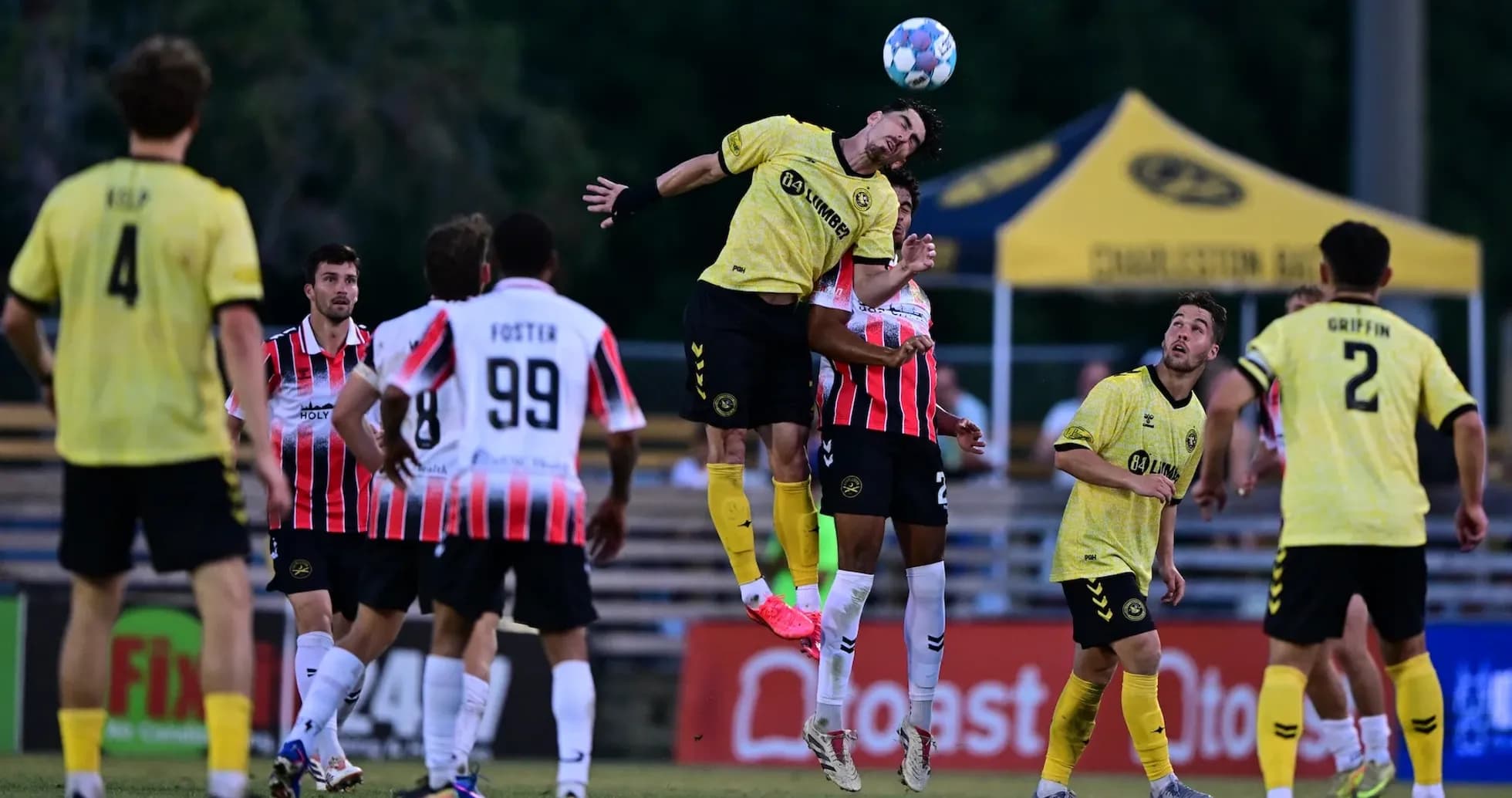
The floodlights at Patriots Point Soccer Complex had barely cooled when the story of this Group Stage tie in the USL League One Cup began to crystallize. Charleston Battery and Pittsburgh Riverhounds went the distance — 120 minutes of stalemate, 0-0 at full time and after extra time — before Charleston edged the penalty shootout 4-2 to underline why they sit top of Group 6.
Following this result, the broader arc of the group is clear. Charleston, ranked 1st in the standings, have made a habit of control and efficiency. Across the campaign they have taken 8 points, with a goal difference of 7 built on 10 goals for and 3 against in total league play. Their season statistics echo that dominance: overall they average 2.3 goals for per game and concede just 0.3. At home, they are more pragmatic, with 1.0 goal for and 0.0 against on average, but on their travels they open up, scoring 3.0 and allowing 0.5. Pittsburgh, by contrast, are chasing from 3rd in the group. Their total goal difference of -1 (8 scored, 9 conceded overall) and away average of just 0.5 goals for and 1.5 against paint the picture of a side still learning how to impose itself outside its own ground.
I. The Big Picture: Styles Meeting Under Pressure
This match, finished after penalties, became a stress test of each squad’s identity. Charleston’s season-long defensive parsimony — 7 goals for and only 1 against in total in the Cup statistics snapshot — has been built on structure and discipline. They have yet to lose in this competition, with 3 wins in 3 fixtures in the stats block and no defeats recorded, and they have kept 2 clean sheets in total. Pittsburgh’s profile is more volatile: 4 goals for and 3 against in total, one clean sheet, and a pattern of sharp home performances offset by away struggles.
On the night, those identities converged into a tense, chess-like contest. Charleston’s ability to grind through 120 minutes without conceding aligned with their statistical DNA: failed to score in 0 matches this campaign, and rarely allow opponents clear sights of goal. Pittsburgh, who have failed to score only once in total, found themselves running into a black-and-gold wall.
II. Tactical Voids and Discipline: Edges in the Margins
There were no listed absentees in the data, so both coaches — Ben Pirmann for Charleston and Rob Vincent for Pittsburgh — could lean into their preferred core groups. That made the discipline narrative even more important.
Charleston’s yellow-card distribution this season tells of a side that tends to pick up cautions as the intensity climbs after the interval: 50.00% of their yellows arrive between 46-60 minutes, with additional flashes early (16.67% in 0-15) and late (16.67% in 76-90). They manage to avoid red cards altogether. Pittsburgh mirror that second-half edge: 42.86% of their yellows also come between 46-60 minutes, with scattered bookings across the rest of the match and a notable flashpoint — 100.00% of their reds landing in the 76-90 window.
In a knockout-style finish decided by penalties, that late-game volatility matters. Pittsburgh’s propensity for a late red suggests that as matches stretch and nerves fray, they can tip over the line. Charleston, by contrast, stay on the right side of the law, which helped them keep their defensive block intact all the way to the shootout.
III. Key Matchups: Hunter vs Shield, Engine Room vs Enforcer
Without explicit top-scorer data, the “Hunter vs Shield” battle in this tie is best read collectively. Charleston’s attacking “hunter” is systemic rather than individual: a team that has scored 7 goals in total Cup play from a variety of sources, with no failures to score and a biggest away win of 0-4. In this match, that collective edge was embodied by the front unit of M. Berry, L. Blackstock and M. Foster, supported by the intelligent movement of E. Ycaza. They constantly probed for spaces between Pittsburgh’s centre-backs V. Souza and O. Mikoy, and full-backs P. Barnes and L. Kelp.
Pittsburgh’s “shield” has been strongest at home — 0.0 goals against on their own turf — but away they concede 1.5 on average. On this night, though, M. Sheridan and his back line held firm for 120 minutes, bending but not breaking against a Charleston side that usually finds a way through.
In the “Engine Room” duel, Charleston’s midfield axis of S. Suber and K. Pakhomov offered the platform. Suber’s physical presence and Pakhomov’s metronomic recycling allowed G. Smith and D. Martinez to push on from the back line, compressing the pitch and keeping Pittsburgh’s creators, notably R. Mertz and C. Ahl, with their backs turned. For Pittsburgh, D. Griffin’s work without the ball and E. Goldthorp’s transitions were crucial in relieving pressure and springing counters, often linking into the runs of T. Amann and S. Bassett.
On the benches, the profiles hinted at different late-game levers. Charleston’s options like C. Allan, A. Cabrera and A. Hughes offered fresh legs to maintain intensity and defensive security, while K. Held and J. Wayne could stretch the flanks. Pittsburgh’s substitutes — including A. Dikwa, B. Larsen and M. Viera — gave Vincent the possibility of adding penalty-box presence and direct running, a classic away-day counterpunch.
IV. Statistical Prognosis: Why the Shootout Tilted Charleston’s Way
From a statistical lens, the eventual outcome — Charleston winning 4-2 on penalties — tracks with the underlying trends. Heading into this game, Charleston’s total defensive record in the Cup (1 goal conceded, 0.3 per match) suggested they were well-equipped to drag the contest into a low-scoring trench war. Their clean-sheet tally of 2 in total and the fact they have never failed to score made them strong favourites in any scenario that went the distance.
Pittsburgh’s away metrics — 0 wins, 0 draws, 2 losses, with 1 goal for and 3 against on their travels in the standings snapshot, and an away average of 0.5 goals for and 1.5 against in the stats — implied that creating and finishing chances in Charleston would be an uphill task. Without penalties taken or missed by either side in the season data (both have 0 total penalties, 0 scored, 0 missed), the shootout itself was a mental rather than historical edge.
In the end, Charleston’s blend of defensive serenity, disciplined aggression in the key 46-60 window, and a deeper sense of control across the campaign made them the more likely side to hold their nerve from the spot. Pittsburgh’s resistance was admirable, their back line and midfield shielded by the hard-running Griffin and the composure of Souza and Mikoy. But in a contest defined by fine margins rather than open play xG fireworks, the group leaders behaved like group leaders, turning a 0-0 grind into another step in a Cup run that still feels built on granite.