.svg&w=384&q=75 "GoalGist logo")
Canada's Unforgettable World Cup Journey
Canada was supposed to be the quiet partner in this World Cup. The “forgotten host,” tucked behind the star power of the United States and the romance of Mexico.
Try telling that to anyone who watched Jesse Marsch’s team rip up the script over a feverish month of football.
Les Rouges rewrite their own history
For years, Canada’s men’s national team existed on the margins of the global game, a curiosity in a country where football is played everywhere but rarely placed at the centre of the sporting conversation.
This tournament changed that.
Under the unapologetically brash American coach Marsch, Canada surged into the round of 16 for the first time in their history, a run stitched together with landmark moments: their first World Cup point, their first win, and then, finally, their first knockout-stage victory. Morocco ended the dream, but by then the story was already written.
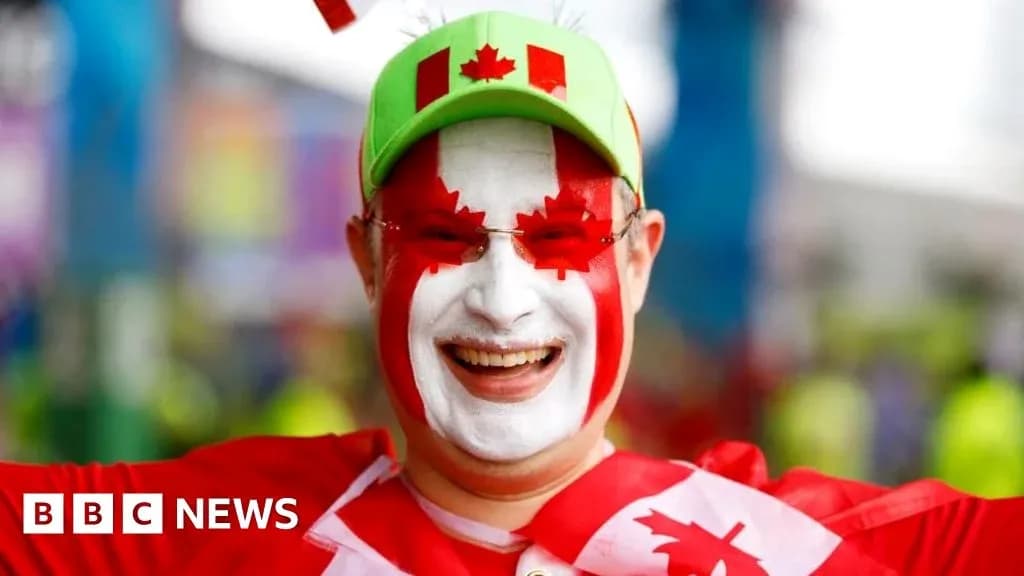
“They shocked everyone,” fan Matt Lorincz told the BBC in Calgary. He meant the football world. He could just as easily have meant their own country.
In a nation that worships at the altars of the NHL, Major League Baseball and the NBA, football has long been the most-played sport with the least political and commercial clout. Kids kick balls in parks; adults fill bars for playoff hockey. That’s the rhythm.
This summer, the rhythm changed.
“Most people you talk to watch, like, hockey or other sports,” Lorincz said. “There’s not a lot of – or as many – soccer fans in Canada. So hopefully there may be a few more of those.”
The hope doesn’t feel fanciful anymore.
A country steps into the spotlight
For a few weeks in June and July, Canada stepped fully into the glare of the world’s biggest stage, co-hosting alongside the US and Mexico and discovering what it really means to be a World Cup nation.
On Tuesday, that responsibility ended with a round-of-16 tie in Vancouver, where Switzerland beat Colombia in the last World Cup match on Canadian soil. The final whistle closed the book on hosting duties, not on the impact.
Toronto and Vancouver staged 13 of the tournament’s 104 games, but the footprint was larger than that number suggests.
In Toronto, the soundscape changed. Matches spilled out of bars and restaurants onto the streets. Colourful, noisy marches wound through downtown towards Toronto Stadium, a city used to hockey nights suddenly pulsing to a different beat.
On the west coast, Vancouver had its own statement moment. Canada tore through Qatar 6-0 in front of a jubilant crowd, a scoreline that felt like catharsis as much as dominance. The only sour note came when star midfielder Ismaël Koné left the pitch on a stretcher with a broken leg after a heavy challenge, a brutal reminder of the sport’s edge on a night otherwise drenched in celebration.
Carney leans into the moment
No one in Canadian politics embraced the World Cup more visibly than Prime Minister Mark Carney. A committed sports fan with a jersey seemingly for every occasion, he became the face of the host nation in the stands – and in the dressing room.
He is, so far, the only leader from the three co-host countries to attend stadium matches. After the demolition of Qatar in Vancouver, Carney headed straight to the locker room.
“You showed a level of character that some people never achieve in their life,” he told the players. “And you showed it when a good part of the country and the world is watching.”
For a “middle power,” as sports minister Adam van Koeverden put it, the World Cup offered a rare chance to stand centre stage.
Canada, he said, had been “growing up a little bit as a middle power, and the opportunity to host the world for the biggest event of the year this year has been a sincere privilege that we have not taken lightly.”
The original bid, as John Kristick remembers it, was built on a simple slogan: one continent, three countries. Kristick, now with Playfly Sports Consulting and formerly the executive director of the United Bid Committee, believes the tournament has largely delivered – but not exactly as imagined.
He feels the “united” aspect frayed along the way.
“I think it’s probably been harder for Canada and Mexico to break through as hosts. I think that the US have taken more of that limelight,” he said, pointing to the politics of the Trump era and the sheer volume of matches staged south of the border.
Yet inside Canada, there’s no confusion about their role.
“Every Canadian knows Canada is hosting it, and I think there’s been a great deal of national pride,” Kristick said.
Boom times in the bars, questions in the council chamber
That pride has had a price.
Canada’s taxpayers have laid out an estimated C$1.1bn to prepare for the World Cup, with Toronto alone responsible for around C$380m. In a country wrestling with economic headwinds and tight municipal budgets, the bill has been a flashpoint.
City Councillor Josh Matlow didn’t sugar-coat his view.
“I don’t think that hosting the games made the city’s situation any better,” he said, voicing a frustration shared by those who see stadium upgrades and security costs as luxuries in lean times.
Van Koeverden pushed back, calling the spending “prudent” and insisting the money circled back into the economy.
“Full stadiums, full parks, full restaurants, and full hotels is a nice problem to have in 2026,” he said.
On the ground, businesses felt the surge.
Ian Tostenson, head of the British Columbia Restaurant and Foodservices Association, described life in a host city as a crash course in “the enormity of the World Cup.” The tournament pulled people in, he said, and they stayed – and spent.
Alcohol sales climbed roughly 5% compared with last year, and, more importantly, so did the mood.
“It raised the spirits of the entire province. I think the whole conversation [for the] last four weeks had been about soccer,” Tostenson told the BBC.
Canada’s broader economy may be dragging, but he drew a simple lesson: “You learn that if you give people a real reason to spend their money and give them value, they’ll spend it.”
A ‘forgotten’ host that visitors won’t forget
If Canada sometimes faded from the global narrative, the visitors who came north didn’t seem to miss the point.
Portugal manager Roberto Martinez praised Toronto’s compact World Cup venue, the smallest of the tournament’s stadiums, dressed up with temporary seating to handle the crowds. It reminded him, he said, of “old-fashioned Premier League grounds.”
After Portugal’s win over Croatia, he called the atmosphere “an incredible spectacle for football.”
For fans, the experience matched the manager’s words. Gudmund Agotnes, over from Norway and lucky with the draw, managed to attend three matches in Toronto. He described the stadium as “pretty cool,” highlighting the “bird’s eye view” of both the pitch and the city’s skyline – a football theatre with a postcard backdrop.
The “forgotten host” tag might linger in some headlines, but in the stands and on the streets, Canada made its impression.
Numbers that rival hockey nights
If there was any doubt about whether the country was paying attention, the television numbers answered it emphatically.
Fifa reported that more than a million fans attended the opening 16 games across the three host nations. The tournament is on pace to surpass the all-time cumulative attendance record of 3.5 million set in 1994 by the end of the group stage – though the expanded format makes that surge less surprising.
What is surprising is how deeply Canada tuned in.
The round-of-16 clash with Morocco on 4 July peaked at 11.7 million unique Canadian viewers, according to host broadcaster Bell Media. That’s the largest audience ever recorded in the country for a World Cup match that wasn’t a final.
To put that in local terms: 9.8 million Canadians watched the opening of the NHL season last October. Hockey, the national habit, suddenly had company.
Across the round-of-32 ties, World Cup matches averaged 1.9 million Canadian viewers, Bell Media said. Hockey Night in Canada, the Saturday night institution, draws around 1.2 million per broadcast.
For once, the beautiful game didn’t just sneak into the conversation. It led it.
A fragile giant starts to stir
Canada has never lacked people who play football. It has lacked a clear path from crowded youth pitches to elite success, especially on the men’s side.
The country’s professional footprint remains modest: two clubs in Major League Soccer, the long-established Vancouver Whitecaps, founded in 1973, and Toronto FC, launched 32 years later. The women’s national team, ranked ninth in the world by Fifa, has carried the competitive flag more consistently.
This World Cup has started to shift the financial and structural picture.
Canada Soccer, the sport’s national governing body, launched a fundraiser before the tournament with a C$25m target. It hit that mark months earlier than expected, a windfall that offers a rare chance to invest off the back of genuine momentum rather than blind hope.
For now, though, the numbers feel secondary to the emotion.
Fans of the men’s national team, Les Rouges, are simply enjoying what they’ve just lived through: a World Cup where Canada didn’t just make up the numbers, but forced the world to take notice.
“It brought a lot of people together in a very kind of segregated world that we’re living in,” said Zeileen Reardon, watching the Morocco match in a Calgary bar.
“So, I think it actually showed the world that we can come together, even for a game.”
The “forgotten host” leaves this World Cup with something far more valuable than a slogan. It leaves with a question that will hang over every frozen training pitch and sold-out summer friendly from here to 2026.
Was this a glorious one-off – or the moment Canadian soccer finally decided it belonged on the main stage?