.svg&w=384&q=75 "GoalGist logo")
Canada and Bosnia & Herzegovina Draw 1-1 – Tactical Analysis
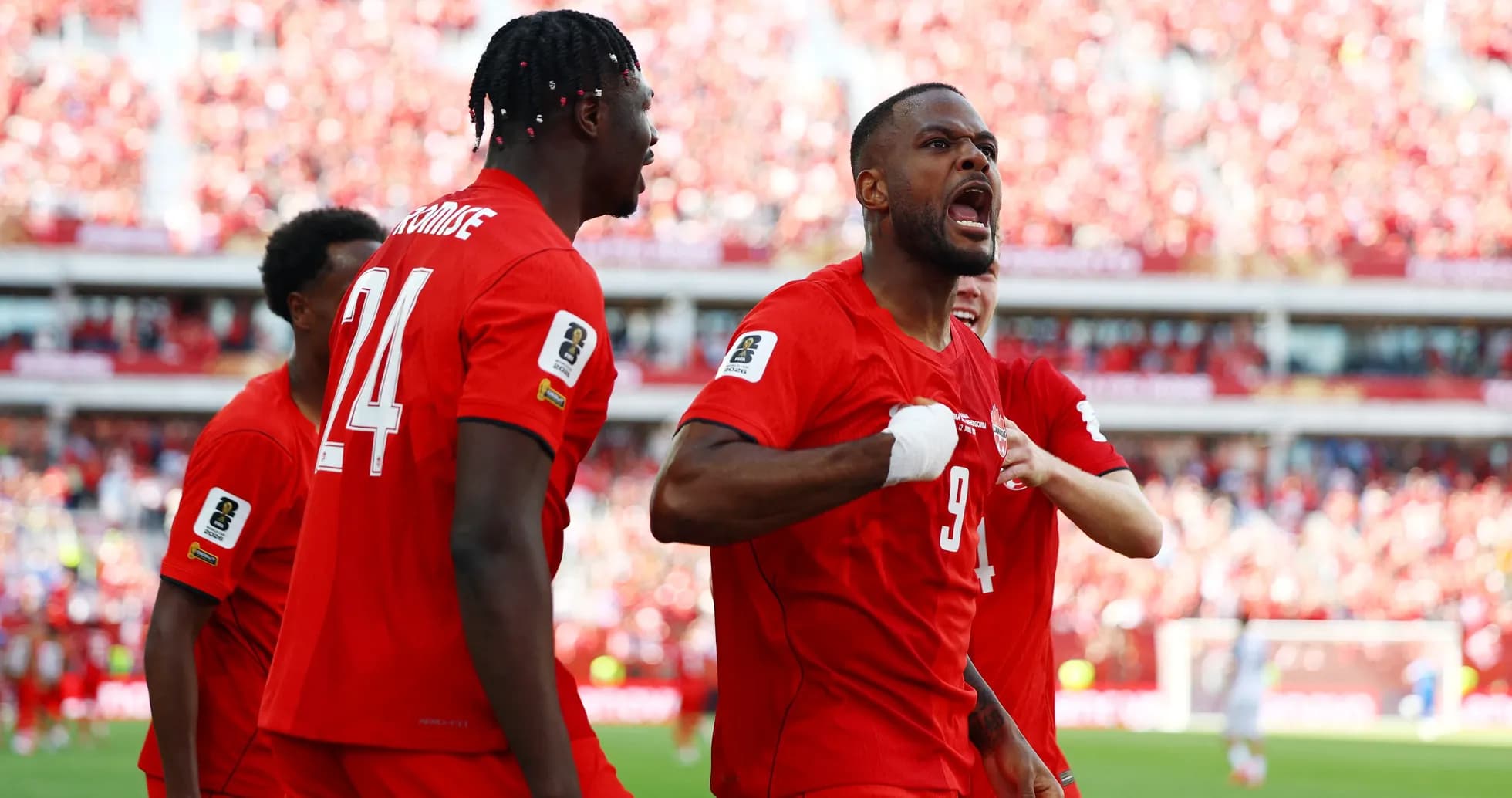
BMO Field under the World Cup lights offered a fittingly tense opening to Group B, as Canada and Bosnia & Herzegovina shared a 1-1 draw that revealed as much about their tactical identities as the scoreline itself.
I. The Big Picture – Two 4-4-2s, two stories
Following this result, both sides sit on 1 point, but the table tells a subtly different tale. Canada, ranked 2nd in Group B with a goal difference of 0 (1 goal for, 1 against overall), occupy a provisional “Round of 32” spot. Bosnia & Herzegovina, 4th with the same 0 goal difference (1 for, 1 against overall), are chasing from behind despite an identical record on paper.
The symmetry of the numbers mirrors the symmetry on the pitch. Both coaches, Jesse Marsch and Sergej Barbarez, set up in a 4-4-2, but the interpretations diverged. Canada’s shape was aggressive and vertical, built to spring from wide areas and second balls. Bosnia & Herzegovina’s was more measured, a compact block designed to funnel Canada wide and then punish transitions through direct, combative forwards.
In total this campaign, Canada’s attacking and defensive profiles are perfectly balanced: 1 goal scored and 1 conceded, with an average of 1.0 goals for and 1.0 against at home. Bosnia & Herzegovina mirror that on their travels: 1 goal scored and 1 conceded away, averaging 1.0 goals for and 1.0 against away. It is a statistical stalemate that reflected the evening’s narrative.
II. Tactical Voids and Discipline – Edges at the margins
There were no listed injury absentees, which meant both managers had close to full tactical decks. The real voids were structural rather than personnel-based.
Canada’s defensive line of A. Johnston, L. De Fougerolles, D. Cornelius and R. Laryea showed promise but also naivety. De Fougerolles, booked once, played an aggressive front-foot game, engaging in 22 duels and winning 10. Johnston, also on a yellow, balanced his edge with composure, winning 5 of 7 duels and completing 72% of his passes. Those two bookings are not just trivia; they sketch a back line that defends by stepping into risk, something future opponents will target.
Bosnia & Herzegovina’s discipline profile was more scattered across phases. Their season card distribution shows yellow cards at 31-45', 46-60' and 91-105', each accounting for 33.33% of their total yellows. J. Lukić, N. Katić and E. Demirović all carry a caution already, underlining a side that walks a fine line between physicality and overreach. Yet, crucially, there are no red cards for either team, and neither side has conceded or missed a penalty so far; the margins have been drawn in open play and in the tackle.
Canada’s yellow-card timing is front-loaded: 50.00% of their yellows came between 0-15' and 50.00% between 46-60'. That early and early-second-half spike hints at emotional starts and re-starts, where Marsch’s intensity can spill into cheap fouls. In tournament football, that can easily become a structural weakness.
III. Key Matchups – Hunter vs Shield, Engine Room vs Enforcer
Hunter vs Shield
C. Larin, despite starting on the bench, has already emerged as Canada’s sharpest finisher. In total this campaign he has 1 goal from 1 shot, 1 on target, across 14 minutes. His 7.7 rating and efficiency underline a penalty-box hunter who needs very little volume to change a game. Alongside him in the attacking hierarchy, J. David and T. Oluwaseyi started this match, but it was Larin’s cameo that reset the tone of Canada’s forward line.
Standing opposite is Bosnia & Herzegovina’s defensive “shield” in N. Katić. Across his 90 minutes, he has been immense: 23 passes at 65% accuracy, 5 tackles, 2 blocked shots and 3 interceptions, winning 15 of 24 duels. Those 2 blocked shots are not incidental; Katić is actively stepping into shooting lanes, a crucial trait against a low-volume, high-lethality striker like Larin.
On the flanks, S. Kolašinac adds another layer to the shield. Rated 8.0 in the top scorers data and 7.9 in the assists data, he has already delivered 1 assist, 21 passes at 71% accuracy, 3 tackles and 2 blocked shots. His capacity to both create and protect the left side makes him a dual-threat full-back, and his duel numbers (6 wins from 10) show he can live in the physical chaos Canada’s wide men thrive on.
For Bosnia & Herzegovina, the hunter is J. Lukić. With 1 goal from 3 shots (2 on target), 10 duels won from 13 and a 7.5 rating, he profiles as a hard-running, backline-battering forward who can both finish and pin defenders. His yellow card is a warning sign, but his work rate is the reference point for Barbarez’s front line.
Engine Room – Playmaker vs Enforcer
Canada’s creative heartbeat in this match and in the early tournament data is P. David. He has 1 assist in total this campaign, carved out from just 3 passes and 1 key pass in 29 minutes, plus a shot and 10 duels contested. He is less a metronome and more a chaos conductor, arriving from the bench to tilt the game vertically. His ability to draw fouls (1 so far) and to act as a target for direct balls gives Canada a second reference point alongside Larin.
On the Bosnian side, the closest thing to an enforcer-playmaker hybrid is again Kolašinac. His 1 key pass and assist, layered over defensive steel, mean Bosnia & Herzegovina often build their first and second phases through his side. When he steps up, B. Tahirovic and I. Basic are freed to hold the central lanes, keeping the 4-4-2 compact.
In midfield, Canada’s S. Eustaquio and I. Kone worked as the stabilising pair, but the data spotlight falls more sharply on the defensive line and forwards. Bosnia & Herzegovina’s central unit, with Tahirovic as a screening presence, provided the platform for Lukić and E. Demirović to contest 34 combined duels, winning 22. That physical central spine is Bosnia & Herzegovina’s true enforcer.
IV. Statistical Prognosis – Margins, xG proxies and defensive solidity
There is no explicit xG provided, but the shot and duel data allow a proxy reading. Bosnia & Herzegovina’s main striker Lukić has already generated 3 shots, 2 on target, supported by Demirović’s 1 shot on target. That suggests a side capable of creating a small but high-quality shot volume through direct play. Their defenders, particularly Katić and Kolašinac, combine ball-winning (5 and 2-3 tackles respectively) with blocked shots, hinting at a low-block structure that forces opponents into crowded zones.
Canada, meanwhile, are ruthlessly selective. Larin’s 1 shot, 1 goal profile, coupled with P. David’s 1 assist from 1 key pass, indicates a team that may not flood the box with attempts but can extract maximum value from limited entries. Their overall averages – 1.0 goals for and 1.0 against at home – point to balanced, knife-edge contests.
Defensively, neither side has kept a clean sheet yet, and both have failed to shut down the opposition in their single outing. Clean sheet totals stand at 0 for both teams overall. That means future matches in this group are unlikely to be cagey stalemates; both defences concede chances, but both have individuals capable of last-ditch interventions.
Following this result, the tactical verdict is of two squads finely poised between promise and vulnerability. Canada’s upside lies in the Larin–David axis and the high-energy full-backs Johnston and Laryea, but their early-game indiscipline and reliance on aggressive duels at the back leave them exposed. Bosnia & Herzegovina’s strength is a brutally competitive spine led by Katić, Kolašinac and Lukić, yet their scattered yellow-card profile and lack of clean sheets suggest they will live on a disciplinary and defensive tightrope.
In a group that will punish small errors, the side that first converts these narrow statistical edges into a clean sheet may be the one that steps confidently toward the Round of 32.