.svg&w=384&q=75 "GoalGist logo")
Brazil and Morocco Draw 1-1 in Tactically Balanced World Cup Match
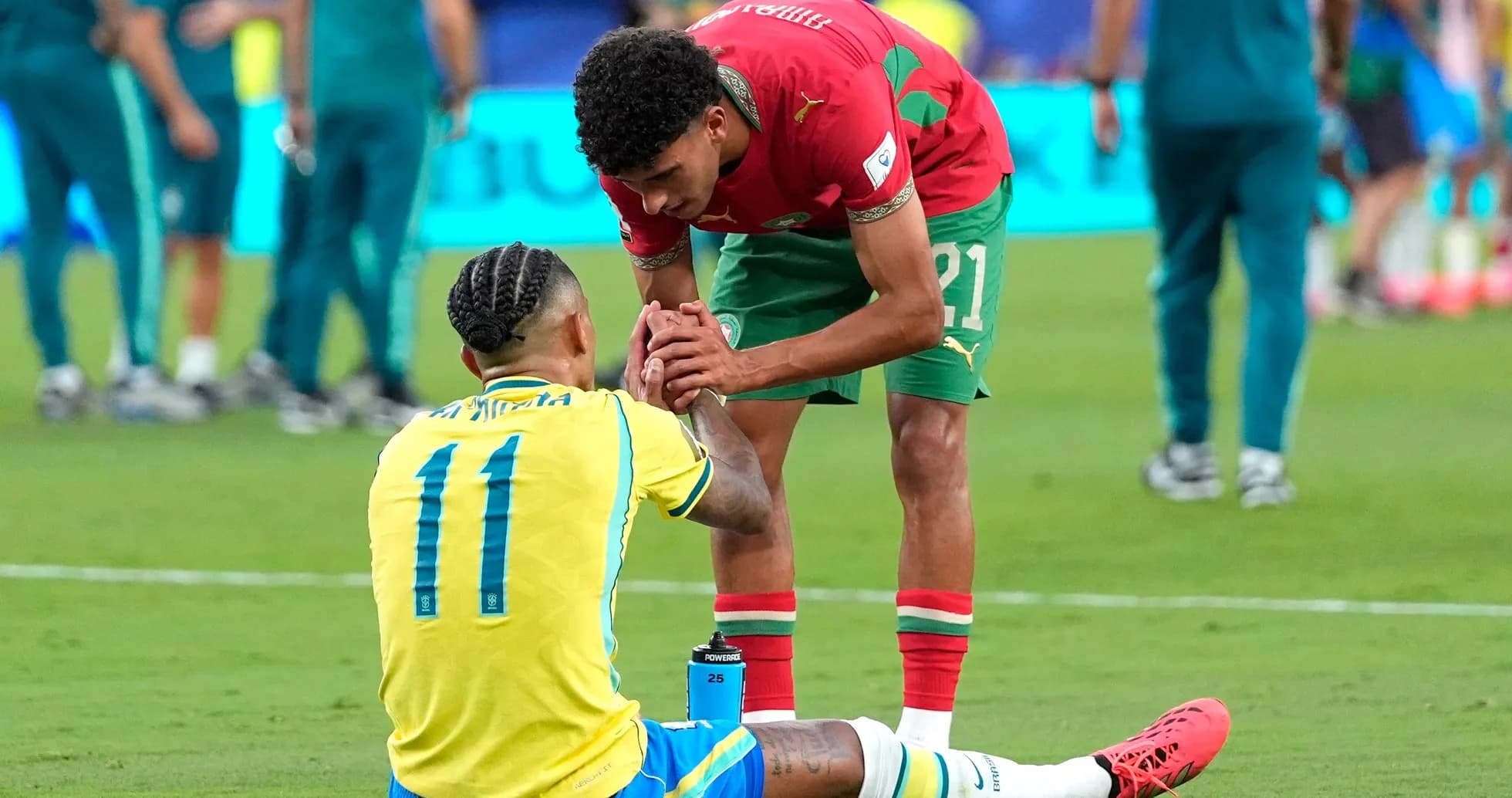
Brazil and Morocco opened their World Cup Group Stage campaigns at MetLife Stadium with mirrored 4-2-3-1 structures and a 1-1 scoreline that accurately reflected a tactical stalemate rather than a lack of ambition. Brazil held a slight territorial and possession edge (54% to 46%) and produced more shots on goal (4 to 2), but Morocco matched their overall shot volume (12-12) and actually edged xG (1.28 to Brazil’s 1.24), underlining how evenly balanced the contest was in terms of chance quality.
Both coaches, Carlo Ancelotti and Mohamed Ouahbi, leaned into compact mid-blocks and strong double pivots, turning the game into a battle over who could better connect midfield to the lone striker.
Ismael Saibari’s 21st-minute opener for Morocco, assisted by Brahim Díaz, was emblematic of Ouahbi’s plan: using the 4-2-3-1’s central overload to spring the advanced midfielder into space between the lines. With Ayyoub Bouaddi and Neil El Aynaoui screening in front of the back four, Díaz was free to drift into pockets, draw a centre-back, and slide Saibari into the channel. Morocco’s 6 shots inside the box from 12 total attempts show how effectively they converted these central combinations into high-value territory, even with only 2 efforts on target.
Brazil’s equaliser on 32 minutes – Vinícius Júnior finishing from a Bruno Guimarães assist – revealed Ancelotti’s contrasting route: using the same nominal 4-2-3-1 but with a far greater emphasis on wide progression and half-space exploitation. With Vinícius starting as a left-sided midfielder and Raphinha on the right, Brazil pushed their wingers high and narrow off the ball, almost forming a 4-2-3-1 that morphed into a 2-3-5 in possession. Bruno Guimarães’ deeper positioning, alongside Casemiro, gave Brazil a stable double pivot to recycle play and find Vinícius between full-back and centre-back. Brazil’s 9 shots inside the box from 12 attempts underline how consistently they managed to work the ball into dangerous central lanes once the wide players had bent Morocco’s back line out of shape.
Out of possession, both teams were disciplined rather than aggressive. Brazil committed 15 fouls to Morocco’s 14, but the key difference was in disciplinary outcomes. Brazil picked up two first-half yellow cards:
- 37' Casemiro (Brazil) — Foul
- 43' Roger Ibañez (Brazil) — Foul
These bookings were a direct tactical consequence of Ancelotti’s high defensive line and proactive counter-press. Casemiro’s caution came as he tried to halt a Moroccan transition through central areas, while Ibañez’s card reflected the strain on Brazil’s right-sided defender zone when Achraf Hakimi and Díaz combined to attack the space behind Raphinha. Morocco, by contrast, managed to maintain similar foul numbers without a single booking, indicating a slightly deeper block and more conservative engagement line that reduced the number of high-risk duels.
The substitutions at half-time were telling. At 46', Danilo (IN) came on for Roger Ibañez (OUT), and Fabinho (IN) came on for Casemiro (OUT). Ancelotti effectively reset the right side of his defence and his holding role, both of whom were on yellows. Tactically, this allowed Brazil to maintain their aggressive rest-defence without the risk of a red card. Danilo’s presence at right-back brought more positional discipline, while Fabinho’s screening allowed Bruno Guimarães to step a little higher in the second half, trying to connect more consistently with Lucas Paquetá and the front line.
On 61', Luiz Henrique (IN) came on for Igor Thiago (OUT), and Matheus Cunha (IN) replaced Lucas Paquetá (OUT). This double change shifted Brazil’s attacking reference points. Without a traditional central reference like Igor Thiago, Brazil’s front line became more fluid, with Luiz Henrique offering diagonal runs from wide and Cunha able to drop off and link. The aim was to increase tempo and combination play just outside Morocco’s box rather than relying on crosses or target-man play. However, Morocco’s compact back four – with Issa Diop and Chadi Riad strong in aerial duels – and the double pivot in front of them meant that Brazil’s increased fluidity did not translate into a surge of clear-cut chances.
For Morocco, Ouahbi’s changes at 64' – Samir El Mourabet (IN) for Azzedine Ounahi (OUT) and Chemsdine Talbi (IN) for Brahim Díaz (OUT) – were partly about energy, partly about preserving structure. With Díaz withdrawn, Morocco lost some creative edge between the lines but gained fresh legs to maintain pressing triggers and track Brazil’s increasingly mobile forwards. Later, at 80', Ayoube Amaimouni Echghouyab (IN) came on for Bilal El Khannouss (OUT), and Anass Salah-Eddine (IN) replaced Noussair Mazraoui (OUT), reinforcing both flanks to cope with Brazil’s attempts to stretch the pitch late. The 89' introduction of Soufiane Rahimi (IN) for Saibari (OUT) gave Morocco a more transition-oriented outlet, signalling an acceptance of the draw while keeping a counter-attacking threat.
From a structural perspective, both sides’ 4-2-3-1s were defined by their double pivots. Brazil’s duo – first Casemiro and Bruno Guimarães, then Fabinho and Bruno – prioritised ball circulation and protection against counters. Their 501 total passes, with 441 accurate (88%), highlight a possession game built on secure short passing and controlled tempo. Morocco, with 432 passes and 375 accurate (87%), were almost as clean technically, but their passing profile was more vertical, aiming to connect quickly to Díaz, Saibari, and later Rahimi and Talbi.
The defensive indices of both teams were strong. Brazil registered 4 blocked shots to Morocco’s 6, underlining how both back lines were willing to defend their box aggressively. Morocco’s higher blocked-shot count fits their slightly deeper block and willingness to absorb pressure, especially once protecting the draw in the final 20 minutes.
In goal, Alisson (Brazil) made 1 save, while Bono (Morocco) recorded 3. The raw save count suggests that Morocco had to rely more on their goalkeeper in key moments, which aligns with Brazil’s marginally higher shots on goal. However, the goals prevented metric – 0.46 for both sides – indicates that each goalkeeper performed to a similar level relative to the quality of chances faced. In other words, Alisson (Brazil) was well protected by his back line and needed fewer interventions, while Bono (Morocco) had more direct involvement but matched Alisson’s overall shot-stopping value when adjusted for xG.
The statistical verdict reinforces the tactical impression: Brazil controlled slightly more of the ball, progressed it cleanly, and generated a narrow edge in shots on target, but Morocco’s shot quality and box occupation were comparable, as evidenced by their marginal xG advantage (1.28 to 1.24). Brazil’s 5 corner kicks to Morocco’s 0 reflect territorial pressure, yet Morocco’s compact 4-2-3-1 and disciplined defending – no yellow cards despite 14 fouls – ensured that this pressure rarely translated into chaotic box situations.
Ultimately, the 1-1 at MetLife Stadium was the product of two well-drilled, structurally similar sides whose adjustments largely cancelled each other out. Ancelotti’s proactive use of his bench maintained Brazil’s intensity and positional play, while Ouahbi’s conservative, structure-first changes preserved Morocco’s defensive integrity. The draw leaves both teams with a solid platform in the group, and the underlying metrics suggest that neither side over- nor under-performed: this was a tactically balanced contest that delivered a statistically fair result.