.svg&w=384&q=75 "GoalGist logo")
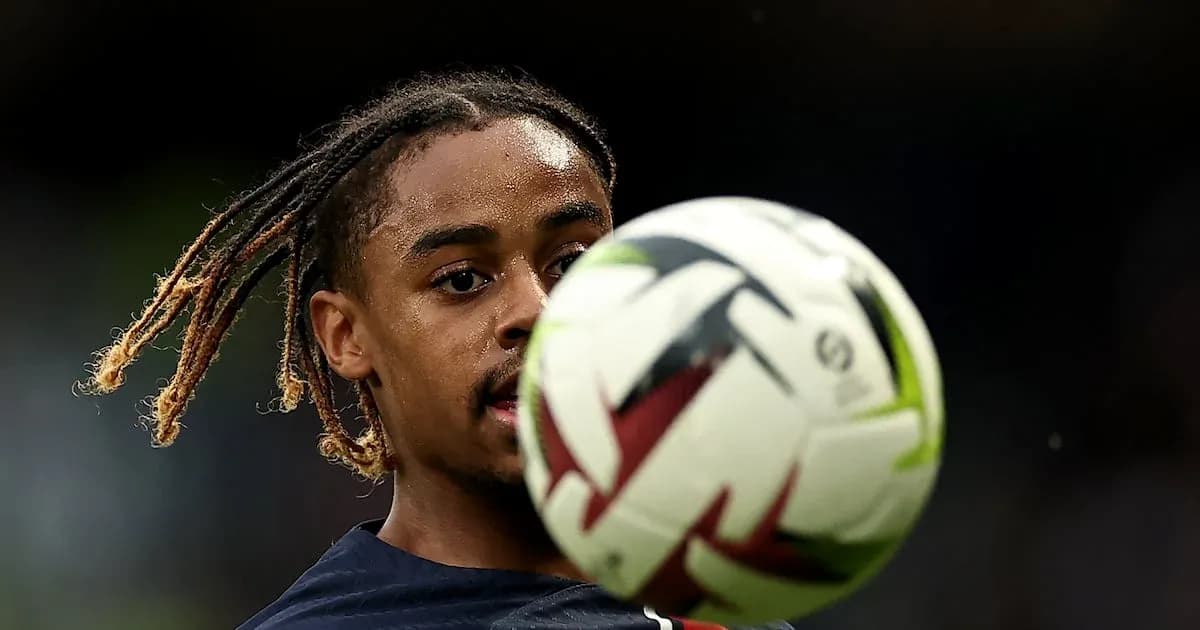
Bradley Barcola's Journey to Liverpool: A Dream Realized
Bradley Barcola used to talk about Liverpool when he was barely a teenager, long before the money, the World Cups and the Champions League nights.
“As a kid, he always spoke to me about Liverpool,” recalls Amaury Barlet, one of his youth coaches at Lyon. So when the call finally came from Anfield this summer, the 24-year-old didn’t hesitate. “Didn’t ask any questions,” he said in his first interview after completing a £123m (€143m) move from Paris Saint-Germain – a transfer that instantly recast a childhood fixation as a record-breaking reality.
A dream that never really faded
At Lyon, they sit players down at the start of each season for interviews, a kind of stocktake of ambition. During one of those sessions, a teenage Barcola told Barlet straight: Liverpool was the dream.
“When he was 15, 16, it was his dream [to play for Liverpool],” Barlet says. “Maybe that changed when he was 19 or 20 ...” The smile in his voice suggests everyone now knows the answer.
What did change was his status. Three seasons at PSG, a World Cup breakout, two Champions League finals, a title-laden spell in Paris – and yet, by the end, he looked like a luxury spare part in a star-studded attack.
His contract ran to 2028 with the European champions, but the writing was on the wall. He started every Champions League game up to and including the last-16 second leg against Chelsea last season. After that, he watched the biggest nights from the bench. He featured in the past two Champions League finals, but only as a substitute in both.
Luis Enrique’s decision to start Khvicha Kvaratskhelia ahead of him after the Georgian’s arrival in January 2025 was hard to argue with on form. For Barcola, it was a clear signal. He could not dominate on the right or through the middle in the same way he thrived from the left, and in a squad this deep, that limitation closed doors. Logic, and his own ambition, pointed elsewhere.
PSG cash in, Liverpool pounce
For everyone involved, the timing aligned. Barcola’s displays for France at the most recent World Cup – three of his six international goals came there – proved he could hurt elite opposition on the biggest stage. That tournament helped fuel a market in which PSG were able to turn a hefty profit.
They had signed him from Lyon for around €45m. They sold him to Liverpool for €143m. A near €100m gain. He leaves as PSG’s most expensive sale of all time, overtaking the €90m fee Al-Hilal paid for Neymar, and his departure played a major part in the club banking roughly €350m in player sales this summer, a record haul for a Ligue 1 side in a single window.
Inside the PSG dressing room, the move stung for different reasons. Barcola was widely liked, something underlined by the flood of farewell messages from former teammates. The club’s hierarchy also parted on good terms. He wanted Liverpool, but he never forced the issue. His absence from matchday squads early this season was, it is understood, about protecting an asset on the verge of a huge move, not punishing a wantaway star.
“He’s got good people around him,” Barlet says. He coached Barcola at under-12 and under-13 level, then again with the under-16s. “His parents always said the same things as us, the coaches ... I know his family. He has the perfect entourage to come through at an academy.”
The family evidence runs deeper. His older brother Malcolm, a goalkeeper now at Ittihad Tanger in Morocco, also came through Lyon’s system before forging his own professional path. Malcolm was a late bloomer. By modern standards, Bradley wasn’t far off.
The slow burn at Lyon
In an era when 16-year-olds break into first teams and go viral, Barcola took a more measured route. Lyon did not rush him up age groups. They waited. He made his senior debut at 19, a relative latecomer compared with someone like Rayan Cherki, who played for the first team at 16.
“He wasn’t small, but he was ... very fresh,” Barlet remembers. “He was very thin. He hadn’t yet grown.” At under-16 level, he stayed with his age group all year, stepping up only briefly for France under-17 internationals in April and May. “He was someone we were waiting to develop on an athletic level.”
When the physical growth finally arrived, everything else clicked into place with startling speed. Barcola debuted midway through the 2021-22 season. One full campaign later, PSG dropped €45m to bring him to Paris.
His delayed physical development had shaped his game. “Because he was playing against defenders that were stronger than him, he always wanted to get ahead of them,” Barlet says. “He was very often offside ... he is always someone who has had a habit of making a lot of runs in behind the defence.”
The instincts came from his earliest role. He was not groomed as a classic winger. “He was a bit of a fox in the box; he scored a lot of goals,” Barlet says. “He scored acrobatic volleys, toe-pokes, left foot, right foot ... it was just his heading that wasn’t necessarily his strong suit.”
The numbers eventually caught up with the talent. His most prolific season arrived in 2024-25: 21 goals, 21 assists. A double-double of rare weight at the top level.
Criticism, composure and a tight circle
Not everyone bought the hype. Questions about his end product have followed him, a sense that his decision-making can fray at the edges. One wasteful display against Newcastle in the Champions League in November 2023 drew a brutal verdict from a French pundit, who labelled him a “little lamb”.
Barcola chose not to bite back. “I didn’t know what was being said about me, but I knew that there would be criticism,” he told Le Parisien. “I don’t pay any attention to it, whether what they say is good or bad.”
He keeps his circle small. “I don’t have many friends. I have very few, in fact, so when they say, ‘You’re doing something stupid,’ it is because they’re right, and if they say that I played well, it’s also because it’s true. I don’t listen to what is said on the outside. To be completely honest, it’s my friends who send me the things [being said] in the media. Sometimes we laugh about it, but it doesn’t go any further than that.”
Barlet remembers the same personality in the academy. Barcola was close to Castello Lukeba, now at RB Leipzig, and Billy Koumetio, who passed through Liverpool and is currently at Charlton. “He’s a very loyal person,” Barlet says. “When he was young, he had tears in his eyes; he was annoyed when he lost, but he wouldn’t criticise his team-mates. He was more annoyed with himself because he is a real competitor.”
To Barlet, he was “the ideal team-mate” and “endearing”. Liverpool now need that mix of edge and warmth to translate to a new dressing room and a demanding fanbase.
The perfect fit for Iraola’s Liverpool?
The task in front of him is clear. The fee is enormous. Liverpool’s start under Andoni Iraola has been patchy. Pressure is baked into the situation. If anyone is equipped to shut out the noise, it is a player who has trained himself not to listen.
He also happens to be exactly the profile Liverpool have been missing. Luis Enrique once called Barcola “one of the best dribblers in Europe”. In a Premier League increasingly defined by transition, by the ability to tear into open grass before defences can reset, that matters.
Liverpool have recently laboured against low blocks, running into walls and staying there. Barcola specialises in something different: timing his runs beyond those walls, attacking space when it appears for half a second, turning defence into panic with one movement.
Iraola has been blunt about what he wants from his wide players. They must be “game-changers”. Barcola has spent years waiting for a club to hand him that responsibility, rather than treating him as a high-class option off the bench.
Now he has the stage he dreamt of as a teenager. The question is no longer whether Bradley Barcola will play for Liverpool. It is how far he can drag them, at full tilt, into a new era.