.svg&w=384&q=75 "GoalGist logo")
A Beautiful Obsession: Guardiola's Raw Journey at Manchester City
Pep Guardiola has never been shy of the cameras, but this is different.
After two seasons with Amazon’s lenses trained on the final act of his Manchester City reign, “A Beautiful Obsession” lands on Prime on Wednesday – and what stuns is not the access, but the lack of varnish. This is not a club-approved love letter. It’s a four-part dissection of a season when the “machine built for winning”, as chair Khaldoon al-Mubarak calls it, starts to splutter and stall.
The winter when City cracked
The heart of the series is that brutal 2024-25 campaign. Thirteen games that ripped up City’s aura: nine defeats, one lonely win, a mid‑winter plunge that turned a juggernaut into something fragile and human.
City have controlled and filmed the project themselves, yet the edit is merciless. There is no attempt to smooth over Guardiola’s most harrowing season in Manchester. No attempt to reframe the decision to let Kevin De Bruyne go, despite his status as the club’s greatest modern player. No attempt to hide the fury in the boardroom when Guardiola changed 10 players for a Champions League home tie against Bayer Leverkusen – and lost 2-0.
Khaldoon’s anger at that selection call is not hinted at. It is shown. So is the fallout.
“I’m fucking divorced…”
The most jarring moments are not tactical. They are personal.
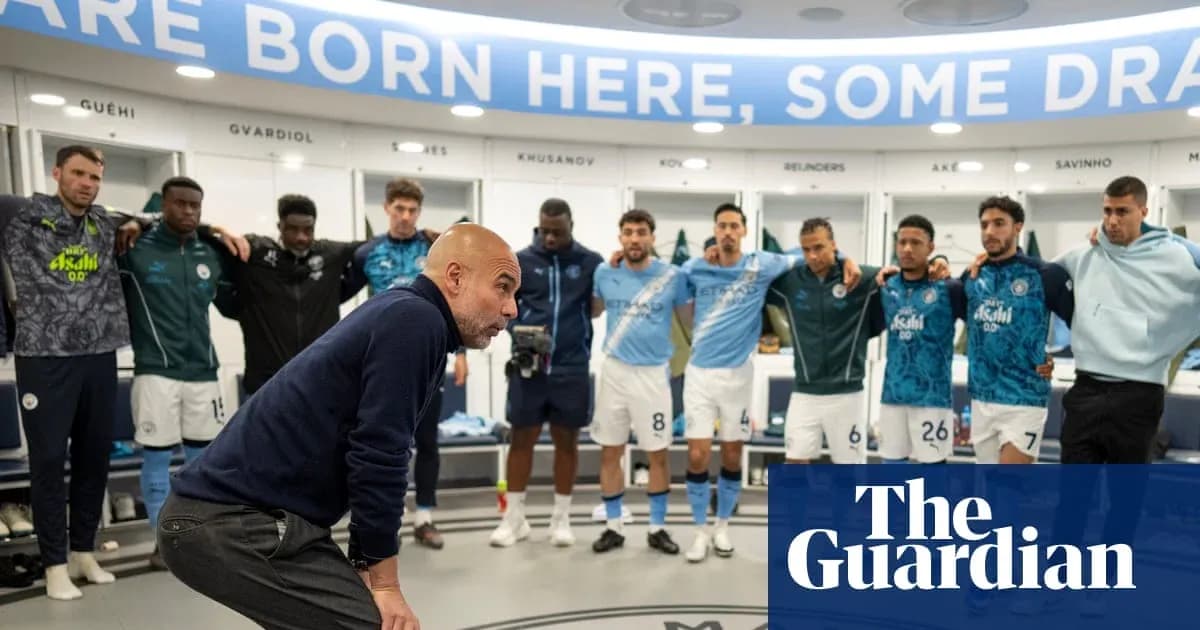
After a 2-0 defeat by Juventus in the Champions League on 11 December 2024 – City’s seventh loss in 10 matches – Guardiola stands in front of his players and strips away the last of the professional mask. His marriage, he tells them, has collapsed.
“I’m fucking divorced from the most beautiful woman on your planet,” he says. “I love her unbelievably, but we lost the passion. How do you play football, because you are paid? Or because of something inside? Where is the passion?”
It is a startling choice of motivational tool. Guardiola has every right to speak about his private life, but here the line between manager and man blurs in a way that may weaken, rather than strengthen, his authority. When he later explains what a true No 1 must be, he puts it bluntly: “You have to convince your players [that they would] go to the penthouse, the roof and jump down [for you].”
A year on, after that infamous 10-man rotation against Leverkusen, he returns to the same theme. Again, he tells the squad: “I leave my life, my divorce and my family is away, and everything for all of you. And what do you give back?”
The message is clear: he has sacrificed everything. The question is whether anyone in the room still feels moved by that sacrifice.
When the manager becomes a case study
Episode two, “The Rebuild”, digs deeper into that sense of a man running out of emotional levers to pull. Manuel Estiarte, Guardiola’s close friend and City’s director of first-team operations, reveals he went to the players to explain the manager’s turmoil.
He told them Guardiola was “anxious, sad, different” because he was getting divorced. “I said to the team: ‘Please, you have to understand, you’re not playing with a coach who can be a bit impulsive, intense, sometimes a bit up and down. You’re seeing a human being. He’s getting a divorce.’ It was necessary for the team not only to visualise Pep as a manager but for the first time as a human being.”
That admission raises uncomfortable questions. Why did Guardiola not tell the players himself? If his private life was so central to his mood and methods, did Khaldoon and Ferran Soriano, the club’s CEO, ever stop to ask whether it was affecting his ability to do the job?
The camera then cuts, almost cruelly, to a smiling Guardiola. “In my life I made a lot of changes – I got divorced and I have to settle a bit. But no complaints at all honestly,” he says, before insisting he is happy. At least in one area. “In my job, yeah,” he adds.
The documentary leans into this tension. Relationships, love, loyalty – they run through the series as a constant refrain. Episode three is even titled “Love and Hugs”. The sentimentality is real, but so is the coldness that follows.
Captaincy, conflict and Anfield tears
Part one, “The Desert”, shows how quickly bonds can fray. Kyle Walker’s departure in January 2025 is framed as a betrayal at the worst possible time. City’s captain walks away just as the ship is listing.
Guardiola tells the squad Walker did not behave like a leader when they needed him most. Then he turns on them. They had voted for Walker as captain. Why, he asks, did none of them pin him to the wall and demand more from him?
The flashpoint comes at Anfield. Walker’s mistake leads to Luis Díaz winning a penalty, converted by Mohamed Salah, in a 2-0 defeat. In the dressing room Guardiola points out the error. Walker snaps back that he is being blamed in “every meeting”.
The argument leaves the manager in tears. On camera, he delivers a raw monologue about loyalty and commitment. Just 11 days earlier, in the midst of that disastrous run, he had signed a new contract because he wanted to fight. The shot lingers: Guardiola speaking, voice cracking; Walker silent, processing.
“If captains first, then the other ones, for example [feel] that there’s a problem, tell me,” Guardiola says. “It’s not going to change the love I have for all of you. I’m sorry.”
The regret is palpable. So is the distance.
Saying goodbye to “Super Kev”
Episode two opens with another wrench. Kevin De Bruyne, the defining player of the Guardiola era, is not offered a new deal. Soriano stresses to Khaldoon that “Kevin gets the respect he deserves as the greatest player in the modern history of City”, but the outcome is brutal.
Guardiola reveals De Bruyne broke down in his office. The manager admits there had to be “coldness” in the decision to move him on. The cameras then find De Bruyne himself, in tears when asked what he will miss most.
“My kids don’t want to go,” he says.
In those few words, the series underlines what elite sport often buries. The machine must keep turning. The human cost is left behind in the offices, the living rooms, the school playgrounds. Guardiola and De Bruyne, icons of an era, are reduced to assets to be moved on when the algorithm says so.
The Leverkusen gamble that broke the room
Honesty cuts both ways. When Guardiola makes 10 outfield changes for the home game against Leverkusen in November 2025, the boardroom does not rally around him.
“Our attitude with Pep Guardiola should not be too negative. But it shouldn’t be too kind or accommodating either. This is his mistake this time,” Soriano says. Khaldoon goes further. “To pick an entire new [outfield] team in a game this important is probably one of the lowest points we’ve had. I can’t speak to him – I’m so angry.”
These are not lines designed for club propaganda. They are a record of a relationship pushed to the edge, of a hierarchy no longer willing to shield its greatest manager from criticism.
Twenty trophies, and then the door
By the time part four, “Nothing Is Eternal”, winds towards its conclusion, the storm has eased. City do what City do: they win. The Carabao Cup and FA Cup are lifted, taking Guardiola’s haul to 20 trophies in a decade, including three Community Shields. The league title escapes them, but they finish second. The rebuild, in the club’s eyes, is complete.
The farewell is warm and lavish. Guardiola gets the send-off his achievements demand. Yet his final words in the series carry a different kind of weight.
“Life should not just be about football. It’s too much to be honest,” he says.
For a manager who built a “machine”, the documentary shows the cost of keeping it running. The question now is what he does with the rest of his life – and what City become without the man who gave them both their edge and, as this series reveals, their most human flaws.