.svg&w=384&q=75 "GoalGist logo")
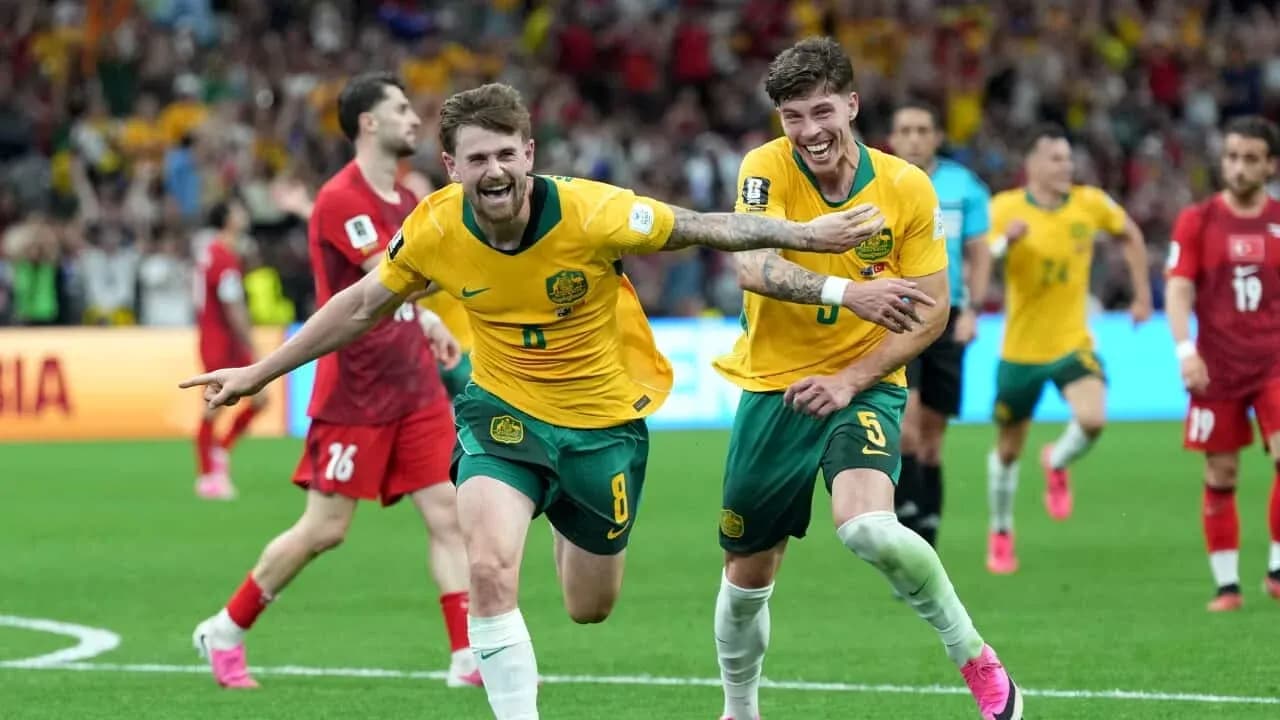
Australia's Tactical Masterclass Against Türkiye: A 2-0 Victory
Australia’s 2-0 win over Türkiye at BC Place was a classic example of an underdog executing a low-possession, high-discipline game plan to perfection. In a World Cup group opener where Türkiye monopolised the ball and volume of shots, Australia’s 5-4-1 structure, direct transitions and penalty-box efficiency decided the contest. Despite having just 28% possession and being outshot 30-9, Australia struck in each half and protected the lead with compact spacing, aggressive last-line defending and a standout display from debutant goalkeeper Patrick Beach.
I. Scoring sequence & disciplinary log
The match’s tactical storyline hinged on two Australian strikes against the run of general possession.
At 27', Australia’s first real attacking pattern paid off: Nestory Irankunda finished a transition move for 1-0, assisted by Paul Okon-Engstler. The goal underlined Australia’s plan to spring from their 5-4-1 mid-block, using Irankunda’s pace from the right side of the midfield line and Okon-Engstler’s ability to connect the first pass out of pressure. That advantage held to half-time, with the score 1-0 at the interval.
In the second half, substitutions began to reshape the attacking zones. At 61', Irankunda (OUT) was replaced as Nishan Velupillay (IN) came on for fresh legs on the flank, while Türkiye had already introduced Kenan Yıldız (IN) for Barış Alper Yılmaz (OUT) at 46' to add more penalty-box presence.
The decisive second goal arrived at 75'. Connor Metcalfe drove forward from midfield and scored for 2-0, unassisted. It came just one minute after a double change from Australia at 74', with Tete Yengi (IN) for Mohamed Touré (OUT) and Jason Geria (IN) for Jacob Italiano (OUT), signalling a shift towards more hold-up play and defensive solidity on the right.
Türkiye continued to rotate in search of a breakthrough: Yunus Akgün (IN) for Orkun Kökçü (OUT) at 62', Salih Özcan (IN) for İsmail Yüksek (OUT) and Mert Müldür (IN) for Zeki Çelik (OUT) at 81', and Deniz Gül (IN) for Kerem Aktürkoğlu (OUT) at 85'. Australia, for their part, refreshed the left and central midfield zones with Aziz Behich (IN) for Jordan Bos (OUT) and Jackson Irvine (IN) for Okon-Engstler (OUT) at 84'.
The only card of the match came at 86':
- 86' Yunus Akgün (Türkiye) — Roughing
Discipline totals were therefore: Australia 0, Türkiye 1, Total 1.
II. Tactical breakdown & personnel
Australia lined up in a 5-4-1 under Tony Popovic, with a clear emphasis on vertical compactness and penalty-box protection. The back five of Jacob Italiano, Alessandro Circati, Harry Souttar, Cameron Burgess and Jordan Bos stayed narrow, allowing crosses from wider zones but fiercely contesting first and second balls in the area. The midfield four – Connor Metcalfe, Aiden O'Neill, Paul Okon-Engstler and Nestory Irankunda – operated in two tight banks, shifting laterally to block central progression from Hakan Çalhanoğlu and Orkun Kökçü.
In possession, Australia rarely built slowly. With only 270 total passes, 202 accurate (75%), their attacks were direct and selective. The front reference, Mohamed Touré, worked primarily as an outlet for clearances and early passes, looking to drag Türkiye’s centre-backs away from the line and open channels for Irankunda’s diagonal runs. The first goal reflected this: a quick transition, Okon-Engstler finding a vertical lane, and Irankunda attacking space behind an advanced Turkish full-back.
After the break, the introduction of Nishan Velupillay and later Tete Yengi allowed Australia to preserve the same basic structure but with fresh runners and a more physical target to relieve pressure. Jason Geria and Aziz Behich coming on for Italiano and Bos further tilted the side towards defensive reliability, with both substitutes more conservative in their positioning. Jackson Irvine’s late entry in central midfield added height and aerial presence for the final defensive phase.
The central figure in Australia’s plan was Patrick Beach (Australia). Facing 30 total shots and 8 shots on goal from Türkiye, Beach (Australia) made 8 saves, matching every effort that hit the target. His handling on long-range attempts and his positioning on cut-backs were decisive in stabilising a defence that often had to absorb sustained pressure. The goals prevented metric of -0.95 for Australia suggests that, on balance, the model expected Beach to concede slightly fewer than the 0 he actually allowed, indicating that some Turkish finishing helped him, but his error-free execution under a heavy workload underpinned the clean sheet.
Vincenzo Montella’s Türkiye used a 4-2-3-1 with a heavy emphasis on ball circulation and territorial dominance. With 72% possession and 707 passes (638 accurate, 90%), Türkiye controlled the tempo. Ferdi Kadıoğlu and Zeki Çelik pushed high and wide to pin Australia’s wing-backs, while Çalhanoğlu and Yüksek attempted to dictate from the double pivot. In the attacking band, Arda Güler, Kökçü and Barış Alper Yılmaz interchanged frequently, looking to overload half-spaces and feed Kerem Aktürkoğlu’s runs off the shoulder.
However, Türkiye’s shot profile betrayed structural issues in the final third. Despite 30 attempts, only 8 hit the target, with 12 blocked – a reflection of Australia’s deep block and willingness to defend the box with numbers. Many of Türkiye’s efforts came from outside the box (16 shots), where Australia were content to concede space, trusting Beach’s positioning and the density of bodies in front of him.
Uğurcan Çakır (Türkiye) faced far fewer actions, making 2 saves from 4 shots on goal. Türkiye’s high line and aggressive full-backs left them vulnerable to the few Australian transitions that did materialise, and both goals came from sequences where the midfield screen was bypassed too easily, leaving the back four exposed to direct runs and late arrivals from Metcalfe.
III. The statistical verdict
The underlying numbers underscore the tactical paradox of the match. Türkiye led in virtually every volume metric: 72% possession, 707 passes to Australia’s 270, and a 30-9 shot advantage with 14 attempts inside the box. Their xG of 1.33 compared to Australia’s 0.77 reflects that they did create more and slightly better chances overall. Yet the distribution of those chances and Australia’s penalty-box defence were decisive.
Australia’s 5-4-1 produced a low-pass, high-impact attacking pattern: 6 of their 9 shots came inside the box, and they converted two of their four on target. Their 12 fouls, compared to Türkiye’s 4, aligned with a strategy of controlled aggression in duels, while maintaining discipline in terms of cards.
For Türkiye, the single yellow card to Yunus Akgün for Roughing at 86' was a minor footnote compared to the larger issue: turning territorial dominance into high-quality, central shots. With 12 blocked efforts and many from distance, their possession often ended in low-probability attempts against a set defence.
Ultimately, the data paints a clear tactical picture: Australia maximised a compact defensive game plan, elite penalty-box commitment and clinical finishing, while Türkiye’s structured but predictable possession failed to unpick a well-drilled 5-4-1 block.