.svg&w=384&q=75 "GoalGist logo")
Arsenal's Triumph Amidst VAR Drama: A Turning Point for Lewis-Skelly
At full time at the London Stadium, it felt less like a routine VAR check and more like a theological event. Arsenal players froze. West Ham fans held their breath. Chris Kavanagh, surrounded by chaos and accusation, finally pressed his finger to the microphone and delivered the verdict that could yet shape a title race.
“Final decision, direct free-kick.”
Pablo had fouled David Raya. Callum Wilson’s 95th‑minute equaliser was wiped from existence. The away end erupted. West Ham sank. Arsenal lived.
On Sky Sports, Ian Wright was asked if those were the sweetest words he had ever heard. Wright, never one to play it down, went straight for the grandest comparison he could find: “The sweetest words since Martin Luther King’s ‘I have a dream’.” Hyperbole, of course. But in that moment, for Arsenal hearts, it did not feel far off.
A dressing room on the brink
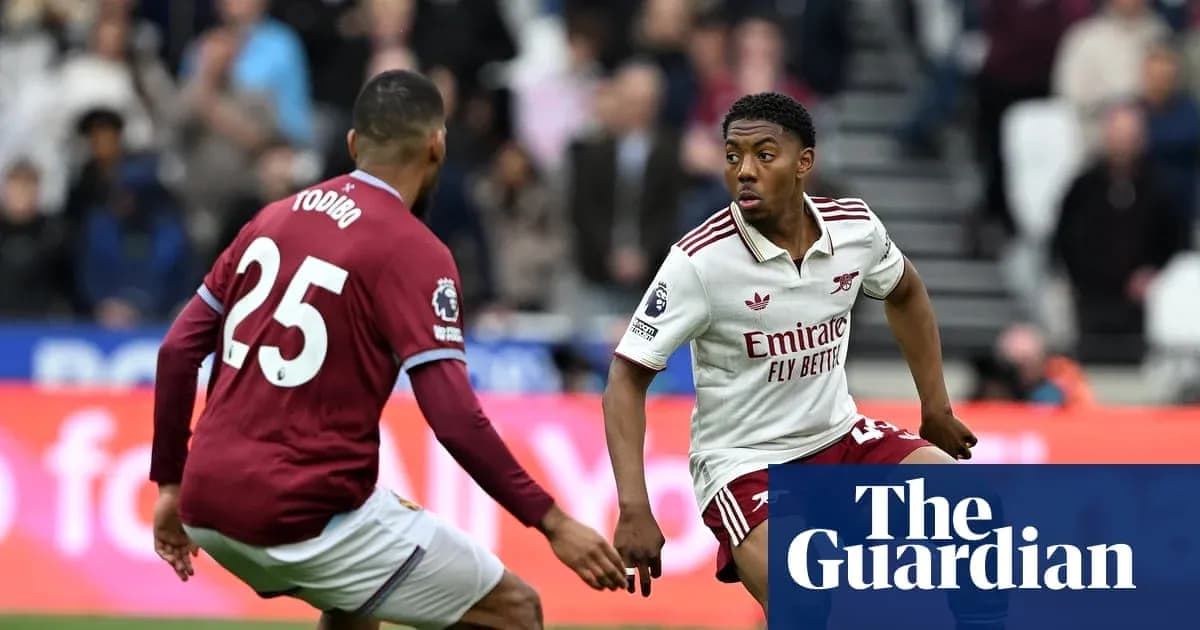
Inside the away dressing room, Myles Lewis-Skelly tried to make sense of it all. The 1-0 win had not just kept Arsenal’s season alive; it had dragged them five points clear of Manchester City with two games left. Burnley at home. Crystal Palace away. City still looming with a game in hand and a run-in of Palace at home, Bournemouth away, Aston Villa at home.
“It is just a huge sense of relief,” Lewis-Skelly said, before the words tumbled out faster. Joy. Excitement. Fulfilment. Arsenal’s players know the maths, they know the jeopardy, and they know the thin line they walked in east London. “We are buzzing, but we know that the job is not done. We have got two more finals left.”
The VAR delay only stretched the drama. On the pitch, Kavanagh stared at the monitor, the seconds dragging, the noise rising. On the touchline, Mikel Arteta paced. In the stands, West Ham felt the chance of a precious point and the oxygen of survival. When the decision finally came, the mood flipped in an instant.
“I don’t even know … it was just God on our side,” Lewis-Skelly said. “We are so grateful.”
He could have been talking about more than a single whistle.
From golden boy to test case
For Lewis-Skelly, that sense of deliverance runs deeper than one frantic stoppage-time scramble. His season has been a long, uncomfortable examination of what happens to a prodigy when the spotlight moves on.
Last year, he looked like he was writing his own story. Fifteen Premier League starts. Big stages, big moments. His first Arsenal goal in a 5-1 demolition of Manchester City, punctuated by a cheeky nod to Erling Haaland’s “Zen” celebration. A teenager walking into heavyweight arenas as if they were his back garden.
He scored on his England debut against Albania after 20 minutes. At the Bernabéu in a Champions League quarter-final, he ran the show to such an extent that Real Madrid’s grandees in the posh seats were left asking the same question: “Who is this kid?”
This season, that soundtrack stopped. The minutes dried up. His England place disappeared. The story stalled.
When Arteta named him in the XI for the Bournemouth game on 11 April, it was only his second league start of the campaign. Arsenal lost badly. For a 19‑year‑old who had flown through every previous level, this was the first real stretch of turbulence.
Arteta later admitted he had been hard on him. Demands went up, opportunities went down. For Lewis-Skelly, it became the acid test of how badly he really wanted it.
“It was tough for me initially,” he said. “But I pride myself on having mental strength. Sport is not one pathway because there are ups and downs. It’s how you bounce back from that, how you are in those moments when you face adversity. That is what defines you.”
He shut out the noise. “I spoke with my family and friends. I just told them: ‘I don’t want to hear all the noise that is coming from social media. Let me stay in this moment, let me continue to face this adversity and let me come out the other side of it.’”
So he trained like a starter while living like a squad player. Waiting. Watching. Preparing for a chance that might not come.
The Fulham gamble that changed everything
Then, nine days ago, Arteta went with his gut. Fulham at home, a selection call that raised eyebrows: Lewis-Skelly in midfield from the start. Not at left-back, where he had broken into the team, but in the role he knew best from his academy days.
“It feels so natural for me to be there,” he said. “I have been training there a lot so [against Fulham] I felt comfortable. The boss told me: ‘You are going to play midfield, so go for it.’ That is what I did. I had to be bold and play with courage because that is what this league demands.”
He did more than just survive. He drove Arsenal through a 3-0 win, snapping into tackles, carrying the ball, injecting tempo into a midfield that had looked short of spark. In one afternoon, the narrative shifted. The forgotten prospect became the live option again.
Arteta trusted him once more for the Champions League semi-final second leg against Atlético Madrid. Another high-wire night, another 1-0 win, another step into the season’s sharpest glare. A place in the final against Paris Saint-Germain secured, and Lewis-Skelly right in the middle of it.
Then West Ham. Same intensity, different kind of pressure. This time, he had to show he could handle the grind of a tight league game with the title on the line.
He did, and when Martin Ødegaard came on after 67 minutes to tilt the game back in Arsenal’s favour, Lewis-Skelly simply shifted to left-back and got on with it. No fuss. No drama. Just the adaptability that makes managers trust you in May.
Above Zubimendi, locked on the run-in
Almost without fanfare, Lewis-Skelly has climbed above Martín Zubimendi in Arteta’s midfield thinking. That alone tells you how sharply his stock has risen in the space of three matches.
He knows the competition. Ødegaard, the captain, changed the rhythm at West Ham the moment he stepped on. The bar in that part of the pitch is high. Arsenal’s margin for error is low. Every selection now carries weight.
Off the pitch, his future has been a talking point. In the era of balance sheets and squad churn, his name has been dragged into the cold language of “pure profit” – the accounting term that hovers over academy graduates in the transfer market. Sell one of your own and the books look better.
For now, that conversation can wait. It has to.
“I am focused on the games we have got coming up,” he said. “And bringing this club back to glory.”
Two league games. A Champions League final. A title race that refuses to settle. A teenager who has gone from the edge of the picture to the centre of it.
If this is what Lewis-Skelly produces when adversity bites, what happens when the storm finally clears?

