.svg&w=384&q=75 "GoalGist logo")
AC Milan Women Define Their Identity with 3–1 Victory Over Parma
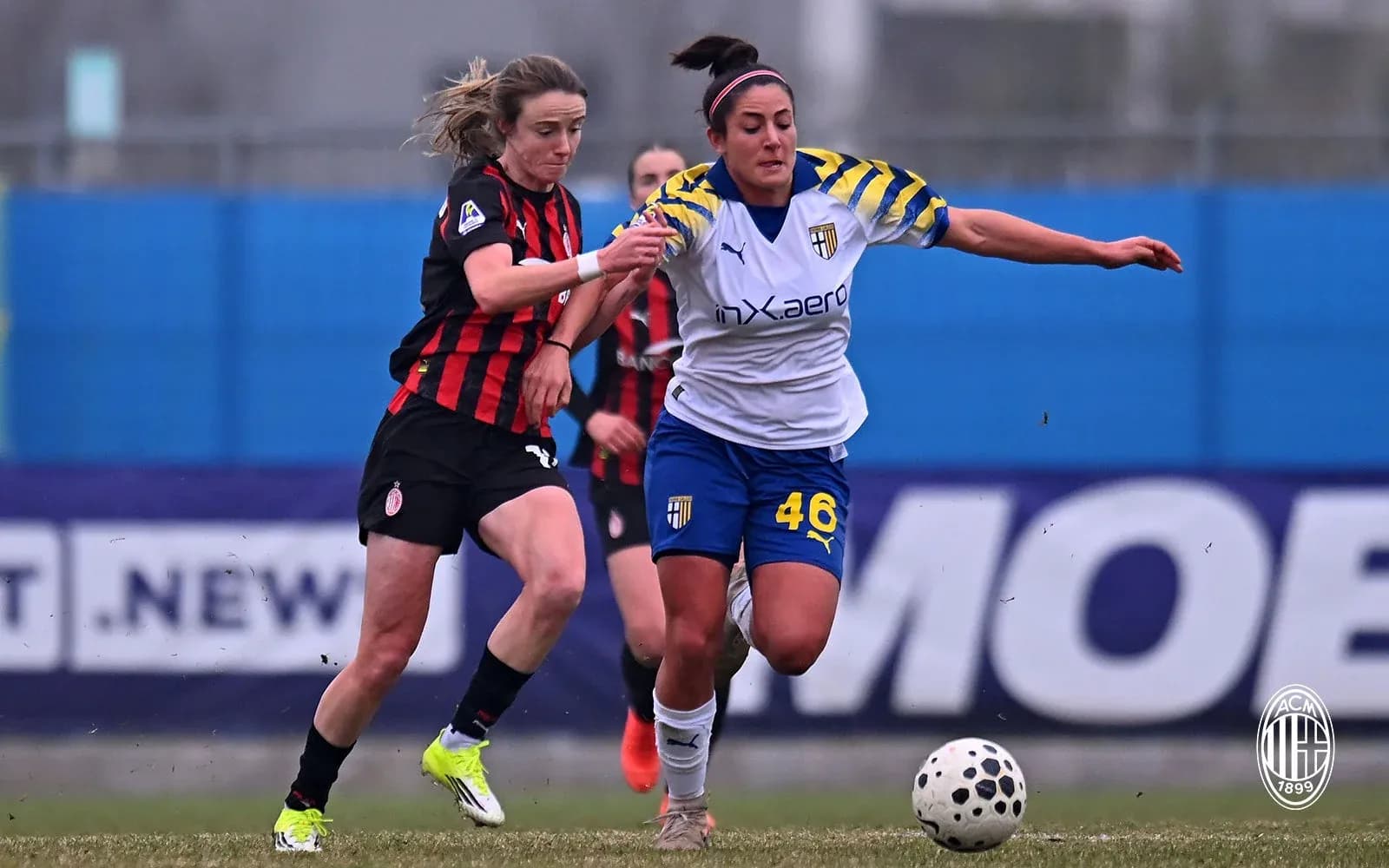
Under the spring light of Centro Sportivo Peppino Vismara, AC Milan W closed out a demanding stretch of the Serie A Women season with a performance that felt like a manifesto. In a league defined by fine margins and tactical nuance, a 3–1 win over Parma W in Round 21 was more than a routine home victory; it was a crystallisation of Milan’s evolving DNA under Suzanne Bakker.
Heading into this game, the table already framed the clash as a meeting of two very different projects. Milan sat 6th with 32 points, built on 9 wins, 5 draws and 7 defeats from 21 matches. Their overall goal difference of 6 was cleanly earned: 31 goals scored and 25 conceded. At home, they had been solid if not spectacular – 5 wins, 3 draws and 3 losses from 11 fixtures, with 18 goals for and 15 against. The numbers painted a side that could outplay most opponents, but occasionally left the back door ajar.
Parma arrived in Milan with survival as their central storyline. Ranked 10th on 16 points after 21 games, their overall record of 2 wins, 10 draws and 9 losses told of a team that clung to games but rarely seized them. Their goal difference of -13 (15 scored, 28 conceded) was stark, and the away split even harsher: on their travels they had yet to win, with 0 victories, 5 draws and 6 defeats, scoring just 2 away goals while conceding 14. If Milan were trying to refine a European-chasing identity, Parma were fighting simply to stay afloat.
By half-time, the narrative tension was still alive at 1–1, but across 90 minutes Milan’s superior attacking structure and squad depth turned the afternoon decisively in their favour.
Tactical voids and discipline – walking the line
Both coaches had to work within incomplete tactical pictures. The lineups data lists formations for the season – Milan leaning heavily on a 4-3-3 (used 10 times), with occasional shifts to 4-1-4-1, 4-2-3-1 and 4-1-3-2; Parma almost exclusively three-at-the-back variants, most often 3-4-2-1. Yet for this fixture, the exact match formations are not recorded. Instead, the story is told through personnel.
For Milan, Suzanne Bakker trusted a spine of L. Giuliani in goal, with E. Koivisto, K. De Sanders, A. Soffia and M. Keijzer forming the defensive platform. In midfield, G. Arrigoni and M. Mascarello provided balance, while C. Grimshaw – one of the league’s top assist providers – offered vertical running and late box entries. Up front, S. Stokic, T. Kyvag and C. Dompig gave Milan pace and direct threat.
On the bench, the presence of K. van Dooren and V. Cernoia underlined the depth at Bakker’s disposal. Van Dooren, with 5 league goals and a 6.9 rating, is Milan’s leading scorer in Serie A Women this season; Cernoia brings experience and control. That neither started yet Milan still produced three goals speaks volumes about the squad’s attacking layers.
Parma’s Giovanni Valenti built his side around M. Copetti in goal and a back line featuring C. Minuscoli, C. Ambrosi and D. Cox, shielded by the industrious M. Uffren and M. Gueguen. Higher up, I. Rabot, L. Dominguez and C. Prugna were tasked with connecting to the front duo of G. Distefano and A. Kerr. From the bench, Valenti had options like H. Cissoko, V. Benedetti, Z. Kajan and A. Zamanian to tweak shape or add defensive solidity.
Discipline has been a defining subplot of both teams’ seasons. Milan’s yellow card distribution shows a clear late-game spike: 31.58% of their cautions come between 76–90 minutes, a sign of intensity and perhaps fatigue-driven fouls as they protect leads or chase games. Red cards are spread evenly across 46–60, 61–75 and 76–90, each range accounting for 33.33% of their dismissals. Players like C. Dompig, K. van Dooren and M. Keijzer have all seen red this season, underscoring a high-risk, high-intensity edge in duels.
Parma, too, have a disciplinary profile that flares late. Their yellow cards peak at 29.17% between 76–90 minutes, with another 20.83% in the 46–60 range. Their lone red card arrives in that same 76–90 window, a reminder that as games stretch, their back line can be dragged into desperate challenges. Individually, M. Uffren is emblematic: 7 yellow cards, a combative presence who also missed a penalty this season – a key detail that shapes how she approaches high-pressure moments around the box.
Key matchups – hunter vs shield, engine room vs enforcer
Even without a blow-by-blow of each minute, the key duels are written into the season data.
Hunter vs shield was defined by Milan’s multi-pronged attack against Parma’s fragile away defence. Overall, Milan average 1.5 goals per game, with 1.6 at home. Parma, on their travels, concede 1.3 goals per match and have failed to score in 9 of 11 away fixtures. The 3–1 full-time scoreline fits that pattern almost too neatly: Milan hitting above Parma’s defensive average, Parma managing to pierce Milan’s back line once but unable to sustain pressure.
Within that, the presence of C. Dompig from the start added a volatile edge. She has 1 goal, 1 assist and a red card this season – a player who stretches defences and forces fouls. Her movement, combined with the verticality of T. Kyvag and the all-round threat of van Dooren off the bench, constantly asked questions of Parma’s back three.
In the engine room, the duel between Milan’s midfield and Parma’s enforcers shaped the tempo. C. Grimshaw, with 2 assists, 11 key passes and 10 successful dribbles this season, is a transitional hub – capable of breaking lines with both passing and carrying. Alongside her, M. Mascarello brings structure and bite: 15 key passes, 4 yellow cards, and a willingness to step into tackles.
Opposite them, M. Uffren and G. Distefano formed Parma’s heartbeat. Uffren’s numbers are outstanding for a team in the lower reaches: 512 passes at 82% accuracy, 32 tackles, 34 interceptions and 110 duels contested, winning 60. Distefano, listed among the league’s top assist providers, blends creativity and graft: 2 assists, 16 key passes, 31 dribble attempts with 11 successes, and a huge 151 duels, winning 81. She also blocked 3 shots this season, underlining her work rate in both directions.
Yet over 90 minutes, Milan’s engine room had more platforms to play from. Their overall goals-against average of 1.2 (1.4 at home) is tighter than Parma’s 1.3, and with Giuliani protected by a back line including Keijzer – who has blocked 3 shots and made 10 interceptions this season – Milan could commit midfielders forward without completely losing defensive control.
Statistical prognosis – why this result made sense
Following this result, the numbers and the narrative are in harmony. Milan’s 3–1 victory is the logical extension of their season-long trends: a side that scores more than it concedes, particularly at home, and that can draw on multiple attacking profiles even when their top scorer starts on the bench.
Parma’s story is equally consistent with the data. A team that has failed to score in 11 of 21 league games and averages just 0.2 goals away from home did well to find the net once in Milan, but their structural issues – especially in transition and in late-game discipline – were always likely to be exposed by a host that averages 1.6 home goals and has the depth to maintain tempo into the final quarter-hour.
While explicit xG figures are not available, the underlying indicators point to a match where Milan would be expected to generate the higher-quality chances: superior home scoring rate, a broader spread of creative contributors (Grimshaw, van Dooren, Park Soo-Jeong from the wider squad), and a Parma defence that has already absorbed 14 away goals.
In tactical terms, this was a game where the hunter’s tools were sharper than the shield’s resilience. Milan’s layered attack, disciplined – if occasionally combustible – back line, and control in midfield all converged at Vismara. Parma, brave and industrious through Uffren and Distefano, simply could not bend the probabilities far enough in their favour.