.svg&w=384&q=75 "GoalGist logo")
World Cup Last 16: Giants Fall and England Face Mexico
Six days, 16 matches, and half the World Cup has been stripped away. The bracket is down from 32 to 16, and the tournament has already claimed one heavyweight scalp that reshaped the odds.
Germany are out. Not in a classic, not in a storm of goals, but in the cold cruelty of a penalty shoot-out against Paraguay. The numbers had them at around 63% to go through. They didn’t. One bad night from 12 yards, and the entire balance of the competition shifted.
Senegal came close to detonating a second shock of the same magnitude. Had they held their lead against Belgium, the upset would have ranked right alongside Paraguay’s ambush of the Germans. Instead, Belgium survived and the bracket kept a little more of its expected shape.
Morocco’s win over the Netherlands felt like an upset to the naked eye, but the data paints it differently. Elo ratings had the Dutch at only about 55% to progress – essentially a coin toss dressed up in big-name shirts. It was one of the most even ties of the round, and it played out that way.
Underdogs bite, favourites sweat
Some of the most lopsided ties on paper produced the most tension.
Cape Verde, given just a 10% chance of going through, dragged holders Argentina into extra time and refused to go quietly. Argentina survived, but not without a bruise or two and a small dent in their status as outright favourites.
Congo, rated at only 17% to progress, led England with 15 minutes to play. For a spell, the script was in shreds. England eventually turned it around, but the warning lights flashed: in knockout football, even a 1-in-5 shot can land.
The broader picture of the last 16 looks familiar. All Asian teams are out. All but two African sides have gone as well. The business end of the World Cup is once again dominated by Europe and South America.
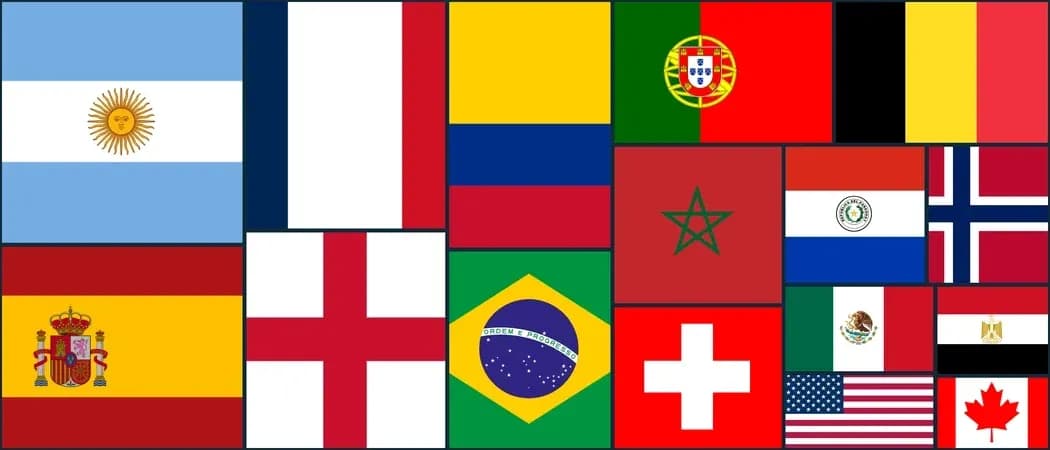
Five nations sit outside those traditional power blocs: Canada, Egypt, Mexico, Morocco and the United States. Collectively, their chances of winning the whole thing add up to around 3.5%. They are the long shots keeping the storylines interesting.
At the other end of the spectrum, Argentina remain the benchmark. Their escape against Cape Verde came at a cost in the models: their probability of lifting the trophy has dipped slightly to 28%. Part of that is down to France. Germany’s exit opened up the path on that side of the draw, and the French have stepped into the gap.
France are now up to a 14% chance of winning the World Cup. Spain, ruthless in their dismantling of Austria, have climbed to 16%. Both cruised through their last-16 ties – Spain easing past Austria, France doing the same to Sweden – and both are now a game closer to the trophy.
England, by contrast, have edged up to 12%. That rise says as much about the shrinking field as it does about their form. Brazil and Argentina still loom as potential roadblocks, assuming England first handle the assignment immediately in front of them.
That assignment comes with thin air and thick narrative.
England, Mexico and the truth about altitude
England face hosts Mexico in Mexico City, a fixture wrapped in talk of altitude, lungs burning and legs fading. The numbers are less dramatic.
Strip away the noise and the expected goals model gives England a clear edge: 1.6 xG to Mexico’s 0.6, even after allowing for home advantage. From that, the probabilities fall into place: England at 62% to win in normal time, Mexico at 13%, and a 25% chance of a draw and penalties.
Altitude is the obvious talking point. Mexico City sits above 2,000 metres, and the folklore around such venues is rich. But thousands of historical international matches at different heights offer a cooler perspective.
Round the altitude to the nearest 500 metres and look at outcomes: home teams actually win more often at sea level than they do at Mexico City’s band. Around 55% of matches at or near sea level end in home wins. At 2,000–2,250 metres – Mexico City’s range – that figure drops to 52%.
On the face of it, home advantage does not grow with altitude. If anything, it dips.
The key is controlling for team strength. The model leans heavily on Economic Observatory Elo ratings, which mirror FIFA’s rankings closely and have a strong record in predicting international results. Those ratings generate an expected probability of a home win between 0 and 1. Subtract that expectation from what actually happens and average the difference, and you get a clean measure of over- or under-performance.
High-altitude nations tend not to be global heavyweights in Elo terms. Bolivia play above 3,000 metres; Ecuador, Ethiopia and Mexico above 2,000. They are often underdogs on paper.
When the Elo expectation is stripped out, a pattern appears. Below about 1,750 metres, home teams win roughly as often as the ratings suggest. Above that threshold, they start to outperform those expectations. The higher you go, the more the home side tends to overachieve.
Even then, the effect is modest. At the very highest altitudes, the over-performance gap is around 20 percentage points – and that still sits within the margin of error. The data hints at an advantage, but not an overwhelming one.
So what does that mean for England in Mexico City?
It does not point to a huge built-in edge for the hosts. It does not dismiss the idea that Mexico could benefit either, especially against a visiting side with little time to acclimatise. If you tweak the expected goals to reflect a plausible altitude impact – shave 0.25 xG off England, add 0.25 xG to Mexico – the picture narrows.
Under that scenario, England’s win probability drops from 62% to 48%. Mexico’s jumps from 13% to 24%. The rest moves into the draw-and-penalties bucket.
England still come out as the better team, both in the Elo-based model and in other assessments, such as those built on Transfermarkt squad values. Altitude acts as a leveller, not a magic spell. It can close the gap, but it is unlikely to turn the match into a true 50–50.
The thin air may test England’s lungs. The bigger test will be whether they can impose their quality before the atmosphere – literal and figurative – tightens around them.
The rest of the bracket: favourites, traps and one awkward tie for France
Beyond Mexico City, the last 16 offers a slate that leans heavily towards the favourites.
The simulations point to Argentina progressing against Egypt with a 77% likelihood. England are put at 74% to go through against Mexico. Morocco, fresh from that win over the Netherlands, are rated 70% likely to beat Canada.
Spain are given a 72% chance of knocking out Portugal, a heavyweight clash in name but one where the numbers lean clearly towards the Spanish. Colombia are 70% favourites over Switzerland. Brazil, at 69%, are expected to move past Norway. Belgium, at 64%, are tipped to end the United States’ run.
And then there is France–Paraguay.
On paper, it looks straightforward: free-scoring France against a dogged South American side. The model is less relaxed. France are only 62% likely to progress, making it one of the more precarious ties for a top seed.
The expected goals tell the story. France, who have been sweeping opponents aside, are projected at just 1.1 xG in this match. Paraguay sit at 0.6. That gap is narrower than many might assume for such a clash.
Paraguay’s reputation from the group stage holds: aside from their opener against the United States, they have been stubborn, disciplined and hard to break down. For all France’s attacking talent, this shapes up as their sternest examination yet.
The giants remain in the draw. The probabilities still favour the usual suspects. But Germany’s exit, Cape Verde’s push, Congo’s scare and the quiet, nagging effect of altitude all serve as a reminder.
This World Cup is following the numbers – until, suddenly, it doesn’t.