.svg&w=384&q=75 "GoalGist logo")
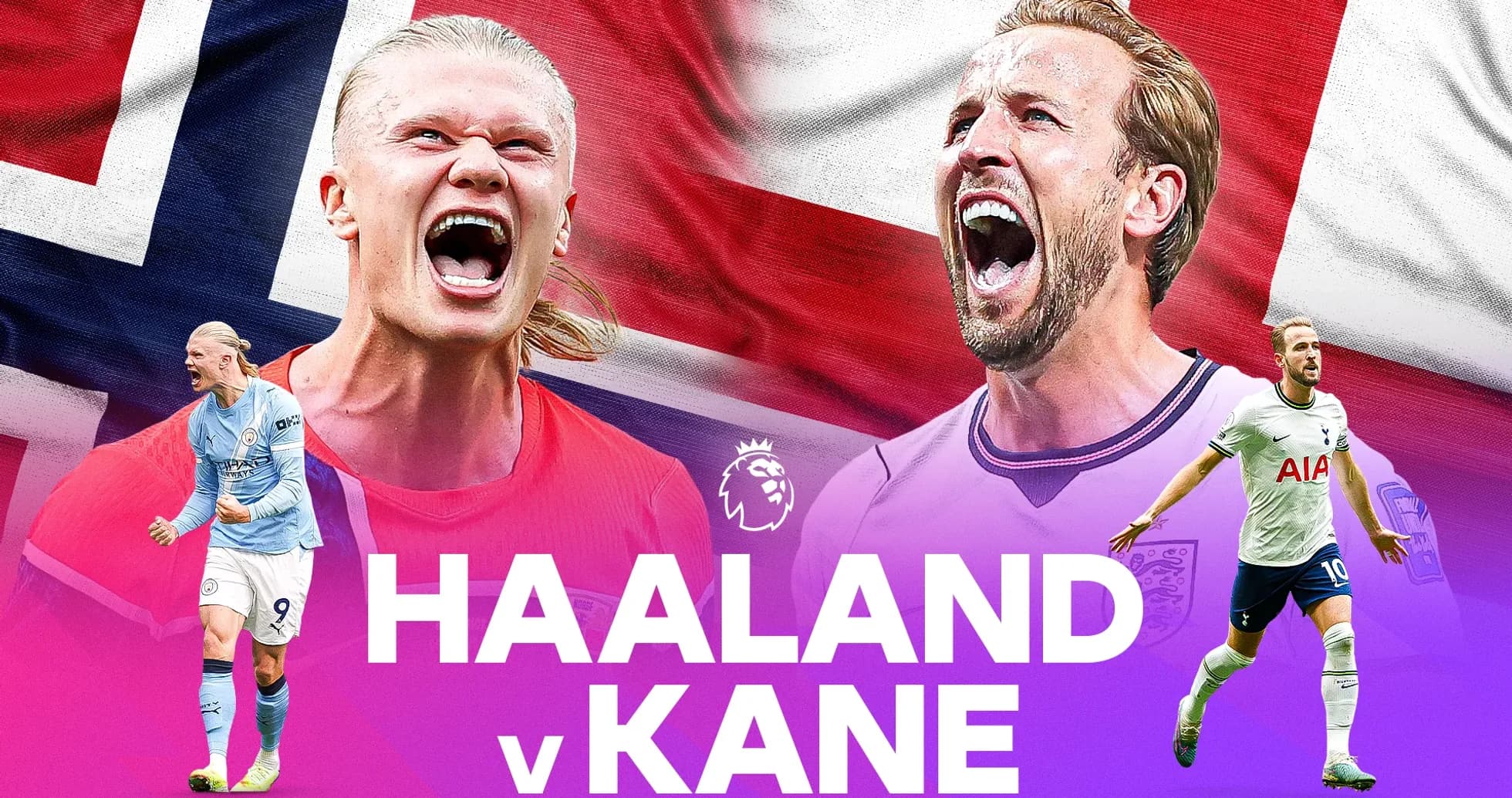
Kane vs Haaland: A Striker Showdown at the World Cup
Harry Kane and Erling Haaland are bound by numbers and separated by instinct.
Two of the greatest strikers the Premier League has ever seen, both defined their eras with a relentlessness in front of goal. Yet as No 9s, they could hardly be more different.
Haaland is the pure finisher, a penalty-box predator who moves like a shadow and strikes like a hammer. Cold, ruthless, almost mechanical in his efficiency, he exists to finish moves and collect medals.
Kane is something else. Creator, conductor, and assassin rolled into one. At Tottenham Hotspur he wore the number 10 shirt by choice, a statement that he saw himself not just as the spearhead, but as the heartbeat. He drops deep, threads passes, dictates tempo – and still scores at a historic rate.
For years their rivalry has been more theoretical than direct. They shared only one Premier League season, 2022/23, before Kane left for Bayern Munich. The comparison has lived mostly in data and debate, not in duels.
That changes on Saturday. England v Norway. World Cup quarter-final. Kane v Haaland, finally, with the stakes at their highest.
Premier League giants, different paths
Strip it back to the numbers and both belong in the Premier League’s pantheon.
Kane sits on 213 Premier League goals, second only to Alan Shearer’s 260. He is 47 short of the all-time record, and at his historic rate of around 25 league goals a season, he would have needed roughly another 18 months in England to overhaul Shearer.
Haaland, by contrast, has “only” 112 Premier League goals. The gap is huge in raw totals, but misleading. Kane enjoyed nine seasons as a first-team regular at Spurs. Haaland has had four in England.
What Haaland has done in those four seasons is unprecedented. His 0.91 goals per 90 minutes is the best rate in Premier League history. At that speed, he needs just 113 more league games – around four more campaigns at his usual 33 matches a season – to score the 102 goals required to pass Kane and move into second on the all-time list.
From there, the maths keeps tilting his way. Haaland has eight years left on his current contract. He would need only about half of that to move beyond Kane, and then another 52 matches, at his current rate, to clear Shearer’s 260.
Give it time and the Norwegian is on course to become the most prolific goalscorer the competition has ever seen.
Kane, though, still owns the present.
Records, awards – and the different weight of trophies
Their Premier League scoring peaks tell a story of timing and impact.
Haaland detonated on arrival. In 2022/23, his debut season in English football, he smashed the single-season record with 36 league goals.
That same year, Kane signed off at Spurs with 30 goals, matching his own previous high from 2017/18. He also had a 29-goal season in 2016/17. Between them, the top five Premier League scoring seasons read:
- Haaland – 36 (2022/23)
- Kane – 30 (2022/23)
- Kane – 30 (2017/18)
- Kane – 29 (2016/17)
- Haaland – 27 (2025/26)
Haaland owns the single-season summit. Kane occupies more of the upper slopes.
On records, they trade blows.
Haaland is the fastest player ever to 100 Premier League goals, holds the single-season goals record, and boasts the best per-90 ratio the league has seen. Kane counters with the most goals for a single club in Premier League history – 213 for Spurs – and the most goals in London derbies, with 51.
Individual honours underline how closely matched they are, but also hint at what might come.
Haaland has five Golden Boots – three in the Premier League, two in the Champions League – plus three Player of the Year awards (one each in the Premier League, Bundesliga and UEFA). Kane has nine Golden Boots spread across competitions: three in the Premier League, three in the Bundesliga, one in the Champions League, one at the World Cup and one at the Euros, along with a Bundesliga Player of the Year award. Kane also has two European Golden Shoes to Haaland’s one.
The Norwegian’s advantage lies in silverware of a different kind.
Haaland’s teams have lived at the summit. He has three league titles – two Premier League crowns and one Austrian Bundesliga – and a Champions League to his name. He has also lifted five domestic cups: two FA Cups, one EFL Cup, one DFB-Pokal and one Austrian Cup.
Kane, for all his personal brilliance, spent most of his Premier League career chasing, not celebrating. His trophy cabinet is lighter: two Bundesliga titles and one DFB-Pokal with Bayern.
Some will say that makes his goal tallies more remarkable. He scored relentlessly in teams that often fell just short.
Bayern, Bundesliga – and a late-career explosion
If anyone still doubted Kane’s status as an all-time great, his move to Bayern Munich has removed the last hint of hesitation.
In Germany, he has produced video-game numbers: 98 goals in 94 Bundesliga matches. That is the realm usually reserved for Lionel Messi and Cristiano Ronaldo, the rare air of players who bend entire leagues around their output.
It raises an uncomfortable question for Premier League defenders: what would Kane’s numbers look like had he spent his peak years under Pep Guardiola at Manchester City, supplied by the division’s most dominant team?
We will never know. What we do know is that in 2025/26, he stood alone.
Across all club competitions in Europe last season, Kane scored 61 goals. Kylian Mbappe finished second with 42. Haaland, third with 38.
In an era obsessed with marginal gains and tiny differences, that is not a marginal gap. It is a chasm.
Haaland’s international roar
Haaland, though, hits back on the international stage.
Playing for Norway, without the depth or pedigree of England, he has produced an astonishing return: 62 goals in 54 caps, at a rate of 1.26 goals per 90 minutes. He has scored in each of his last 14 internationals.
Kane’s England record is, in its own right, historic. He has 85 goals in 119 appearances, at 0.83 goals per 90, and is his country’s all-time leading scorer.
Yet even that is shaded, statistically, by Haaland’s output. The Norwegian has managed elite, era-defining numbers in a team that does not live at football’s top table.
So the ledger swings back again. Club totals. League records. International ratios. Trophies. Individual awards. Every time one man seems to pull clear, the other drags him back.
Who is better – now?
Strip away the hypotheticals and projections and focus on the only thing that truly matters: the present.
As of July 2026, Kane has the edge.
He leads on cumulative Premier League goals, has matched and surpassed Haaland’s best single seasons more often, and is coming off a year in which he outscored everyone in Europe by a distance. His Bundesliga record is outrageous. His finishing, creativity and consistency have never looked sharper.
Haaland, seven years younger, owns the future. His goals-per-90 numbers in the Premier League are unmatched. His path to the all-time record is laid out in front of him. His medal collection will almost certainly grow.
But right now, in this moment, Kane stands as the best striker in the world.
On Saturday, Haaland gets the stage to argue otherwise – 90 minutes, maybe more, to tilt the debate and drag the narrative towards his era.
Quarter-final. England. Norway. Kane. Haaland.
One of them will walk off that pitch closer to the World Cup. The other will walk away with a question that might haunt the rest of his career.

