.svg&w=384&q=75 "GoalGist logo")
World Cup Chaos: England's Players Amid Transfer Uncertainty
The World Cup is supposed to strip life back to its basics: country, shirt, ball, goal. For England this summer, it comes with agents, clauses and eye-watering fees buzzing around the squad like Florida humidity.
Thomas Tuchel has 26 players in West Palm Beach, all chasing the same prize. Not all of them know where they’ll be playing their club football in six weeks’ time. That uncertainty trails them from the training pitch to the hotel lift, from ice baths to late-night calls home.
He knows he cannot shut it out.
“If I said to the players not to deal with it now, their telephone will still blow up,” Tuchel admitted. The line was half joke, half resignation. He understands the game’s new reality: World Cups no longer pause the market; they fuel it.
A shop window and a storm
A major tournament has always doubled as a shop window. James Rodriguez dazzled in 2014 and walked into Real Madrid. Enzo Fernandez rode his 2022 surge all the way to Chelsea. Harry Maguire turned his 2018 form into a move to Manchester United.
Those stories live in every player’s mind. Shine for a month, change your life.
But the other side is just as real. Transfer noise can seep into performances, blurring decisions, slowing reactions. Tuchel’s task is to keep England sharp while the market tugs at his dressing room.
“It’s a reality,” he said. “We will always recommend a player to take a decision before a tournament starts and as early as possible and go with the decision, but it’s not always possible for the player. We’re not alone in this, it’s just how it plays out.”
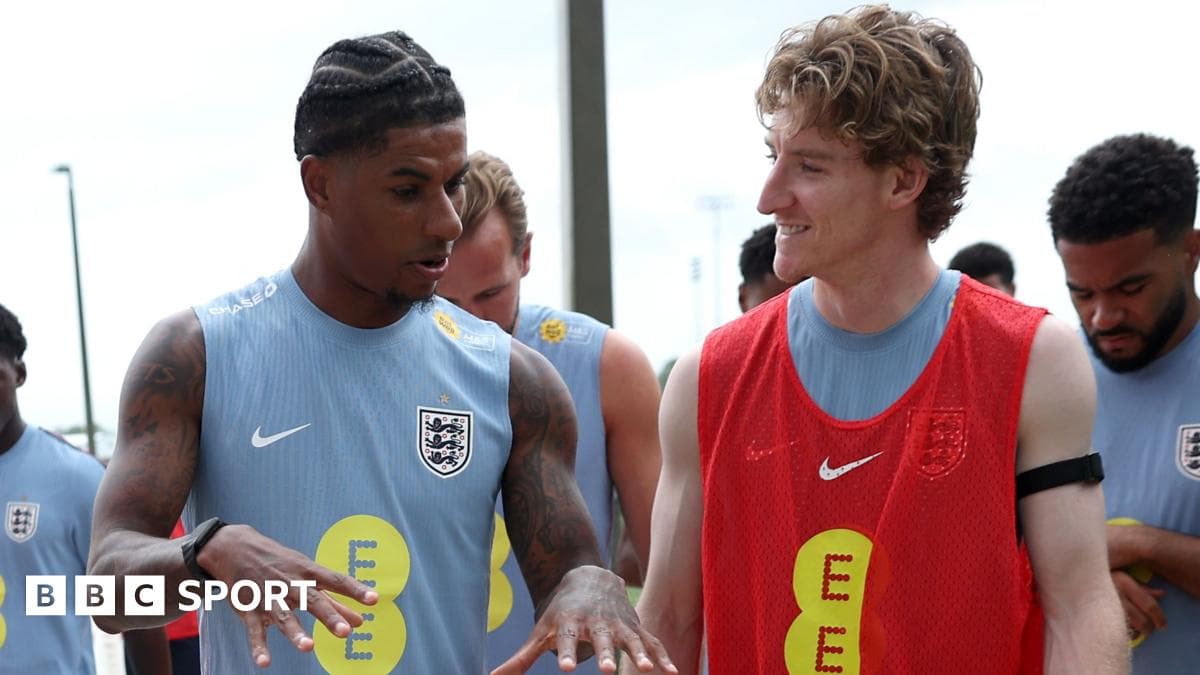
So England run through tactical drills in the Florida heat, work on pressing triggers and set-pieces, while phones vibrate in kit bags and agents refresh their inboxes.
Elliot Anderson and a potential record
For Elliot Anderson, the stakes could hardly be higher.
The midfielder arrives off a standout season with Nottingham Forest and finds himself at the centre of a tug-of-war. Both Manchester clubs are circling. Manchester City have already seen an opening bid knocked back. The 23-year-old is understood to favour a move to Etihad Stadium, a step that would drop him straight into a title-chasing machine.
Any agreement will not be cheap. The fee being discussed could break the British transfer record, eclipsing the £105m Arsenal paid West Ham for Declan Rice in 2023. That kind of number follows a player everywhere. Onto the coach. Into the team meeting. Into his own head.
Tuchel wants Anderson thinking about Croatia, not clauses.
Morgan Rogers, the £80m question
Then there is Morgan Rogers, another England midfielder with his name pinned to the gossip columns.
He has just come off a relentless season with Aston Villa: 55 games, 14 goals, 12 assists. Those are not the numbers of a squad player; they are the numbers of a creative hub. Naturally, the Premier League’s heavyweights have taken notice.
Arsenal and Manchester United are already in the conversation. Chelsea and Manchester City have been linked. The message from Villa’s side is blunt: it will take more than £80m to even start a serious discussion, according to BBC Sport’s senior football correspondent Sami Mokbel.
Rogers is trying to build chemistry with his England team-mates, to time runs and understand patterns. At the same time, he knows that every clever pass, every driving run in this tournament could add another few million to the fee that defines him.
Rashford and Barcelona’s ticking clock
Some players have tried to tidy their futures away before boarding the plane. Anthony Gordon managed it. He completed his move from Newcastle United to Barcelona last month, clearing the fog before the World Cup began.
Marcus Rashford has no such clarity.
Barcelona hold a clause to make his loan from Manchester United permanent for £26m. The deadline is brutal: 15 June, just two days before England’s opener against Croatia. The Spanish club want to renegotiate. The clock keeps ticking.
If that deadline passes without agreement, Rashford heads into the tournament with his future open and talks still rumbling on in the background. He will prepare to face Croatia while wondering whether his next club appearance will be at Old Trafford, Camp Nou, or somewhere else entirely.
Stones closes a chapter
At least John Stones knows one thing for certain: his Manchester City story is over.
After a decade at the club, he leaves as one of England’s most decorated modern players. Six Premier League titles, a Champions League, two FA Cups, five League Cups, and a stack of medals that would fill a small cabinet. The decision to move on is made. The destination is not.
That clarity of ending, if not of next step, may yet work in his favour. Stones can throw himself into this World Cup without wondering whether a medical has been booked for tomorrow morning. His agent will do the legwork; he can focus on defending.
Tuchel has set his own boundary.
“It’s about common sense. I would not like it [transfers] the day before a match, or on a matchday, that’s the policy,” he said. “But everything else if it’s done privately, efficiently and quietly then we are always happy to help.
“It helps to have clarity around the player. The best thing we can have is clarity so if anyone has a chance to complete a change of club and a transfer we will not stand in their way. But it has to align, of course, with our schedule and our goals which is to be focused and prepared for matches.”
In other words: do your business, but don’t let it walk into the dressing room on matchday.
History repeating itself
None of this is new for England. Transfer sagas have long slipped under the hotel door.
Ashley Cole spent the 2006 World Cup wrapped in a drawn-out Arsenal exit that finally ended with a deadline-day move to Chelsea. The medical for that swap deal with William Gallas had to be squeezed in while he was on England duty in Manchester.
Four years later, Joe Cole went to South Africa in 2010 without a club at all after leaving Chelsea. He insisted he had handed everything to his agent so he could concentrate on his country.
“I just want to get my head down and try and train and play well. My future will sort itself out. It won’t distract me,” he said at the time.
That is the ideal. Train, play, trust the rest to fall into place.
This England squad will try to do the same under a manager who understands the modern game’s chaos but refuses to let it define his tournament. The World Cup will not pause for release clauses or record bids. The question is whether England’s players can shut out the market noise long enough to make this summer about medals, not moves.