.svg&w=384&q=75 "GoalGist logo")
World Cup Euphoria and Breath Tests: England's Dual Reality
In the grey light of Thursday’s rush hour outside Durham, the World Cup felt a long way from Texas – until the blue lights started flashing.
Patrol cars lined the road on the edge of the city. One by one, drivers were waved over, windows rolled down, and plastic mouthpieces were handed out. Blow, wait, stare at the numbers. A different kind of pressure to the one Harry Kane and Jude Bellingham had faced the night before.
Durham Constabulary had picked their moment. England’s 4-2 win over Croatia had sent pints flying and voices hoarse across pubs and fan zones, and the force knows the pattern by now: statistics show around 20% more collisions on England match days. With this World Cup staged in North America, kick-offs land late into the UK night. That’s when the danger starts to creep into the next morning.
On this roadside, none of the drivers failed the breath test while reporters watched, but one was stunned to learn how close they were to the limit. The message landed.
Sergeant Sarah Manser put it bluntly: alcohol doesn’t clock off when you do. “We come out this morning to give that message that alcohol still might be in your system the next morning,” she said. “We’ve had a couple this morning already who haven’t blown over the limit, but they have had alcohol in the system. Please just don’t and drink-and-drive, it’s just as simple as that.”
For some, the checks were an inconvenience. For others, reassurance. Driver Louis Renwick, who blew clear with no alcohol in his system, welcomed the campaign. “There’s too many deaths on the roads through drink-driving,” he said, watching the next car pull in behind him.
The operation is rooted in hard numbers and a hard truth: football changes behaviour. England play, people drink. When kick-offs slide later into the evening, the hangover drifts straight into the commute. Police forces across the country have seen it for years. Durham chose not to wait for the crash reports.
Thousands of miles away, the other side of this story was unfolding in Dallas.
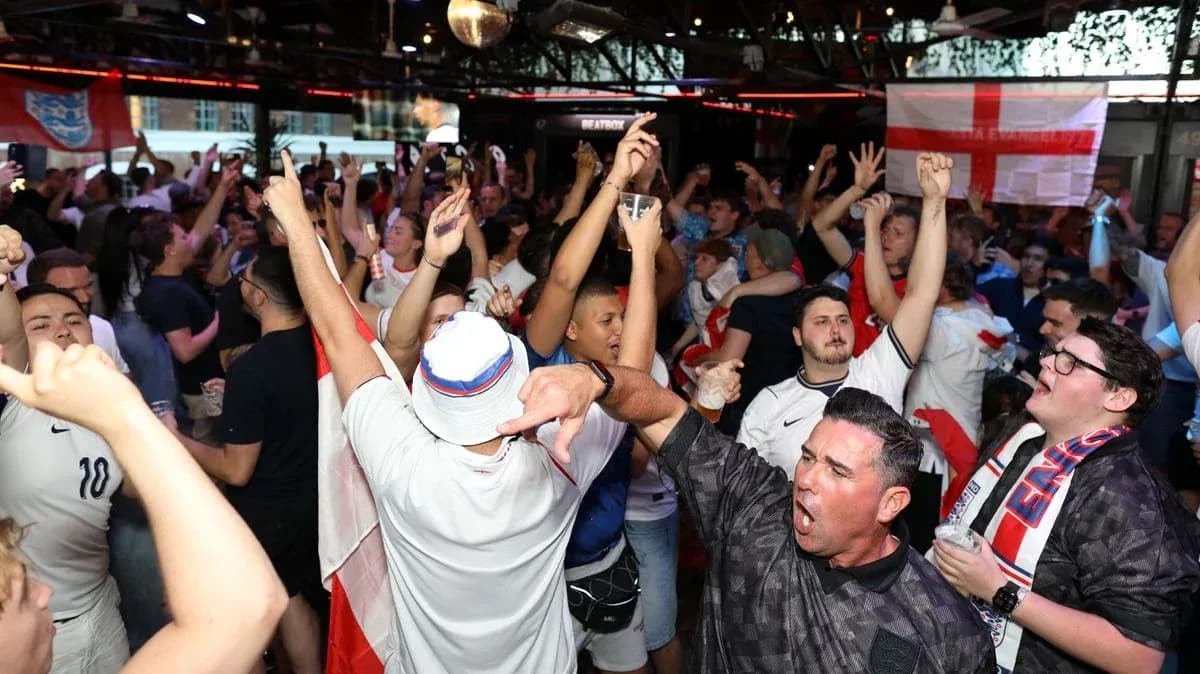
At the Londoner Pub, the tills rattled and the walls shook. England fans turned the place into a makeshift corner of home, knocking back more than 5,000 beers in a single night. The pub shifted 2,352 bottles alone and took in over £30,000 before the fire marshal stepped in and ordered an early closure amid what staff later called “the mayhem that descended on us”.
Videos showed police moving through the crowd as supporters belted out the national anthem. The venue had hit maximum capacity, with only two security guards trying to stem a tide of red and white shirts. The pub later stressed that the headline sales figures didn’t reflect the damage to property and landscaping, and reminded visitors that the bar sits in a mixed complex with other businesses and residential homes.
Inside the “Palace in Dallas”, as some were calling it, the match itself played out like a fever dream of English football. At times it felt like a wild FA Cup third-round tie, scrappy and breathless. At others it had the gloss and spectacle of a Super Bowl. When Marcus Rashford lashed in England’s fourth on 85 minutes, the place turned into a karaoke booth: “Hey Jude”, “Wonderwall”, “Sweet Caroline” and finally the old anthem, “Football’s Coming Home”, rolled around the stands and the bar.
Among the crowd, American fan Jessica Long grabbed a journalist’s hand, buzzing about the World Cup coming to her home city. A former London Marathon runner, she’d once unknowingly pounded the streets past his flat in the capital. Now she stood in Texas, watching England, swept up in the same tournament. “This is brilliant, what an amazing day,” she said. “The World Cup is fantastic – look at everyone coming together.”
Back on the pitch, the story belonged to Kane, Bellingham and Rashford – and to Thomas Tuchel, the man orchestrating it all from the touchline.
Kane’s first-half brace dragged England through a chaotic opening and hauled him level with Gary Lineker’s 10-goal haul as the country’s leading World Cup scorer. He did it with the kind of all-round display that had Tuchel almost purring.
“If you see the commitment of our captain, of our number nine, in the extra time to block a crucial shot after a set piece with all his body and his commitment to buy into a defensive action like this, then you know everything about his performance today,” Tuchel said. “Complete performance, absolute leader and he is all in – he's all in physically, he’s all in mentally, and he's all in.”
Kane’s own motivation is being stoked from afar. He admitted that seeing Kylian Mbappé and Erling Haaland both start their tournaments with braces, and Lionel Messi hit a hat-trick for Argentina against Algeria, has sharpened his edge in the Golden Boot race. The Bayern Munich striker, already the winner in 2018, is chasing history as the first man to top the scoring charts at two World Cups.
“Obviously I saw the guys scoring their goals,” Kane said. “I don't like to concentrate on other people, but it is natural as a sportsman and athlete to want to reach the highest level. Those guys started in a great way. As a striker myself, I just want to get on the scoresheet as quickly as possible. In the back of my mind that competition helps me to push my levels.”
If Kane supplied the numbers, Bellingham supplied the edge.
This is his fourth major international tournament at just 22, but his selection still came wrapped in noise. He’d missed the September and October camps through injury. Last summer ended with Tuchel publicly criticising his behaviour, saying his own mother had found it “repulsive”, and questions followed about whether he could buy into the manager’s idea of “brotherhood”. Morgan Rogers had pushed hard for the same place in midfield.
Bellingham’s answer came two minutes into the second half. With England level at 2-2 and Croatia threatening to turn the night sour, he surged into the box and finished to restore control. From there, England never really let go. Rashford’s late strike iced it.
Bellingham described himself as playing with a “chip on my shoulder” and sounded like a man who had no intention of brushing it off.
“For me personally, it was nice to put some of the noise aside and just show my country and my team-mates how committed I am to help us try to win football matches,” he told BBC Sport. “It has been a tough season for me but I am feeling fresh and sharp and stronger. I have got a little bit of a chip on my shoulder. That helps me a lot to find that focus early in the game and to find that intensity.”
He knows the criticism won’t stop. He also knows he can use it.
“I know that it's part of being a footballer and I don't hold a grudge against anyone who says bad things about me because sometimes I do deserve it,” he added. “Today, it was nice to try to show people and remind people what I'm about.”
Tuchel, who admitted before the game that Bellingham was far from guaranteed a starting spot, saw exactly what he needed. “A very good player, he deserved to start, and that's what he needs to do to fight for his place,” the England boss said. “You can rely on Jude in these moments. He loves these pressure games. That brings out the best in him.”
Former Germany midfielder Dietmar Hamann, once a sceptic, has been forced into a rethink. Covering the game for RTE, he confessed that some of Bellingham’s antics at Borussia Dortmund had grated on him. But the Champions League triumph in his first season at Real Madrid and the performance against Croatia have changed the picture.
“I wasn't sure about him going to Madrid,” Hamann admitted, before pointing to the way Bellingham has adapted under intense scrutiny. “There is huge pressure to perform, and tonight he looked like a team player. When he does play for the team, when he does work for his team-mates, we know he's an excellent player.”
Rashford’s story sits in the same frame. Tuchel revealed he’d been “very, very impressed” with the forward’s last 16 days in camp, praising his intensity in meetings and his speed in translating tactical demands onto the pitch. Rashford, he said, is pushing “on a very respectful level” with Anthony Gordon for that wide role. Against Croatia, he came on and killed the game.
The turning point, though, came in the dressing room at half-time.
England had twice led and twice been pegged back. The match threatened to slip into one of those familiar tournament sagas. Tuchel’s response underlined exactly why some players feel this is a new era.
Harry Kane later revealed the manager’s message. “He told us to take the shackles off, calm down and let's go. He said what's the worst that can happen? Show the world who we can be,” the captain said. “We came out in the second half full gas and they couldn't live with it, and that's the level we have to set in every game.”
Kyle Walker, writing in The Sun, drew a sharp line between Tuchel and his predecessor Gareth Southgate. The defender praised the German’s in-game management, pointing to the timing of the substitutions against Croatia – Bukayo Saka, Morgan Rogers and Rashford all arriving with around 20 minutes left – as the kind of boldness that can rattle any opponent. Under Southgate, Walker said, the same trusted XI tended to stay on, even when players on the pitch were silently begging for change.
Tuchel’s adjustments worked. England’s second-half control meant they “never really looked like we were in danger,” as Kane put it, and when the counterattack chances came, they took them.
The bookmakers noticed. Betway cut England’s odds to win the World Cup from 8/1 to 13/2 after what spokesperson Lewis Knowles called “a real statement win”. The market, once cool on Tuchel’s men, is starting to warm up. Belief, as ever with England, is gathering pace.
Beyond England’s bubble, the tournament rolled on with its own dramas. A drone was brought down by the military near South Korea’s training camp in Mexico, prompting concern – though coach Hong Myung-bo said it was spotted just before tactical work began and did not affect preparations for their clash with Mexico. In another corner of the competition, Cristiano Ronaldo laboured through Portugal’s draw with DR Congo, prompting Chris Sutton to accuse coach Roberto Martinez on 5 Live of being “scared” to take the veteran off.
Day eight of the World Cup now looms, with Czech Republic facing South Africa, Switzerland meeting Bosnia-Herzegovina, Canada taking on Qatar and Mexico playing South Korea in a Group A showdown that could all but decide a place in the knockouts.
Back in England, though, the picture is stark. In Dallas, thousands of fans drain pints and sing into the night as Kane hunts the Golden Boot and Bellingham hunts respect. In Durham, officers line up cars and ask bleary-eyed drivers to blow into a tube.
Same tournament. Same team. Two very different mornings.
The football might be coming home this summer. The question is whether everyone who celebrates it will get there safely.

