.svg&w=384&q=75 "GoalGist logo")
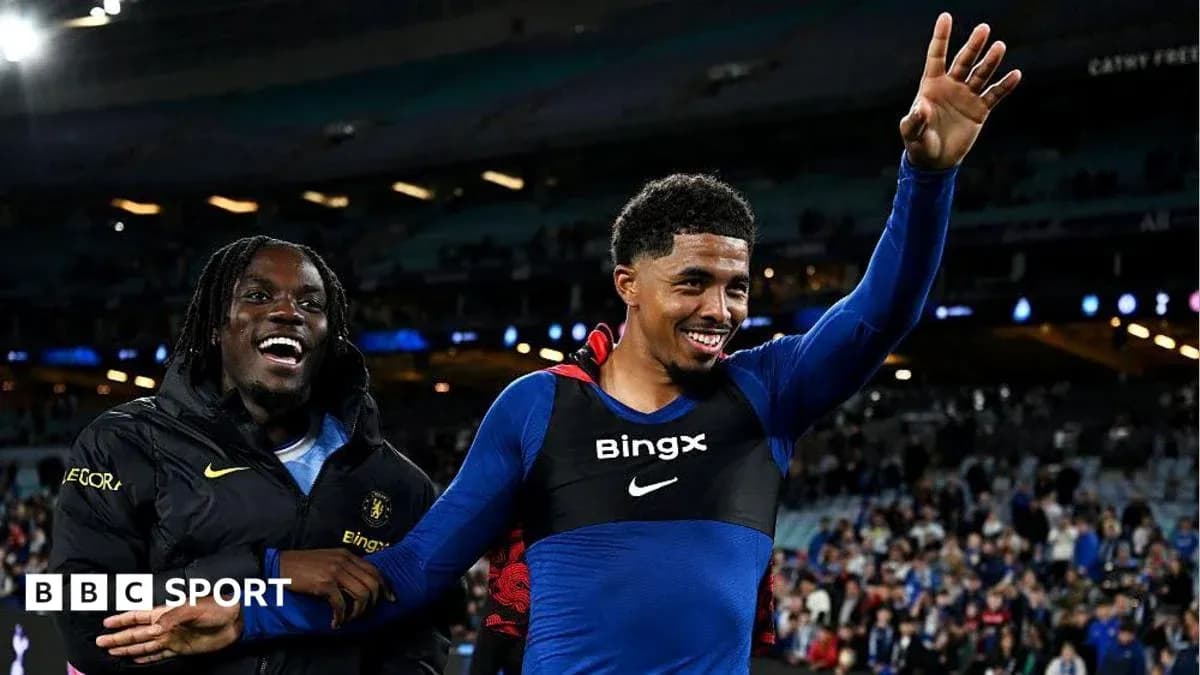
Wesley Fofana on Chelsea's Stability and Overcoming Challenges
Wesley Fofana has cried on the pitch, been hammered for laughing on the bench and opened his phone to find racist abuse waiting for him. Now he is talking about something Chelsea have not known for years.
Stability.
The 25-year-old defender has lived almost the full Chelsea soap opera since his £75m move from Leicester City in 2022. Injuries, managerial churn, online hate, questions over his mentality. Through it all, he is still standing – and, remarkably, he is now one of the old faces at Stamford Bridge.
With Marc Cucurella gone to Real Madrid, only academy product Reece James has been at the club longer. Fofana smiles at the statistic.
“Football is like this. It moves fast, but it is a good stat,” he says. “For me, some years were difficult, but now I'm back. I'm playing, I'm fit.”
He pauses, then corrects himself with a grin.
Well, almost.
“Thanks, Filip,” he jokes, nodding to goalkeeper Filip Jorgensen, who caught him with a punch in an aerial challenge and cost him the chance to say he had a completely clean bill of health last season.
From broken leg to backbone
Fofana has had to rebuild his body as much as his reputation. A broken leg at Leicester. An ACL injury and hamstring surgery at Chelsea. Each setback chipped away at his confidence.
“For me, the most important thing last season was to be fit, just to remove this from my head – the injuries and other things,” he explains. He talks about “small details” in his preparation, the marginal gains that finally allowed him to string games together.
It matters to him in a way that goes beyond contracts and transfer fees. This is the club he grew up loving in Marseille, drawn in by Didier Drogba and the blue shirt on television. Joining Chelsea was, as he puts it, his “dream”.
The reality, so far, has been brutal. Chelsea finished 10th in the Premier League last season and ended the campaign without a trophy. The project looked confused, the dressing room fractured, the fanbase restless.
Fofana found himself in the crosshairs.
He became a lightning rod after footage emerged of him laughing on the bench during a heavy Champions League defeat by Paris St-Germain in March. Context did not matter. The clip travelled, the anger grew.
He insists it was not as deep as people wanted it to be, that those inside the club “know my mentality”. But he also understands the game.
“When the team is not doing well, we need to find someone [to blame]. I can accept that,” he says. “The club bought me for a very big transfer [fee]. I came with the ambition to be the best in my position and to help the team. So, when things go badly, I accept being the guy [people blame].”
He could have pointed upwards. Others did.
Former manager Enzo Maresca left after a breakdown in relations with the hierarchy. Liam Rosenior arrived, failed to win his first five games, failed to score in them too, and quickly lost sections of the dressing room. Four months later, he was gone.
Fofana refuses to hide behind that chaos.
“Of course we can use this as an excuse, but I think it's the players,” he says. “We didn't give everything. We lost some games, we produced some poor performances and we missed a lot of things.
“Of course you can't bring that into the new season, but I think everyone knows what was wrong last season. Everyone looked at themselves in the mirror.”
Drawing the line on abuse
There is one area where he will not accept excuses.
A Muslim with an Ivorian father, Fofana was racially abused on Instagram last season and again highlighted messages in March 2025. He has been receiving this kind of hate since he was young. It still stings.
“It is not a big thing to expose people who do that,” he says. “For me, it is very important. For me and other players, we need to show what people are saying.”
He wants the platforms to do more.
“We need to educate people. I think the people behind Instagram need to work on that. I exposed this on Instagram and Twitter [now called X] because I think they need to be more aware and more conscious of this problem.
“It is not only football. I think the world is a little bit like this and it is too easy to say some things.”
The contradictions of online fandom are laid bare in his inbox.
“Sometimes I receive messages and I don't think these people are racist,” he says. “They send monkey emojis because they are unhappy with the result and then, if I score in the next game, the same people support me.
“We need to educate people because it is not normal to talk like this. I understand that if I get a red card, you can be disappointed, but you cannot say these things.”
Younger team-mates have shown him similar messages and then shrugged, choosing not to act. Fofana will not let it slide, even if speaking out invites criticism of his own character.
Fighting for his place in a crowded room
On the pitch, the picture is complicated. New manager Xabi Alonso has leaned on him heavily in pre-season, picking his strongest XI in three of five games. Fofana started all three.
The numbers behind him, though, are impossible to ignore. Chelsea have signed Maxence Lacroix and now have nine centre-backs on their books. The club also keeps a list of “untouchable” players who are not for sale.
Fofana is not on it.
He does not flinch when told this.
“Yes we have a lot, I think there are nine or 10,” he replies. “Everyone needs to be good, to train well and after the manager takes the decision. It's like this for everyone.
“Maybe some guys will leave, others will come again. For myself, it is about training well, trying to be fit and we will see what the manager does. If the club tells me they don't need me anymore, it is like this. Of course I will be sad but this is football. You can't say 'I have my place and I am sure to play'.”
Right now, that scenario feels distant. Fofana wants to stay. He believes in what he is being told.
He is one of several players reassured by conversations with the sporting directors and the board, who have promised a change of direction. That shift is visible in the arrivals of Jordan Henderson and Danny Welbeck, two veterans brought in for their experience as much as their legs.
At 36 and 35, they are not signings for the resale spreadsheet. They are, in Fofana’s eyes, signings for the dressing room.
He says they “know how to win big games”, will be “important in training sessions” and might hand out “a kicking” if standards drop.
The message is clear: the kids need guidance, and sometimes they need to be told.
Betting on Alonso – and on calm
For all the talk of leadership groups and new voices, one figure towers over Chelsea’s immediate future: Xabi Alonso.
Alonso has already shown Fofana that he trusts him. The defender, in turn, sees the Spaniard as the key to whether Chelsea finally step off the rollercoaster.
“I think everyone knows we need stability,” Fofana says. “We talked last season with the directors and they said the same thing. They think the same way as the players. We need stability.”
For a player who has lived through the turbulence, the idea of calm almost sounds radical. He has been the big-money signing, the scapegoat, the injured absentee, the survivor. Now he wants to be something simpler.
A constant.
If Chelsea give Alonso time and give Fofana the platform he craves, the defender is convinced the story can flip. After everything he has carried, you sense he is desperate for the chance to prove that this “amazing” future he talks about is more than just another promise in a club that has heard too many.