.svg&w=384&q=75 "GoalGist logo")
US Soccer Triumphs Over Australia 2-0 in Seattle
On a clear, almost gentle afternoon in the Pacific north-west, there was never much doubt about which sport would own the stage. Soccer – football, if you prefer – ruled Seattle, and the United States rode that wave to a 2-0 win over Australia that felt as significant as it was controlled.
Sixty-six thousand nine hundred and twenty-five fans packed into Seattle Stadium, most of them draped in red, white and blue, and left with what they came for: a victory that books the hosts’ place in the knockout round and keeps top spot in Group D within reach, depending on how Turkey v Paraguay plays out.
A stage built for stakes
For the US and Australia, World Cups are never just tournaments. They are arguments. Proof-of-concept exercises in countries where soccer still fights for oxygen against other sports. Both arrived in Group D on the back of impressive opening wins. Neither could afford to blink.
The occasion matched the stakes. Three pockets of Australian support, almost entirely yellow and lodged around the south end, did their best to punch holes in the noise. They were loud. They were stubborn. They were ultimately drowned out.
A perfectly timed flyover of four military helicopters at the end of the national anthem turned a big game into something grander. The crowd roared, flags snapped in the breeze, and for a moment the stadium felt less like a group-stage venue and more like the center of the sport in the United States.
Then came the problem: no Christian Pulisic.
Speculation over the US star’s calf injury had dominated the buildup. He left the opener at half-time, trained alone all week, and in the final moments before kick-off Mauricio Pochettino confirmed the worst: not available. A question instantly hung over the night. Without their talisman, could the US pick apart a disciplined Australian back line?
Early scare, early break
The first answer came from Australia.
Inside a minute, Alex Freeman underhit a pass, Mohamed Touré pounced, and suddenly the US were scrambling. Touré drove at Chris Richards and squeezed off a low shot from a tight angle, but Matt Freese read it and gathered cleanly. A warning, nothing more.
The Americans steadied, then began to squeeze. They worked both flanks, shifting Australia from side to side, searching for seams in a back line that had arrived with a point to prove after being dismissed in some US corners as a “layup.”
The pressure told in the simplest way.
Antonee Robinson punched a ball forward into space where Pulisic might usually roam. Folarin Balogun pulled wide, squared up Jacob Italiano, then simply burned past him. His low ball into the box was vicious and awkward. Burgess, caught in the wrong place at the wrong time, could only stab it into his own net.
Another early own goal in the Americans’ favor, their second in as many games. Unlike Paraguay, though, Australia did not unravel.
They almost bit back immediately. Two minutes after the opener, Touré held the ball with his back to goal, Mathew Leckie curled a bold outside-of-the-boot effort from the top of the box around Richards, and the ball sailed high and wide. Ambitious, but a reminder that the Socceroos were not here to play the foil.
The physical edge that had been promised all week began to show. Nishan Velupillay thundered into Tyler Adams right in front of the US bench, drawing fury from the home support. Jordan Bos earned the first yellow for a hand to Weston McKennie’s face. Later, Alessandro Circati clipped Malik Tillman’s heel as he surged toward the area, taking his own booking as the free-kick was hacked clear.
The game had teeth. The US had the lead.
Freeman’s redemption arc
In the 39th minute, the match lurched. Freeman and Paul Okon-Engstler clashed heads and both crumpled, medical staff sprinting on. After treatment, both chose to continue. Freeman did more than that.
Moments later, Tillman carved out the move that would define the defender’s night. Wrestling with Velupillay on the byline, he refused to let the ball die and finally drew a foul in a dangerous spot. Robinson rolled the free-kick back to the top of the box for Sergiño Dest, who let fly. Harry Souttar launched himself into the shot, the ball cannoned off him, and chaos took over.
Freeman reacted first, stabbing the rebound into the net. The flag went up, the goal went to review, and the stadium held its breath. Then came the verdict: onside. Goal.
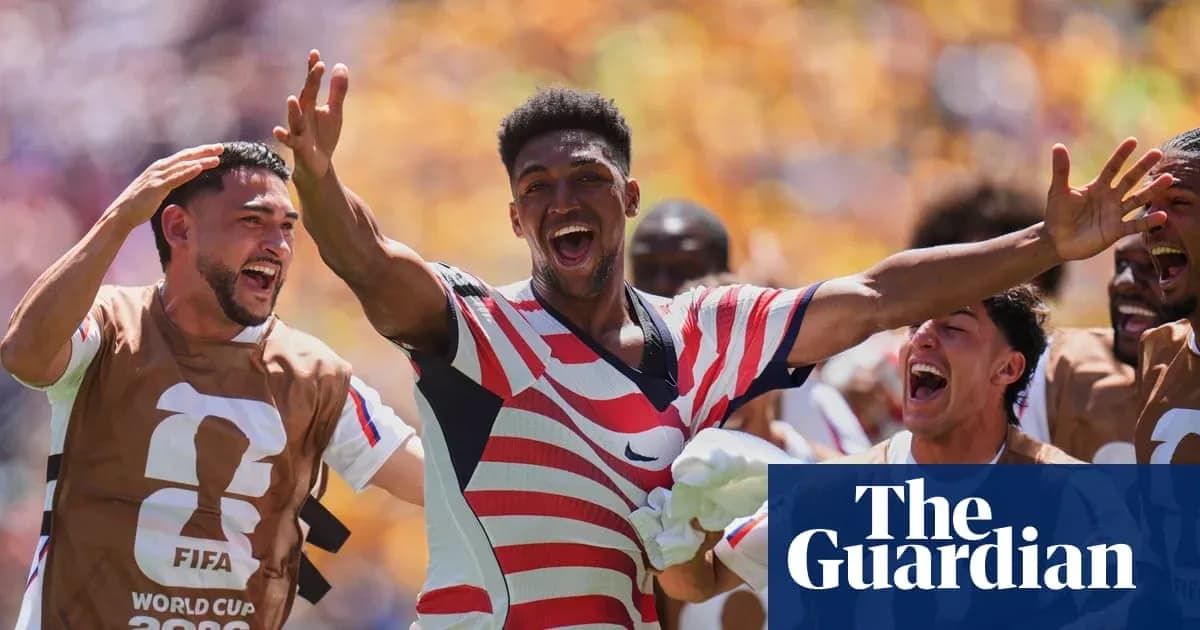
By the time the decision was confirmed, Freeman had already sprinted the length of the pitch, celebrating in front of the opposite end, engulfed by teammates pouring off the bench. From early error to crucial strike, his night had flipped.
The US walked into the tunnel 2-0 up, Australia bruised and blunt.
Popovic rolls the dice
Tony Popovic had seen enough. The second half began with a wave of Australian changes and a clear change of intent.
Jason Geria replaced Burgess. Nestory Irankunda and Connor Metcalfe, both scorers in the Socceroos’ opener, came on for Touré and Velupillay. The shape shifted into a bolder 4-3-3 with the ball, snapping back into a five-man line without it.
The gamble opened the game.
Seven minutes after the restart, McKennie stole possession and threaded Balogun into space with only Souttar chasing. The forward drove at goal, but Souttar recovered just enough to block the shot. A let-off, and a message: Australia wanted to push higher, but the US could punish every loose touch.
The flip side arrived soon enough. Robinson picked up the Americans’ first yellow in the 56th minute as he chopped down a growing attack down his flank. The Socceroos had started to find territory and angles they never saw in the first half.
Popovic went again after the hour. Cristian Volpato replaced Leckie and immediately stamped his presence on the game, lashing over from inside the box after a surging, bruising run down the right by Irankunda. Minutes later, Metcalfe wriggled into space and fired low, only for Freese to smother comfortably.
Australia were no longer hanging on. They were asking questions.
Hanging on with authority
Pochettino responded with a manager’s instinct for risk. As Popovic piled on attackers, he doubled down on security. Robinson, Dest and Ricardo Pepi made way for Sebastian Berhalter, Auston Trusty and Joe Scally, fresh legs to protect what the US had earned.
The effect was subtle but clear. The Socceroos kept pushing, but the Americans had bodies in every lane. Circati went close in a crowded box, stretching for a half-chance. Shots flashed wide. Crosses skimmed off heads and out. The tension in the stands grew with every scramble.
The tackles hardened. The crowd, sensing both danger and defiance, roared “USA” in long, rolling chants. Late yellow cards flew: Souttar, Balogun, Italiano, all booked amid shoves and tugs on and off the ball as tempers frayed.
Even the referee briefly joined the injury list. Felix Zwayer went down awkwardly, treatment delaying the final whistle. He carried on, limping through the last minutes, determined to finish what he had started.
As the clock wound down and the noise began to dip, Balogun turned conductor. Arms raised, he beckoned the stands to life, demanding one last surge of sound. The response was instant. For a few more minutes, Seattle was exactly what it had felt like all day: Soccer City, USA.
The US now move on with six points, momentum in hand, and a statement made without their brightest star. Australia leave with bruises, regrets, and the knowledge that they stood up to the fight but never quite landed the punch.
The group will settle itself soon enough. The bigger question is whether this US team, carrying the familiar weight of a sport’s future on its shoulders, has just taken the first real stride toward something more than a respectable home World Cup.

